How a Student-Directed Production Became a Cosmic Cup of Coffee with Our Queer Ancestors

Entering our senior year at Drew University, we found ourselves with the opportunity to co-direct a play. The two of us met three years prior. We quickly realized that we both come from a movement-based background, share an enthusiasm for collaborative processes, and strive to create theatre art that centers queer lives. As co-directors, we knew we wanted to explore our shared passions as a duo and create a process that centers physical exploration. In a world where the freedom of the queer body is highly politicized, the idea of creating a safe space to explore our embodied narratives compelled us.
Not only did directing a queer play feel right for us, but it also felt right for our campus—a small liberal arts school with a prominent queer community. We hoped to speak to our collective experience. In searching for the right play, we considered everything from brand new works to classics. There was one piece that excited both of us from the start, The Baltimore Waltz by Paula Vogel. This piece from 1992 explores grief and joy in the time of the AIDS crisis. At first, the play seemed like a daunting choice. As young adults, were we equipped to handle this deeply historical piece? Would a contemporary play speak to our community more directly? Despite our concerns, we took on the project and discovered that the play’s historical nature is exactly what impacted our community.
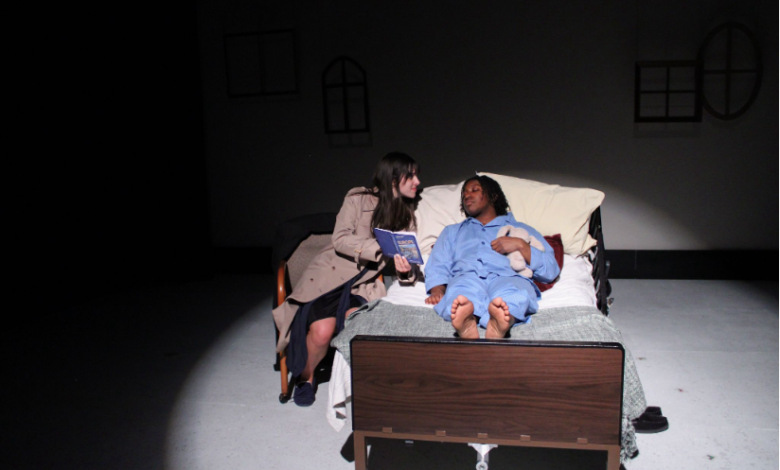
The Baltimore Waltz unfolds in a hospital in Baltimore, Maryland as Anna imagines a fantastical trip across Europe with her brother Carl. They encounter a cast of outlandish characters all played by the mysterious Third Man. Gradually, the boundaries of the fantasy crack until the reality that they are in a hospital is unavoidable and Anna is forced to confront the reality that Carl is dying from AIDS. The character Carl was named after Vogel’s brother who had invited her to travel with him in Europe. Not knowing that he was HIV-positive, she turned him down. He later passed away due to complications related to AIDS. The fact that the play is about a lost opportunity struck us. Those lost to the crisis would be considered our elders if they were alive today. We thought performing this play could be a way to connect with them.
One of the most meaningful aspects of the project was exploring AIDS history throughout the rehearsal process. A particular theme that struck our company is how radical love and acceptance can be a form of resistance. Anna and Carl are physically affectionate throughout much of the play, even sleeping in the same bed. This is based on Paula Vogel’s experience of caring for her brother despite the perceived danger of contact with AIDS patients. As actor Josiah Kemp attested, “Community is central to queerness, especially when it becomes difficult or risky to maintain that community.” We were taken with the idea of intimacy as a scarce resource for those affected by AIDS at this time.