Kids are gifted questioners.
- Why does the sky change colors at sunset?
- Who decided what words mean?
- Why do we call it a building if it’s already built?
- Do fish know they’re wet?
- Why do we have to learn this?
Those questions—even the tricky or silly ones—are signs of something remarkable happening in a child’s brain. Curiosity is one of the most powerful drivers of learning, yet it’s rarely treated as something we actively teach. We expect it to show up on its own, or we hope it survives the school day intact. But a 2022 University of Virginia study found that by 5th grade, curiosity in the classroom is nearly gone. Turns out, we can do much more than hope. We can nurture it, model it, and build opportunities for curiosity deliberately into the way we teach.
Read on to learn more about what curiosity actually is, why it matters so much for kids, and how to teach curiosity in the classroom every day. Plus, check out seven hands-on curiosity-building activities from the Van Andel Institute for Education.
So, What Is Curiosity Exactly?
At its core, curiosity is the drive to seek out new information, experiences, and understanding. It’s what makes a child pull apart a flower to see what it’s made of, ask “what’s inside?” about basically everything, or spend an entire recess figuring out how to go up the slide. It’s not just interest, it’s the impulse to act on that interest and go find out.
Psychotherapist and owner of Polaris Counseling & Consulting Jennifer Weaver puts it simply: “Curiosity in children looks like kids asking lots of questions. Where? Why? How come? All of these questions are super normal—even when seemingly excessive—for kids to ask all day.”
She also notes that curiosity can look like nosiness. “‘Who are you talking to on the phone?’ ‘What video are you looking at?’ These are examples of a child learning about the world and trying to understand it.”
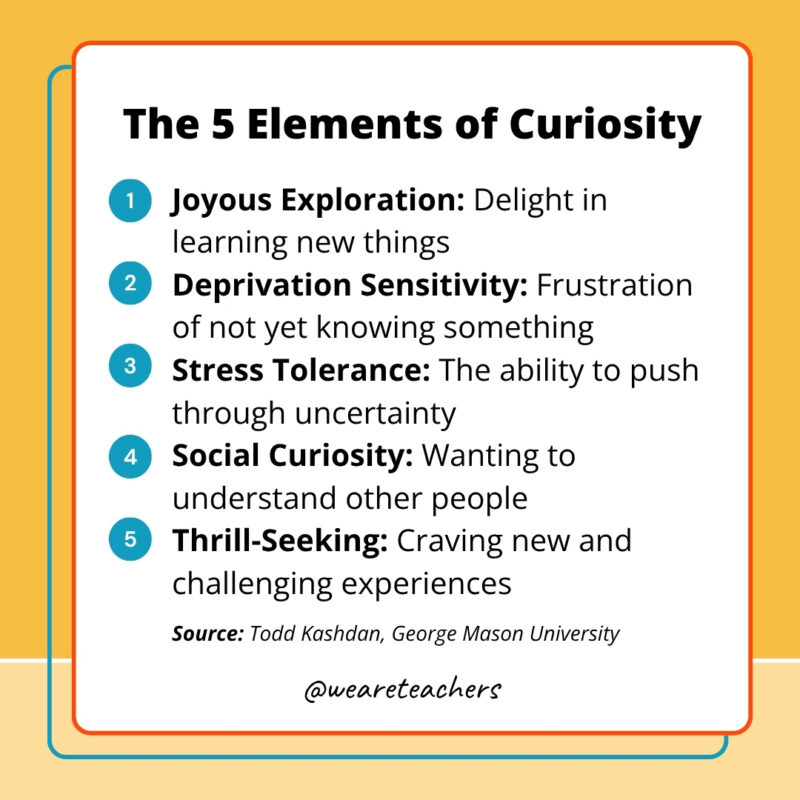
In other words, when kids seem like they can’t stop asking questions or are nosy about everything around them, they’re often doing exactly what developing brains are supposed to do. According to Dr. Todd Kashdan, a psychologist and researcher at George Mason University, curiosity isn’t just one single thing. His research, published in the Journal of Research in Personality, identifies five distinct dimensions of curiosity: joyous exploration (delight in learning new things), deprivation sensitivity (the frustration of not yet knowing something), stress tolerance (the ability to push through uncertainty), social curiosity (wanting to understand other people), and thrill-seeking (craving new and challenging experiences).
Recognizing all five dimensions matters because research tells us they don’t sustain themselves. The University of Virginia study found that curiosity in all its forms tends to diminish the longer children are in school. That means teachers aren’t just content deliverers—keeping curiosity alive in kids requires intentional, deliberate teaching.
Why Curiosity Matters for Kids
Curiosity isn’t just nice to have. It’s deeply tied to how kids learn, grow, and develop a sense of themselves in the world.
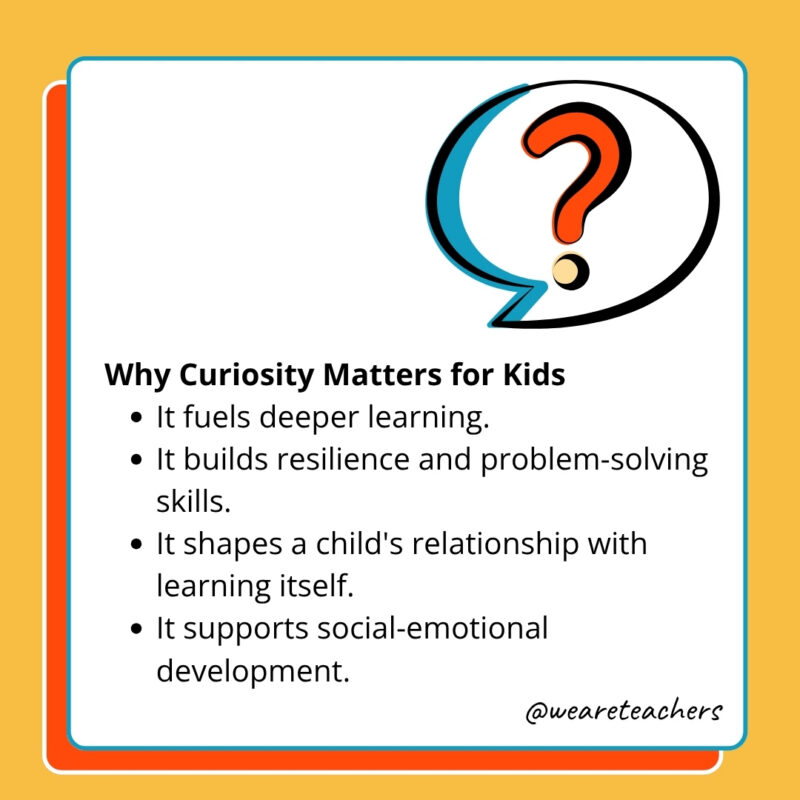
Curiosity fuels deeper learning
When students are curious about a topic, they engage with it more deeply and remember it longer. UC Davis neuroscientist Dr. Charan Ranganath has shown that curiosity activates the brain’s reward system, and this response puts the brain in a state primed for learning and retention. In other words, curiosity doesn’t just make learning more enjoyable, it makes it stick.
It builds resilience and problem-solving skills
Curious kids may not give up as easily when things get hard. They may reframe obstacles as puzzles to solve. The student who wonders “why” something didn’t work is already on the path to figuring out what will.
Curiosity shapes a child’s relationship with learning itself
This might be the most important reason of all. According to Weaver, “When a child’s curiosity is encouraged or suppressed, we either reinforce them to learn more or convey that learning shouldn’t be valued. It’s that simple.” How we respond to a child’s questions sends a powerful message about whether their wondering is welcome. Over time, that message shapes whether they see themselves as learners and whether they feel their thoughts have value or not.
Curiosity supports social-emotional development
Curiosity about other people—“Why do they do things differently than my family?” “What’s it like to be them?”—is foundational to developing empathy and connection. Students who are curious about their classmates can become more open, more collaborative, and more inclusive.
How To Teach Curiosity in the Classroom
You don’t have to add a new unit to your curriculum to teach curiosity. It’s about shifting how you respond to questions, how you design activities, and creating space for discovery. Here’s how to make it happen.
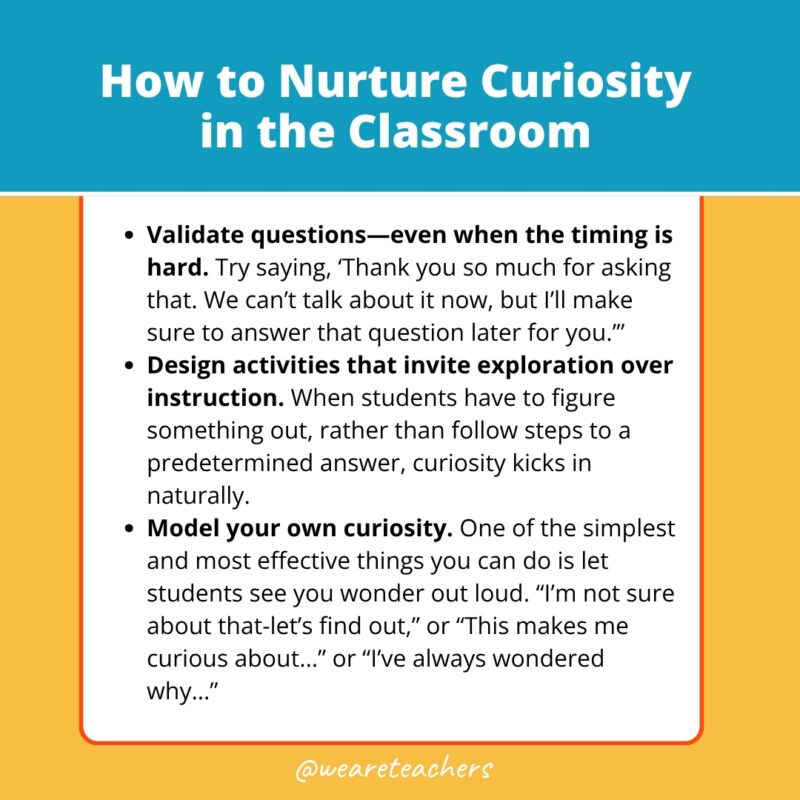
Validate questions—even when the timing is hard
Weaver’s advice for teachers is direct: “Teachers can verbally validate and reinforce kids asking questions.” She acknowledges the reality of a full classroom: “If it’s bad timing for questions, [try saying], ‘Thank you so much for asking that. We can’t talk about it now, but I’ll make sure to answer that question later for you.’”
That small moment of acknowledgment tells a student their curiosity is worth something and that you’ll come back to it. A sticky note on the board, a “wonder wall,” or a simple notebook designated for questions can help you keep that promise.
Engaging activities that invite exploration over instruction
Some of the best curiosity-building activities are ones where the outcome isn’t already decided. When students have to figure something out rather than follow steps to a predetermined answer, curiosity kicks in naturally. The Van Andel Institute for Education (VAI) has developed a number of hands-on curiosity activities and resources that do exactly this:
- Make It Float!, in the STEM Parade Timely Topic, challenges students to explore outcomes using simple materials with just a few variables—perfect for sparking that “I wonder what would happen if …” mindset.
- Twin To Win, from VAI’s Games & Activities, uses Pentominoes to get students curious about how different shapes can fit together to form something familiar. It’s spatial, tactile, and endlessly engaging.
- Bernoulli’s Principle, in VAI’s STEM @ Home Newsletter, takes abstract science and connects it to students’ everyday lives through a variety of simple experiments. When kids realize physics is already happening around them, their questions multiply fast.
- Wind-Powered Pinwheel asks students to design their own pinwheels and discover what it actually takes for wind to generate electricity. The engineering challenge keeps curiosity spinning the whole time.
- Flight School, from VAI’s Books to Builds, invites students to explore how birds fly and what gives a paper airplane its lift. It’s a Books to Builds activity that pairs reading with hands-on discovery.
- Would You Rather, in the Daily SEL Games & Activities, encourages students to get curious about their classmates in a class game—perfect for SEL time.
- Habitat Heroes encourages students to get curious about how they can protect the animals in their community.
Model your own curiosity
One of the simplest and most effective things you can do is let students see you wonder out loud. “I’m not sure about that—let’s find out” or “This makes me curious about …” or “I’ve always wondered why …” When curiosity is something teachers do openly, students get the message that it’s not just for kids—it’s a habit of mind worth keeping for life.
The Bottom Line
Curiosity isn’t something kids either have or don’t have. It’s something that grows or shrinks in response to the environment around them. When classrooms feel safe enough to ask questions, interesting enough to spark wonder, and active enough to support real exploration, curiosity thrives. But it also takes intentional teaching to keep curiosity alive. And when curiosity thrives, so does everything else: engagement, resilience, empathy, and, yes, achievement, because it yields the kind of deep learning that actually sticks. That’s a pretty good return on endlessly asking “why”!
Source link