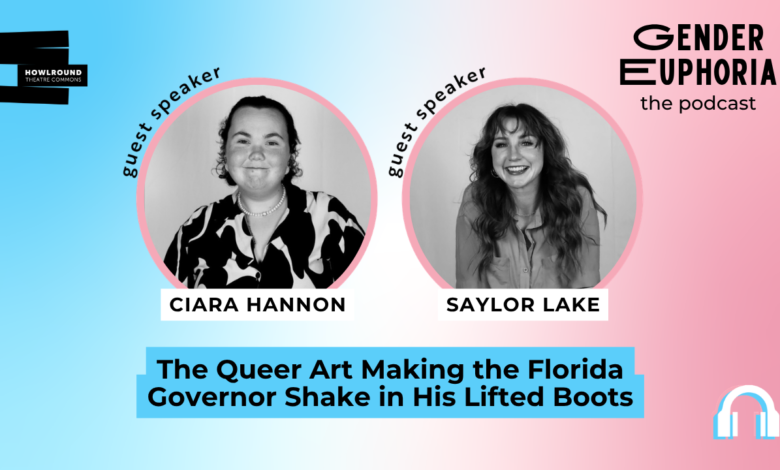
Nicolas Shannon Savard: Hello and welcome to Gender Euphoria: The Podcast, a series produced for HowlRound Theatre Commons, a free and open platform for theatremakers worldwide. I’m your host, Nicolas Shannon Savard. My pronouns are they, them, and theirs.
Today I’m talking with Ciara Hannon and Saylor Lake of 11th Hour Productions.
11th Hour Productions is a queer theatre company based in Orlando, Florida. The Orlando Fringe Festival is their artistic home. 11th Hour Productions’ mission, the short version, is to create queer-centered art that not only tells important stories but actively contributes to the health, safety, and well-being of the Central Florida queer community. As part of that, the company donates part of their ticket sales or show merch sales, audience contributions, other funds raised, etc. back to the LGBT Center Orlando.
I met Ciara and Saylor at the BorderLight Fringe Festival in Cleveland, Ohio this past summer. I was touring my solo show and their company was performing their original work, Mary Kay Vampires. We’ll talk more about that show in the next episode. What caught my attention about their production for the purposes of this podcast and what I’ll focus on in this episode was this section of their performance promo. Quote,
“Recently, the Florida governor cut thirty-two million dollars in arts funding, blaming the Orlando and Tampa Fringe Festivals for being sexual. If you want to see the queer art that’s making the Florida governor shake in his lifted boots, we’ve got you covered. 11th Hour Productions is a collection of loud, proud queer women telling bloody, campy vampire stories straight from a very, very red state.”
It got me thinking about telling queer stories in the places where anti-LGBTQ politics are the loudest and most aggressive. How are other queer artists finding modes of resistance and creating community even as our rights and our livelihoods are under threat?
To give a little context on the state of trans rights and queer art in Florida, the last five years or so have been rough, to say the least. Since taking office in 2019, Governor Ron DeSantis has made anti-LGBT legislation, it seems, a top priority. He has signed some of the most restrictive anti-trans bills into law, including, but not limited to, bathroom ban in all public buildings carrying the threat of criminal trespassing charges, a complete ban of gender-affirming health care for transgender youth, plus multiple restrictions for trans adults attempting to access health care, a don’t-say-gay or trans policy placing restrictions on classroom discussion in schools. It’s in conversation with other restrictions on curriculum and program funding for both K through 12 and colleges and universities. It started mostly with critical race theory and what Florida legislators called gender ideology. It has since broadened to encompass general instruction or educational programming related to gender and sexuality and/or which could fall under the umbrella of diversity, equity and inclusion.
For the arts, the most relevant actions include the drag ban and slashing the state’s arts and culture budget for 2024-2025. So in June of 2024, Governor DeSantis vetoed all thirty-two million dollars of the state’s proposed arts and culture budget, grants allocated to over 600 organizations.
When asked about the decision at a press conference, according to NBC Miami, he said, and I quote,
“So this is money that would go—and we didn’t have control over how it was being given—so you had your tax dollars being given in grants to things like the Fringe Festival, which is like a sexual festival where they’re doing all this stuff. And it’s like, how many of you think your tax dollars should go to fund that?”
He went on to make an argument that he was defending against potentially inappropriate uses of taxpayer money. And his veto left performance venues, galleries, museums, children’s educational programs, and cultural organizations scrambling.
And yet, despite the anti-queer, anti-trans, anti-arts policy coming down from the statehouse, the Fringe found a way. Queer artists found a way.
In this episode, we’ll get into the work that queer stories are doing to resist and to carve out an inclusive haven of pure gay delight against the backdrop of a hostile political landscape.
Without any further ado, here’s my conversation with Ciara Hannon and Saylor Lake, the creative team behind 11th Hour Productions.
Chorus of voices: Gender euphoria is bliss. Freedom to experience masculinity, femininity, and everything in between. Getting to show up as your own self. Gender euphoria is opening the door to your body and being home. Unabashed bliss. You can feel it. You can feel the relief. Feel safe. And the sense of validation and actualization. Or sometimes it means being confident in who you are. But also to see yourself reflected back. Or maybe not, but being excited to find out.
Nicolas: Hello, and welcome back to Gender Euphoria: The Podcast. I’m your host, Nicolas Shannon Savard. My pronouns are they, them, and theirs. I am here today talking to Saylor Lake and Ciara Hannon of Orlando’s 11th Hour Productions. I will give you a chance to introduce yourselves. Um, tell me who are you? What’s your role in the company? And a little bit about you as an artist.
Saylor Lake: Okay. Hi, my name is Saylor. I am the co-owner and company manager of 11th Hour. Um, I do everything that Ciara doesn’t. So right now we’re very much a two-man operation and everything we do is coming between me and Ciara. Um, so I do all the costume designs. I handle travel. I do a lot, yeah. I build props, like right now for one of the shows that we’re taking right now, I’m building a headpiece for that show. I source sponsors, like I’ve been reaching out to community sponsors. I do all of our social media posts. Ciara writes everything and I am their glorious, glorious editor because a writer is nothing without their editor.
Ciara Hannon: I’m Ciara. I am the artistic director and co-owner of 11th Hour Productions. Um, and to kind of echo what Saylor said, I do everything that Saylor doesn’t. Before Saylor got involved, 11th Hour was something that… I really realized I loved writing in high school. Um, and I wrote like little gimmicky shows for our like high school one-act festival and then I realized a really bad high school one-act festival, like one-act show, is like a mediocre fringe show. So like Fringe just kind of was like in my ballpark because it’s so based on like pop culture and references and stuff like that.
Um, so I did a couple shows—and like by doing a couple of shows, I mean I wrote, directed, and produced all the shows by myself. You know, I got my college friends to help out and stuff like that. Then I went off to college. I came back and I started, you know, my career here and like back in Orlando and I realized mama’s getting old. Mama can’t keep doing it all by myself.
Um, and I can’t explain like the exact, “oh this is the event that made me realize,” but, like, it just almost felt like something that just was, was like Saylor being a part of 11th Hour. Like I can’t point to a moment and be like, yep that’s the moment. It just really was a culmination of everything falling directly in the right spot. And that’s kind of what 11th Hour’s become is, like we say constantly, “we’ve girlbossed way too close to the sun.”
Because some deadly habit that we have is saying, “What’s the worst thing that happens? We submit and we get in?”
Saylor: And then we get in.
Ciara: And then we get in and we’re like, oh god.
Saylor: Spiraling.
Nicolas: Oh no, now I gotta do it.
Ciara: So yeah, it’s also I think what I enjoy about working with Saylor so much is that she’s very grounded. And I go, “I want to do this!” And she goes, “Where are we gonna get the money for that?” And I go, “But I wanna!”
Nicolas: We need to give some kind of introduction of the company. Can you tell me just the quick like who slash what is 11th Hour Productions? What kind of stories do you tell? For who? Where?
Ciara: Do you want to go?
Saylor: You can go.
Ciara: Well, you wrote it. You know what it is.
Saylor: Oh, okay. So I guess I’ll say it. I wrote the mission statement. I write some things. It’s the important stuff.
Nicolas: It’s a good one! Please, say it.
Saylor: So 11th Hour Productions is an Orlando-based theatre company and we write specifically for sapphic audiences.
All of our stories are sapphic, lesbian, gay as hell, girls kissing each other, and the lesbians win every single time. Is it a happy ending? Sometimes. Sometimes it’s not. But we really, really take pride in really catering to sapphic audiences. And we’re really, really big into pouring back into our community. So we every time we do a show, we get some of our proceeds back to The Center here in Orlando, which focuses on LGBTQ outreach. And yeah, nailed it.
Nicolas: Love it. Talk a little bit about your experience just with the Orlando Fringe Festival. I know you’ve said that’s kind of your, it’s been your artistic home. How’d you start there? What has that space and community meant to you as artists?
Ciara: Well, Saylor, do you want to hit first? Because I don’t think you’ve ever been in a show with 11th Hour at Fringe. What’s your experience just as an artist?
Saylor: I’ve done two shows…three? Three shows at the Orlando Fringe Festival.
Ciara: Not me knowing your resume.
Saylor: My first one was a bring-your-own venue, which means that like if the show that you’re in doesn’t get accepted to the actual festival, there’s a couple of little venues around Orlando that offer up their space that are still part of the festival map. It’s just a little further removed.
It was this really campy little show about outcast superheroes. I was a fifty year old drunk woman who was convinced she could be invisible. I was approximately twenty-two at the time. It really read, do you know what I mean? It really, really, it was really believable. Probably one of my best performances ever.
My second show, I guess would be, oh, Infestation. I did Infestation in 2018 and that was another really campy sci-fi set in the fifties, very like stereotypical fifties stereotypes. The jock, the nerd, the bad girl, the bad boy, and the weird teacher who gets taken over by Hornet and turns into an alien. Again, probably some of my best work. I did get named as a standout in the cast.
And then I met, well, I didn’t meet Ciara. I actually submitted for the Orlando Fringe Unified Auditions, which means that all the producers that are looking for actors or talent for their shows kind of have like this three day long audition. So it’s all day and they just see actor after actor, after actor, and the actors have a five minute slot and they could sing. They can do a monologue. They can do whatever special weird little talent they want. And I chickened out of my audition and then actually ended up posting a video audition.
And so I had a callback for their show. I was originally going to be Gracie. This was for the Fringe Fundraiser. So every year Fringe would do a fundraiser here to just kind of like jumpstart getting money ready to go for the festival. I assume it’s like an emergency thing, like just in case we need it, it’s here. Like a little extra money laying around never hurt anybody.
So I go and I do this Fringe Fundraiser. I’m in rehearsals. The first like week or so I had strep throat. Two weeks before we opened, I stepped into one of the lead lesbian roles after some casts—we did some different little castings and things happened. Somebody had to leave the show. And so then I was going to be Laura. Relearn the show in two weeks, including fight sequences and songs, and we turned it out.
And then after that, I was kind of stuck at 11th Hour just because I realized how much fun I was having. We did our first show, we’re like, “Great dress rehearsal, guys. Let’s open tomorrow.” But I feel like that’s kind of like the 11th Hour charm. I mean, that’s why we’re called 11th Hour. It’s like everything somehow comes together.
And then I did another show later that year called the Saints of West Orange County with a local theatre company here in Orlando called Whiskey Theatre Factory. You forgot about that one.
Ciara: That is true because you were in rehearsal for Saints and Adele. So not only did she jump into the lead role, she was also fully auditioning another show with Whiskey Theatre Factory. And also that show is a full on monologue show.
Saylor: Yeah, I had a monologue that was four and a half pages long. And I’m like, oh, yeah, no, I can totally. I didn’t sleep for like a month. But I think that’s also just the fringe experience. Like you just kind of accept you’re not going to sleep from like February to May 30th.
Ciara: My favorite Orlando fringe joke that I’ve ever heard was so before they have something where they just call it like the teaser show, like I want to say it’s like April 15th or something. And every show performs like two minutes. So it’s like you just like go and like see what’s coming at the festival in May. And one of my favorite things is–I think it was Blake Aburn for the mature teaser. He goes, “What do I love about the teaser shows? Because you can tell this is the first time this cast has ever rehearsed.” Like it’s either you’re on top of it where you are rehearsing in February to May, or you’re an idiot and don’t start until end of April, like into May.
Saylor: Let’s see what happens.
Ciara: But my experience was I wrote my very first show, Leviticus. It’s about my experience as an LGBT person in the church. Spoiler alert, it’s sad as fuck, whatever. So I wrote that in high school and then I submitted it for the Fringe Festival. And what’s really great about the Orlando Fringe is that it’s a lottery. They really just throw a bunch of—you pay, you throw your show in a bucket and then they pick it out.
Like it’s so you never know. So there’s no like, I don’t know, like solidified whatever. But it was crazy because my experience… I remember sitting in the audience with my mom, and they pulled it out and we were Leviticus, number eighteen out of twenty two pulled. And peace and love, that’s the verse!
Saylor: I didn’t know that!
Ciara: So, quite literally, they go, “Leviticus 18:22.” And I was like, oh, my God. And so here I was at nineteen producing my own Fringe show, not really knowing what it was or what even producing was. All I knew was like, okay, how do I put a show together? And like we won Best New Producer there. We won Best LGBT Supporting Actress with that. So like that’s called like a festival run show. Okay, check. Did that.
So we have the show, as we talked about before, An Adele Horror Story. And what that was, was I was like, “oh, like we’re gonna be in like a cabin in the woods.” We didn’t get in. And so I’m with my friend Clark and we’re walking in my car, whatever. And we had to walk through like this huge field that’s like surrounded by a bunch like little trees. And so I go, oh, my God, let’s just do it out here. Let’s switch the cabin, the woods, like a tent outside.
And so that was the best decision I’ve made and the worst decision I’ve made because they said, we’re not going to give you any power out there. So we were running that whole show off hurricane lights, Bluetooth speakers and a dream. So it was so much fun. We sold out before the festival even started.
We did that show in the sun. We did that show in the rain. We did that show in May outside in Florida. So it was awful. But it was so much fun. We sold out and then people would just start like coming up to the fence to watch it. So we ended up having like one hundred people each night. It was such like a fun community experience.
What’s really cool about Fringe is they have these things—site specific shows, like there’s been a musical in the woman’s restroom. There’s been one at the Radisson Inn that’s right across the street. And so ours was we’re going to do it, An Adele Horror Story in the woods. So we pitched a tent in a little patch of woods.
And then for Cowboys, submitted didn’t get in. But there’s this really awesome LGBT theatre in Orlando. It’s called the Renaissance Theatre Company. And they do awesome immersive stuff there. And they’re a BYOV.
Nicolas: BYOV stands for bring your own venue. Local spaces will host performances during the festival, just a little bit more off the beaten path. Okay, back to Ciara.
Ciara: So I submitted to there, we got in. And so then we were part of Fringe within a BYOV. Um, then I went off to college, came back. And I kind of went to Fringe. And I was like, listen, like Adele was super successful. I would love to help out Fringe. Like I will take twenty percent. If I can give each actors fifty bucks and a kiss on the head, I’m calling it a day.
That’s kind of where me and Saylor met, casting with Adele, where I watched her whole audition tape.
Saylor: And they loved every second.
Ciara: and I loved every second. And her resume, I didn’t even have to look at it because I watched the tape, and I said, “that’s a star!” So that version of Adele happened. And it was inside of a theatre. It was fantastic. We were able to help out The Center as well. And then yeah, then here we are. And we went on our little tour over the summer.
Something that like I say about Fringe is Fringe is like nothing that you expected, but everything that you needed. It is such a cool place and just such a place that like champions new work, which I think is really hard to see in community theatre because everyone’s doing Into the Woods or Evita. So it is a place where Adele in the woods makes sense. It is a place where you can do queer Westerns and stuff like that.
What’s also really big at the Orlando Fringe Festival is we are called the “Gay Fringe Festival” because, mama, everybody’s kissing everybody. And it is like walking around Fringe. It really is walking around being like, that’s my ex. That’s my ex.
Like, it’s just like a fun tight-knit community and a place where jukebox musicals reign. Like if you want to see a jukebox musical, you go to the Orlando Fringe Festival. And that’s something that like we’ve always said is that like with Adele Horror Story, some people are like, “Ciara, what are you going to do if Adele like sends you a cease and desist?” And I go, this is my thought: that means that she has to know enough about it. So therefore, totally understand, girl, I won’t do the show again. But did you like it? Did you like that every time that you enter you go, “Hello, it’s me,” you know? I don’t know. I just, like it’s, Fringe is just such a cool place. And I honestly, like a lot of my friends when we were like graduating from high school, they went to performing arts colleges and I went to Fringe. Like that’s kind of where like my little like, you know, little goblin tomfoolery began.
Nicolas: It’s the best kind of place for it really. Got to get serious. So when Florida Governor Ron DeSantis vetoed all thirty-two million dollars of the state’s arts and culture budget a while back, he cited his opposition to quote unquote, sexual festivals, specifically the Orlando Fringe, as his primary reason. So I’m not in the least bit interested in debating that claim. And so you don’t have to, I’ll note here that this is Republican politician code for “they let people be loudly queer here.” What I do want to hear about is how did that financial loss for the festival, or the story behind it, how did it impact you as queer feminist artists? How did it impact your community of artists around you?
Saylor: I want to start by saying that we are on Governor Ron DeSantis’s Sexy Fringe Hate Show List. There’s a couple of our shows here at 11th Hour that are on that list that he is specifically talking about.
Nicolas: Congratulations! You made a list!
Saylor: I am so proud to be on that list. Like, I hope my head shots by it and I’m kissing a girl. Do you know what I mean?
Nicolas: Like, but did you like it? I got on your list. Did you like it?
Saylor: You were the first one to watch Heated Rivalry, weren’t you? I think—Ciara, you can correct me if I’m wrong—I think the main effect that I have seen as an artist is everybody is really and truly using joy as the greatest form of resistance. And I think that’s something that me and Ciara both really take comfort in. I don’t know. Do you want to touch on that?
Ciara: No, say, finish what you’re saying. I’ll speak.
Saylor: Um, something that we’ve kind of realized is… we started touring because we didn’t feel good to perform here in Florida. That’s not the only reason, but it is a reason. It was something– we weren’t sure… Right after it happened—it was right after Adele, or right around Adele, is when it got announced. The fundraiser. Yeah.
We were like—we had a lot of plans. We had written another big show, like a really, really big show that we were going to take to Fringe, hopefully, if we got in. And it’s something that we’ve kind of put on the back burner for now.
But I think we’ve just seen people rally in ways that you would never expect. Like, it feels like mom’s doing a bake sale for their PTA a little bit. Like, I think everybody is just trying so hard to be like, “Go support queer art! Support art, support art! Do what you can to pour into people. Go do this, go to that.” Like, cause I know like I’ve had people reach out to me that I don’t like working with. I don’t like them as people. I try to stay away from them. But the second that they reach out to me, I’m like, “Oh my God, of course I’ll help you.”
Ciara: Yeah. I think with everything that the governor kind of did is something that I know that the festival put out there–because they had an open address to the governor being like, “Come for a day,” you know, of like, “everything that is eighteen-plus at that festival is behind closed doors.”
In complete honesty and transparency, there was like a moment where I felt very, very guilty because our shows do include sex. Our shows do include intimacy in a, in a way that is not typically seen in sapphic shows. Um, so there was definitely a moment for me where I’m like, “I fucked this up for everybody.”
But it was the way that after that got announced and Fringe, like Fringe did everything and they handled it so well of like, they said, then we’re going to take our name out of the hat, give the rest of the money to everybody else. We’ll sit back.
Nicolas: Okay. Quick interjection here. The official response from the festival producers, Tempestt Halstead with the Orlando Fringe and Trish Parry of the Tampa Fringe, took the form of an open letter to the governor.
First, they set the record straight on what it is that fringe festivals do, but mostly they make a strong argument about the impact on the arts in the state as a whole. I think this line sums it up best. And I quote,
“defunding Florida’s entire arts and culture sector because of fringe festivals, which account for just 0.002 percent of the vetoed thirty-two million dollars is akin to canceling Florida’s entire sports industry based on an objection with one player on one team.”
They make the following proposal:
“Governor DeSantis, we, the undersigned fringe festivals, which remain committed to providing inclusive spaces for artists and audiences agree on a non-precedent setting basis to forgo the 2025 state grants that were approved for us in order to facilitate the restoration of the remaining legislature approved arts and culture funding, provided you champion a successful reversal or override of the veto. In addition, we will welcome and host you, your family, and some of your aides when you attend our festivals in 2025. And we ask that you reciprocate by welcoming and hosting us in October or November 2024 so that we can build bridges of understanding and deepen your familiarity with the benefits of arts and culture investments, thus empowering you to be an impassioned advocate.”
Governor DeSantis, unfortunately, did not take them up on that offer.
Ciara: It was the way that they handled everything. But it was the year after that, there was a boost in attendance. There was a drag—no, it wasn’t a drag queen, but there was somebody—after their show, they sold the big clacker fans, and it said “my favorite sex fest” on it. Like, there was that. And it was just like, I remember a bunch of Fringe artists got together, and they made this video that said, “I’m so sorry, Ron DeSantis. I didn’t know that my magic show for children was…” Like, it was like such like a Fringe way to respond to that.
And it was, and I think that was, it is that I think Fringe is its own, especially in Orlando, its own unique language. And watching them respond in ways through comedy, in ways through joy of perseverance, I think is also so, so, so sick.
And everyone at Orlando rallied behind these artists because like I said, it’s a queer festival. So it’s supporting queer art at the end of the day. And so it wasn’t just watching them rally around a theatre festival that does like Our Town and Waiting for Godot. It was rallying behind a Twilight parody musical. You know what I mean? And like, just the importance of that is so, so sick.
And in any way, shape, or form, 11th hour always finds a way to like sneak in to Fringe. Like we always like end up helping out with somebody’s show like, it really is like a community. Someone goes, “I don’t know Q-lab.” And then someone’s like, “I’m messaging you.” It’s that. It’s just, it’s everything.
So yeah, that was definitely something that’s just like, wild and crazy. I hate living through historical moments. But coming back to the festival, and everyone is so like, even more loudly queer, if that makes sense. Like every single lesbian I know making out by the barbecue truck, like that. And I don’t know, I could I could rattle on for hours about just how phenomenal the Orlando Fringe is, and just how special it is. But… slay. Slay. That’s it.
Nicolas: We started to touch on it a couple of times. But could you talk a little bit more about like, what does it mean to you to tell your queer joy escapism stories in Florida, in Cleveland, Ohio? I lived in Ohio for seven years. Cleveland and Columbus are like these cute little bubbles, where you can be queer. The rest of Ohio is usually on the same page as Florida at the state level.
Saylor: Yeah. I will say I came into my queerness really late in life fully like twenty eight. I’m thirty now. Like after Adele, I was like, some of this does feel a little too close. I feel a little too close to the subject matter right now. And I don’t like it. So I talked to my therapist about it. She’s like, “Yeah, it’s probably because you’re a lesbian.” And I was like, “Okay.” Um, but I think what I love most about what we do at 11th hour is it’s so authentic. None of it’s forced. And we’re not being like, “Oh my god, they’re gay.” And that’s the whole problem of the show. Like the way that they exist and the way that they interact with each other, it’s just something that people are okay with. The only show where homophobia is present is in Leviticus where the subject matter calls for it. Nothing else in our shows is homophobic.
Now, I know, I’m not saying that we’re not going to do homophobia as a joke, as other gay people do to gay people. Like I’m allowed, I’m allowed to call Ciara gay as a slur. I’m allowed to say that; nobody else is allowed to say that.
Ciara: And we don’t have an HR department. So I can’t say anything because Saylor is our HR department.
Saylor: But I think something we do really well is the authenticity in speaking to other members of the LGBTQ community as members of the LGBTQ community would. So it’s not like a straight white man writing a show about a gay man, or like gay women, specifically. Because I think—I’m not going to name names, but that’s something that we struggle with here in Orlando is people writing subject matter that they know nothing about. And then you get it, and you’re like, “Damn, did an AI chatbot write this? Because it really feels like an AI chatbot wrote this.” Or it’s something that you’re like, “you are so severely disconnected from what actually is happening here.”
Because like, you’re not gonna be like, “Oh my god, I love you so much!” It’s, “if you don’t get away from me in the next ten seconds–like, I need you to walk away from me right now.” But I think that’s something that we do exceptionally well. And that’s not just me coming from me who co-owns the company and makes all the decisions. That’s coming from members of the community that have come up to me and said that about our shows. And they’re like, “This feels so real. And like, so like, not out of reach.” Because it’s the queer escapism without it seeming like a fairy tale. I think it’s the reality of it.
Ciara: I think with what we do with 11th Hour, it’s something so like… At the end of the day, it’s cool for me to watch people come into a show where they’re like, “I did not think this was where this was gonna go.” Or like, just watching people be surprised, where I feel like a lot of gay shows or a lot of LGBT shows follow a certain copy-and-paste, choose-your-own-adventure type idea.
So I think it’s really fun to be like, reinventive and stuff like that, of either like a genre or what have you. But I think the importance of like, what we do in Florida, I think, first, what I am super, super proud about is—this kind of has nothing to do with the stories that we tell, I’ll get to that. But what is so important to me, is that since Saylor’s jumped on, we have been able to pay every single one of our actors. That’s been super. Because at the end of the day, that’s supporting queer art, is making sure that they don’t have to quit their day job, or to compensate them for the time that they had to call out of work to drive an hour from the parks to get to rehearsal.
So that’s super important to me is that we are able to compensate people for their time. I mean, are we paying them lobster dinners? No. But mama, that Biggie Bag from Wendy’s is calling your name! You know what I mean? So that’s super important to me about what we do at 11th Hour.
Also, something that I think we forget to mention sometimes, but it’s such like a cool thing, is part of the reason we were able to fully pay for Ireland is we got connected with a queer youth author who wrote this six-hundred-page fantasy novel, and he wanted an audiobook for it. So a lot of our company friends came, and we were able to help pay for Ireland by doing queer art in a new way that’s going to be uploaded to Audible and stuff. What a unique way to raise funds is to support other queer art.
Nicolas: What is the name of this book?
Saylor: The Witch in the Wall by Quinn Hogshead. Hi, Quinn, if you’re listening.
Ciara: Hi, Quinn.
Saylor: Oh my god, I love him.
Ciara: So that was such a cool thing for us of just like, it always comes back to, okay, but at the end of the day, what are our stories actually going to do? And for that, it was either uplifting other queer voices, or it’s donating to The Center, like always finding a way to give back. I think that really, it makes me feel like, okay, we’re on the right track.
When it comes to the stories that 11th Hour tells… I have a job where I teach young artists. For me, it’s writing shows that like—I don’t want my shows to like, big Broadway, whatever. It’s like, I want one of my scripts to like, end up with the cover ripped off, held together with a piece of gaff tape rolled up, like, because you can tell someone put in their pocket. Like, that’s almost like what I want for our shows. It’s just, it’s someone’s favorite thing. It doesn’t have to be a thousand people’s favorite thing. It’s just, it’s that. Yeah, it’s the fan fiction that you latch on to. And I think that’s what the importance is, is creating someone’s just underground favorite thing, if that makes sense. Yeah. Yeah. I think that’s what it is for me, is those two things.
Nicolas: It’s a lovely note to wrap up on, I think. And finally, I feel like you’ve had so many of these throughout this conversation, but would you leave us with one last little snapshot of a moment of joyous queer community?
Saylor: I think, I don’t even think I’m going to make it about us. For once in my life, I’m not going to make this about me. But I think right now, the best thing we can do is resist and keep making art because that’s the exact opposite of what everybody else wants.
Ciara: Can I make it about us, though? This was during our Leviticus tour. Like we said, we normally hang back and stuff, and people come up and share their experience of being queer in the church and all that stuff. And this was during, I think, one of the Orlando performances of Leviticus. I clocked them coming in. It was a young girl and her dad. And I was like, uh-oh. I hope we’re fully strapped in and ready for this really, really heavy drama. After the show, we’re striking, we’re doing stuff. And then I could tell they’re waiting in the corner and they’re wanting to talk to me. So I go up and I introduce myself.
And I’m like, “Hi, I’m Ciara. I wrote the play.” And then the dad goes, “Hi, the subject matter of the show is something that we’ve been going through,” and gestures to his daughter. And I’m like, “Oh.” And in that moment, I was like, well, fuck. What does young me want to hear at this moment? And so I kind of very sloppily kind of reiterate what’s in the show at the end of the show, which is like the, “You’re going to be okay.” I tried the best that you could in that moment, but just looking at a twelve-year-old who’s just like, I’m like, wow.
And I mentioned everything that was in the show of trying to muster all that. And I was like, “Trust me, you’re going to be okay.” And I was like, “You’re going to find your little gaggle of gays.” And I found myself gesturing to the company that was working around. And she was like, “Oh, it’s okay. Don’t worry. In five years, I’m just going to be you.” And I was like.
Saylor: That’s not the first time somebody has said something like that to us. I think that’s what’s special.
Ciara: Yeah. It’s just the idea of like one of the tattoos I have—it’s like a little Keith Haring guy holding up another little Keith Haring guy by the shoulders. And for me, it’s the shoulders are only as strong as the ones that you stand on. You want to make sure yours are just as strong. And I think that’s ultimately what my goal is for 11th Hour is to make the queer theatre environment enough that younger people, or even like old people, anybody, coming into it and being like, oh, if they’re slaying and they’re doing this, then there’s room for me at this table.
There’s always room at the Texas Roadhouse that we run this shit at, you know. But yeah, that’s kind of the idea is just the joy of what we do. It’s… it’s everything. I don’t know. Like as a playwright, I always kind of like, I feel like I can always find ways to say certain things. But when it comes to talking about the importance of what we do, I’m always just like it’s a muscle. It’s all that I have to stand on, you know, and I don’t plan on falling anytime soon.
Nicolas: Thank you so much for your time and all the stories. This was delightful.
Saylor: Thanks for having us.
Ciara: Yay.
Nicolas: And that is where I’ll leave us for now. Join us again next week. You’ll hear the other half of the conversation with Ciara and Saylor about 11th Hour’s show Mary Kay Vampires, pop culture femme camp, and their aesthetic of pure queer joy escapism.
Until then, this has been Gender Euphoria: The Podcast. Hosted and edited by me, Nicolas Shannon Savard. The voices you heard in the intro poem were Rebecca Kling, Dillon Yruegas, Siri Gurudev, Azure D. Osborne-Lee, and Joshua Bastian Cole. The show art was designed by Yaşam Gülseven. This podcast is produced as a contribution to HowlRound Theatre Commons. You can find more episodes of this show and other HowlRound shows wherever you find podcasts, including on noncommercial open source apps like Anytime Podcast Player for iPhone and AntennaPod for Android. If you loved this podcast, please share it with your friends, your colleagues, your students. You can find a transcript for this episode along with lots of other progressive and disruptive content on howlround.com. Have an idea for a meaningful podcast, essay, or TV event that the theatre community needs to hear? Visit howlround.com and submit your ideas to the knowledge commons.