 On April 24, 1877, on orders from President Rutherford B. Hayes, federal troops withdrew from the state house in Louisiana — the last federally defended state house in the South — just 12 years after the end of the Civil War.
This withdrawal marked the end of Reconstruction and paved the way for the unrestrained resurgence of white supremacist rule in the South, carrying with it the rapid deterioration of political rights for Black Americans.
What began with Hayes’s elevation to the Presidency following the disputed Election of 1876, is now having dramatic political consequences 150 years later.
Forcing the South to Evolve
After the Confederacy’s 1865 defeat, the Reconstruction Amendments to the Constitution (the 13th, 14th, and 15th, ratified between 1865 and 1870 to overcome the 1857 Dred Scott Decision) abolished slavery, established the citizenship of formerly enslaved Black people, and granted Black people civil rights — including granting Black men the right to vote.
During Reconstruction federal officials and troops remained in Southern states helping to enforce the newly extended rights and administer educational and other programs for the formerly enslaved.
 As a result, Black people in the South, for the first time, constituted a community of voters and public officials, landowners, wage earners, and free American citizens.
The federal presence also addressed deadly violence Black people faced on a daily basis. Continued support for white supremacy and racial hierarchy meant that slavery in America did not end — it evolved.
The identities of many white Americans, especially in the South, were grounded in the belief that they were inherently superior to African Americans. Many white people reacted violently to the requirement to treat their former “human property” as equals and pay for their labor.
Plantation owners attacked Black people simply for claiming their freedom. In the first 12 years after the war, thousands of Black people were murdered for asserting freedom or basic rights, sometimes in attacks by white mobs in communities like Memphis and New Orleans.
Congressional efforts to provide federal protection to Black Americans were undermined by the U.S. Supreme Court, which overturned laws that provided remedies to violent intimidation by so-called “Redeemers.”
Redeemers sought to regain political power and restore white supremacy in the South. They portrayed themselves as “redeeming” the South from the “misrule” of biracial governments.
The Redeemers were firmly committed to white supremacy, conservatism, and reversing the civil rights gains made by African Americans during Reconstruction. Their ultimate goal was to remove federal troops, and disenfranchise Black Americans.
The Great Betrayal
In the 1870s, Northern politicians began retreating from a commitment to protect Black rights and lives. The 1876 election pitted Republican Rutherford B. Hayes of Ohio against Democrat Samuel J. Tilden, the former Governor of New York, who had gained fame in prosecuting Boss Tweed’s corruption.
New York went to Tilden, who also swept most of the Southern states and secured a popular vote majority of roughly 250,000 votes, but had 184 electoral votes, just one short of the majority needed to win. Hayes had 165, with 20 votes from four states (Florida, Louisiana, South Carolina, and Oregon) in dispute.
 In Florida, Louisiana, and South Carolina, both parties claimed victory, but state returning boards — controlled by Republicans — eventually awarded all three states’ electoral votes to Hayes.
As a result of the dispute Congress established a bipartisan Electoral Commission consisting of 15 members to resolve the impasse. In a series of 8-7 votes along party lines, the commission awarded all 20 disputed votes to Hayes, giving the Republican a 185–184 victory.
To prevent a Democratic filibuster in the House of Representatives that would have blocked Hayes’s inauguration, Republicans met secretly with Southern Democrats to strike a deal.
Hayes agreed to withdraw the remaining American troops from the South, and made promises to provide federal aid to help industrialize the former Confederacy.
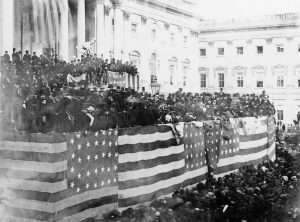
During his March 5, 1877 inauguration he claimed that true peace could be achieved through the “united and harmonious efforts of both races.”
On April 10, less than 30 days later, American troops withdrew from the statehouse in Columbia, South Carolina, allowing the Redeemers under former enslaver, militant white supremacist, and former Confederate Colonel Wade Hampton III (1818-1902) to take full control.
(Hampton’s campaign for governor was marked by extensive violence by the Red Shirts, a white-supremacist paramilitary group that disrupted elections and suppressed black voters in the state. He later served two terms as U.S. Senator, from 1879 to 1891).
 For two weeks Louisiana, which had unanimously rejected the 14th Amendment in 1868, was then the last state in the South to have its statehouse in New Orleans protected by federal forces.
Their departure on April 24 removed the physical barrier protecting Black citizens’ civil and political rights from violent white supremacists.
(Francis Nicholls (1834–1912), who had served as a Brigadier General in the Confederate States Army, assumed the governorship. He is remembered for failing to intervene to stop the largest mass lynching in American history in 1891, when 11 Italians were lynched in New Orleans. He also served as Chief Justice of the Louisiana Supreme Court.)
The Compromise of 1877 is often called the “The Great Betrayal” by Black Americans. The withdrawal of troops led to the immediate collapse of the remaining multi-racial state governments in the South.
Racial terror and violence directed at Black people intensified and legal systems were reestablished to restore a racial hierarchy that put White Protestants at the top.
For example, white Southerners barred Black people from voting and created an exploitative economic system of sharecropping and tenant farming that would keep Black Americans indentured and poor for generations.
 They also implemented segregationist Jim Crow Laws, which would dominate the region for nearly a century until the Civil Rights Movement, and notably passage of the Voting Rights Act of 1965 (VRA).
“One of the most significant elections statutes ever enacted,” according to a Congressional Research Service report. “The law prohibits discrimination based on race, color, or language-minority status in registration and voting nationwide. The VRA also provides protections for blind, disabled, or illiterate voters.”
“Congress designed the VRA to remedy and prevent pervasive racial discrimination in registration and voting, especially in southern states, which continued for a century after the Civil War ended,” the 2023 report reminded.
On Wednesday, April 29, 2026, 150 years after federal troops protecting Black Americans voting rights left Louisiana, the U.S. Supreme Court decision in Louisiana v. Callais gutted key Voting Rights Act protections prohibiting racial discrimination in voting.
The ruling is expected to derail more than two dozen lawsuits aiming to stop state legislatures from drawing electoral maps that dilute the voting power of racial minorities.
“It will pave the way for the greatest reduction in representation for Black and minority voters since the years following Reconstruction,” U.S. Representative from Alabama Terri Sewell said of the court’s decision.
Part of this essay is by the Equal Justice Initiative from their History of Racial Injustice calendar. EJI works to end mass incarceration, excessive punishment, and racial inequality. If you would like to sign up for the daily calendar by email subscribe here.
Read the Equal Justice Initiative’s report Reconstruction in America to learn more.
Illustrations, from above: March 5, 1877 view of the grand stand during the inauguration of Rutherford B. Hayes in Washington DC; “The First Colored Senator and Representatives in the 41st and 42nd Congress of the United States” (Library of Congress); Election of 1876 map showing percentage of the popular vote in each state; a group of Red Shirts pose at the polls at Old Hundred, Scotland County, North Carolina, on Election Day, November 8, 1898 (State Archives of North Carolina); and an effigy strung up by the Ku Klux Klan in Miami, Florida in 1940 (Georgia State University Library).
Source link