 “Marathon swimming is dominated by females,” says Scott Cotten, a fourth-generation member of a YMCA and Silver Bay family who tried unsuccessfully to swim the length of Lake George in 2024.
Bridget Simpson, Charlotte Brynn, Caroline Block and Karyn Scherer are among those who have swum the length of the lake in recent years. Dr. Colby Jones Brown joined their ranks over Labor Day weekend in 2025.
The history of Lake George swims is certainly a rich one. According to Conrad Wennerberg, the author of a history of marathon swimming, there were several races held on the lake after the famous Swim Marathon of 1927, including some in the 1940s and 50s.
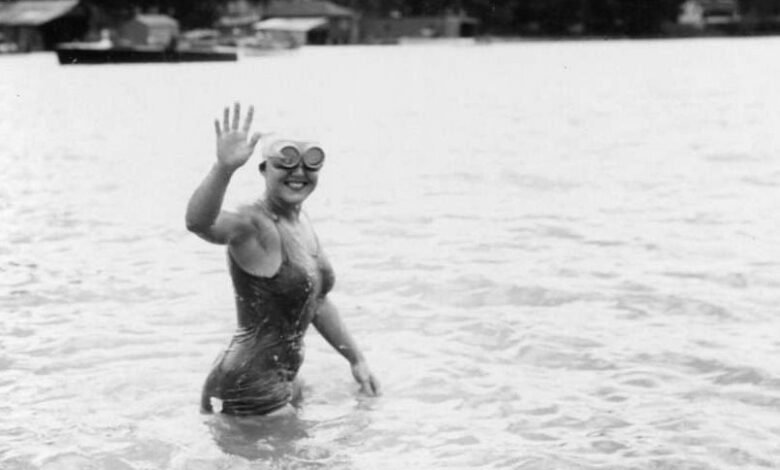
Diane Struble was the first person to swim the entire length of the lake, accomplishing that feat in 1958. Starting from the dam at the lake’s outlet in Ticonderoga, Struble reached Lake George Village approximately 35 hours later.
The 25-year-old divorced mother of three woke up to find herself famous; “Length of Lake George Swimmer Gains International Fame; So Do We!” proclaimed a Lake George Mirror headline.
Struble herself was quoted as saying, “If I can convince even one person that faith can move mountains, this swim will have been worthwhile for that alone.”
In 1962, a former Marine named Bill Stevens staged the same length-of-the-lake swim, completing it in less time – by about four hours – than Struble herself. Stevens appears to have resented the attention lavished on Struble (and the money he believed she earned).
According to him, his was the only “official” swim up the lake. In fact, he sometimes claimed that Struble never actually completed the swim, and whenever Lake George swims were mentioned in the press, he accused sports writers of spreading falsehoods.
He made those accusations so frequently, especially in letters to Times Union reporter Lindy Strout, that the Albany paper’s Sports Department
finally wrote to him in 1975: “You can stop writing to Lindy Strout now. He died ten months ago.”
What Stevens hoped to accomplish with his swim is something he failed to achieve: fame. As he wrote to the secretary of a swimming association, “I said in one statement I [was] doing it for the love of the sport but deep inside me I was serious because I really loved being part of becoming a champion not just to brag but to mingle among people who really care what one is doing or trying to accomplish.”
The next to swim the length of the lake was George Dempsey, a 17-year-old boy from Troy. Dempsey made his swim in 1967, not quite beating the time made by Stevens five years earlier.
Struble was a passenger in the guide boat that accompanied him from the rock at the outlet in Ticonderoga – named Diane’s Rock in Struble’s honor – to Lake George Village. Stevens’ time was finally beaten in 1977 by a 45-year-old English woman, Stella Taylor. She finished the swim four hours earlier than Stevens had.
A number of studies in recent years have looked at the increasing success of women in endurance sports and a number of theories have been posited to explain it.
All, however, owe something to the life and writings of Dr. Mary Putnam Jacobi (1842-1910), who was among the first to base an argument for women’s political equality upon physical fitness; there is nothing inherently, naturally delicate about us, she said after treating women for decades.
It’s quite possible that she repeated those arguments to herself while rowing on Lake George, where she and her husband, Dr. Abraham Jacobi, spent every summer after their marriage in 1873.
A version of this article first appeared on the Lake George Mirror, America’s oldest resort paper, covering Lake George and its surrounding environs. You can subscribe to the Mirror HERE.
Illustration: Diane Struble entering the waters of Lake George.
Source link