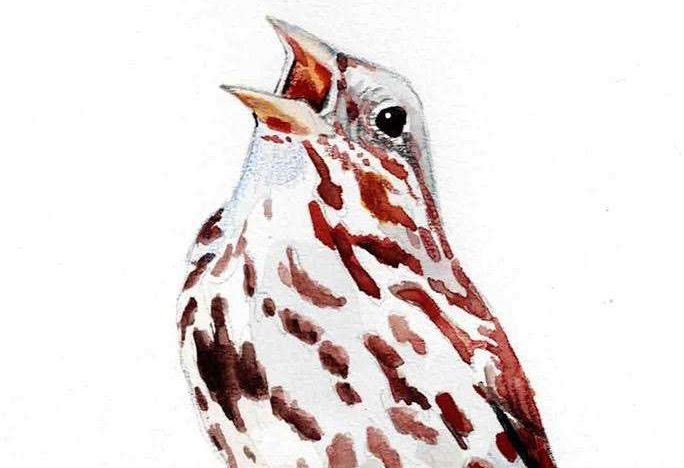
 In early March, birds that have been gone all winter begin appearing at my feeder. One of the earliest of these spring migrants is a brown-backed sparrow with a white breast coarsely streaked with brown.
The streaks converge in a dark central breast spot, an easy identification mark. This is the song sparrow, our most widespread and abundant North American sparrow.
Song sparrows are found throughout the United States and Canada below the subarctic. There is a high degree of regional variation in their appearance.
For example, sparrows of the California coast are smaller and have black streaks, while those of Alaska’s Aleutian Islands are one-third longer than eastern birds and weigh twice as much. Because of this geographic variation, there are 24 recognized subspecies.
Song sparrows prefer open habitat with brushy cover near water, such as marshes, wet meadows, woodland edges, and backyards with shrubs. Most birds that breed in northern regions migrate south as far as Florida and northern Mexico in winter, while those in milder regions remain year-round.
In winter, song sparrows survive on grass and weed seeds, waste grain, and dried fruit that persists through the season. In summer, they add insects, spiders, snails, and earthworms to make up half their diet.
These birds stay low while foraging, scratching at the ground and hopping and flitting through branches of shrubs. When flying short distances, they tend to pump their tail downward.
In spring, male song sparrows establish territories by singing from exposed perches and attacking and chasing other males. Their variable series of chips, trills, and buzzes is one of the characteristic sounds of early spring.
Song sparrows are primarily monogamous, but up to 20 percent will mate with more than one partner over the breeding season. Mated females build nests on the ground hidden in a clump of grass or weeds, or low in a bush or small tree.
The nest is a cup woven of grasses, stems, leaves, and bark strips lined with fine grasses, rootlets, and hair. In it, the female lays three to five pale green eggs, heavily speckled with reddish-brown spots. Then she incubates the eggs for 12 to 13 days while the male defends their territory.
At hatching, the nestlings are almost naked, with sparse down, and their eyes are closed. Both parents forage for caterpillars and insects to feed their young. After 10 to 12 days, the fledglings are fully feathered and leave the nest, though they are not yet able to fly.
Their parents will feed and care for them for a few more weeks until they become independent. Song sparrows may raise two or three broods a year.
In good habitat, such as a field overgrown with brush, a song sparrow’s nesting territory is typically less than an acre. Hawks, owls, raccoons, skunks, and foxes prey on ground nests.
Song sparrows are one of the brown-headed cowbird’s most frequent victims. The female cowbird surreptitiously removes a sparrow egg while the female sparrow is off the nest and lays one of her own in its place.
Cowbird eggs appear similar to those of the song sparrow and may not be recognized by the host, which can end up raising a large, hungry cowbird chick.
Since song sparrows are common and widespread, they have made ideal research subjects. Ornithologist Margaret Morse Nice made significant contributions to understanding the life histories of song sparrows beginning in 1928.
For eight years, Nice carefully observed song sparrows near her home in Ohio. She helped shift the field of ornithology away from collection, description, and studies of distribution, to observing living birds in the wild. Many of her methods are still in use today.
Singing in song sparrows has been studied extensively in more recent years. Scientists have found that male birds instinctively sing songs of two general types: one short and quick, and one that begins more slowly and contains more notes.
They learn by listening to males from neighboring territories. There is regional variation in songs, but males in the same area sing songs that are composed of similar notes and phrases arranged in different orders. Female song sparrows occasionally sing as well.
Keep an eye – and an ear – out for this melodious little bird this spring – it may be nesting as close as your backyard.
Susan Shea is a naturalist, writer, and conservationist based in Vermont. Illustration by Adelaide Murphy Tyrol. The Outside Story is assigned and edited by Northern Woodlands magazine and sponsored by the Wellborn Ecology Fund of New Hampshire Charitable Foundation: nhcf.org.
Learn more about birds in New York State.
Source link