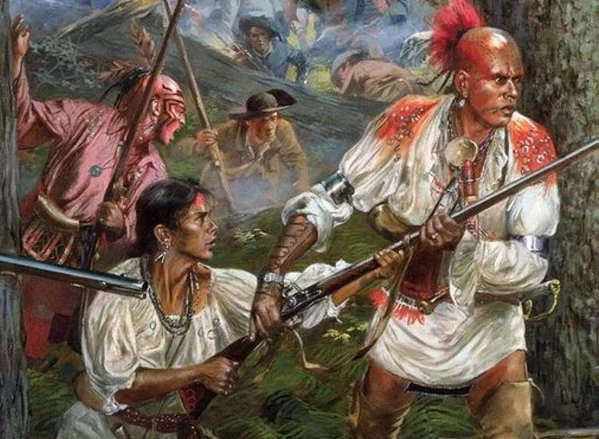
 Tyonajanegan, who Europeans called Sarah Martin Tyonajanegen or Two Kettles Together, was a mother of four who took up arms alongside her husband as their Oneida Nation chose to support the colonists in the American Revolution.
Almost nothing is known about her early life, although at least one family historian reports that she was “taken prisoner with her sister Katy from the Shawanoes, & remained with the Mohawks.”
In 1754 she married Honyere Tewahangarahken (ca. 1724 – ca. 1794), a chief warrior of the Wolf Clan Oneidas known to Europeans by various names, including Han Yerry, Honyere Doxtator, Johan George Dachstetter, or He Who Takes Up the Snow Shoe.
Honyere’s grandfather is said to have been Tee Yee Ho Ga Row (ca. 1660-ca. 1735), of the Wolf Clan, called King Hendrick, Double Life, or Hendrick Tejonihokarawa (not to be confused with King Hendrick Theyanoguin, 1692-1755).
Tee-Yee-Neen-Ha-Ga-Row, as he is also known in the records, was one of the Four Kings who went to London, England in 1710.
Honyere was the son a Mohawk woman and Cornelius Doxtator. Cornelius was educated in the Palatine family of Anna Elizabeth and George Dachstetter in what was then Montgomery County.
In 1759, during the French and Indian War (1754-1763) Honyere served with about 1,000 Iroquois allies in the Niagara Campaign under Sir William Johnson and it’s siege of Fort Niagara.
By the time of the American Revolution, Tyonajanegan and Honyere lived on a prosperous farm at the Oneida village of Oriska (now the village of Oriskany, in the town of Whitestown, in Oneida County). It was established at the confluence of the Oriskany Creek and the Mohawk River before 1766 and some sources say they were founders of the village. The name is believed to be a linguistic corruption of “Ol Hiskè” meaning “a place of nettles.”
The couple had three sons and a daughter and a large farm and frame house, a barn, wagon and sleigh. They grew a variety of crops and raised livestock and other animals including 15 horses, 100 chickens, 60 hogs, six turkeys, six cattle and two sheep. They were said to be among the wealthiest of all the Oneida.
Tyonajanegen cooked meals in kettles made of brass and copper and served guests on pewter plates. The family catered to people from nearby Fort Stanwix as well as travelers along the Mohawk Valley way west.
Early in the American Revolution, Han Yerry and Two Kettles decided to side with the Americans, as did the majority of the Oneida Nation. The Siege of Fort Stanwix in 1777 however, split the Haudenosaunee (Iroquois) centuries-old Six Nations Confederacy.
Brigadier-General Barry St. Leger was then making his way east with 1,800 men to link with General John Burgoyne‘s army heading south toward Albany.
On August 2nd, when the British began arriving at Fort Stanwix (then technically but briefly known as Fort Schuyler), there was a small group of Oneida men and women there.
Two Kettles was one of several Oneidas who made their way out of Stanwix and through the encircling troops to warn the settlements in the Mohawk Valley that the British had arrived.
Meanwhile, a Patriot relief column under the command of Brigadier-General Nicholas Herkimer was making their way up the Mohawk Valley with about 800 militiamen and as many as another 100 Oneida warriors.
St. Leger sent about 500 men under the command of Lieutenant-Colonel Sir John Johnson (the son of William Johnson) to intercept Herkimer’s forces.
Most of John Johnson’s force were Loyalists, with many Mohawk, Seneca, Cayuga, Onondaga and Mississaugas warriors led by Sayenqueraghta, Cornplanter, and Joseph Brant (Thayendanegea, William Johnson’s brother-in-law).
Herkimer’s 800-900 men encamped near Oriska on the evening of August 5th. Two Kettles prepared two pistols and made ready to join her husband, her son Cornelius, and other Oneidas accompanying Herkimer on his march to Fort Stanwix in the morning.
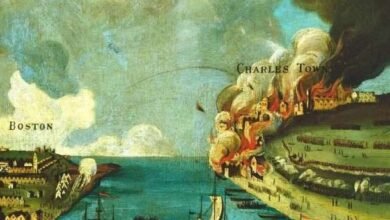
Around 10 am, Herkimer’s column, including Two Kettles and Honyere, fell into an ambush in a small valley about six miles east of Fort Stanwix. During the ensuing Battle of Oriskany Two Kettles fought alongside her husband, firing her pistols until he was wounded through the wrist. She then took up reloading his weapon for him each time he fired.
The British victory cost the Americans approximately 465 dead, wounded, or captured, while Johnson’s force suffered only 93 men killed, wounded or captured. Herkimer was also mortally wounded.
After the battle, Tyonajanegana rode on horseback into the Mohawk Valley to report what had happened and to warn about preparing for the arrival of the many dying and wounded. Meanwhile, Iroquois warriors attacked Oriska and destroyed the village and the family’s farm.
The battle marked the beginning of a civil war among the Iroquois, as Oneida warriors under Louis Cook and Han Yerry/Honyere aligned with the Patriot cause, as did the Tuscarora. Although there were exceptions, in general the Mohawk, Seneca, Cayuga, and Onondaga were allied to the Loyalist cause.
These decisions led to the devastating Sullivan-Clinton Expedition of 1779 and the dispossession of the Iroquois from most of their remaining lands.
The Oriskany Battlefield remains known in Iroquois oral histories as “a place of great sadness,” and has been designated as a National Historic Landmark along with being marked by a monument at the Oriskany Battlefield State Historic Site.
Onward to Saratoga
In the fall of 1777, Honyere and a group of Oneidas joined the American army fighting at Saratoga. Two Kettles again accompanied her husband, both to tend to his still healing wound, and to act as a messenger.
To show his appreciation for her service General Horatio Gates instructed Colonel Peter Gansevoort at Fort Stanwix to “deliver to her Three Gallons of Rum, for a Winter’s supply for her Family.”
Two Kettles’ last documented service occurred on August 14, 1781 at the fortified Palatine homestead and tavern, known as Fort Timmerman (or Fort Zimmerman), near modern St. Johnsville.
The “fort” acted as a base for a small force of militia and Oneida warriors protecting the gristmills on the nearby creek.
While the men were away pursuing a group of Loyalist raiders another force of 150 Loyalists and British allied Iroquois attacked the homestead. Two Kettles and the small group of Oneida and White women with her defended the home and drove the attackers off.
After this, Tyonajanegan, “Two Kettles Together,” largely disappears from written history. The last mention of her is that she lost her eyesight late in life and that she is believed to have died around 1824, surviving her husband by around three decades.
Illustration: Two Kettles fighting by her husband’s side during the Battle of Oriskany on August 6, 1777 (courtesy Oneida Indian Nation – Don Troiani).
Source link