 The death last month of eight-term U.S. Rep. Richard Lawrence Ottinger (D-Westchester) brings to mind the remarkable career of his father, Lawrence (1884-1954), an important player in plywood history.
Lawrence was the youngest of four sons of Moses Ottinger, a real estate developer who as a child emigrated from the German kingdom of Wurttemberg in the mid-nineteenth century and became known for developing properties along Columbus Avenue on Manhattan’s Upper West Side.
The three older boys were Albert, New York State attorney general from 1925 to 1928 and Franklin D. Roosevelt’ s opponent in the 1928 governor’s race; Nathan, who served as a state Supreme Court Justice; and Leon, who continued in the family real estate business.
To the tune of $100,000, Moses backed his youngest son Lawrence in various ill-fated business ventures over a number of years, according to a 1950 Time magazine profile. Among them: the early-twentieth century purchase of a large grove of gum trees near Corbin, Louisiana, about 20 miles east of Baton Rouge.
The gambit, according to a 1945 profile of “The Plywood Baron” in the New Yorker: “a method of coloring living trees so that third-rate timber would take on the complexion of mahogany, maple, rosewood, oak, or satinwood, as desired.
A shot of about twenty gallons of dye was injected into the tree with a kind of gigantic hypodermic needle. Within twenty-four hours the chemical diffused itself throughout the wood and even the leaves began to take on the color of the dye.”
But Lawrence couldn’t give the dyed gum wood away. Then nature struck lucky: after a hurricane blew down thousands of nearby oak trees, young Ottinger took possession by agreeing to haul them away, and found himself in the lumber business.
Self-educated in timber, mixed success, or lack thereof, followed for Lawrence – including when a venture exporting parquet flooring to Europe was submarined by the outbreak of World War I.
On the day he closed up shop, the legend goes, the 30-year-old ran into a friend who suggested he apply to become a lumber inspector for the War Department. “One hundred samples of wood were shown to him, and he correctly identified every one of them,” according to the New Yorker profile.
 Much like the advice on “plastics” given to Benjamin Braddock in The Graduate, the word Lawrence Ottinger had to learn was “plywood.” He got the job and was assigned to a mill in Newport, Vermont, as an inspector of plywood.
“Ottinger could hardly spell the word,” the New Yorker wrote. “Reporting to the Vermont mill owner, he said, ‘I’m the plywood inspector. I’m
usual in that I don’t know what I’m supposed to inspect, but I’m unusual in that I’m willing to admit it.’ ”
Plywood is a composite material manufactured from thin layers – or “plies” – of wood veneer stacked and glued together. It had a reputation for warping and splitting, and its prewar uses had been limited to things like chair bottoms and automobile floorboards.
But its lightness made it a good fit for early warplanes, and after a senior War Department inspector visited the Vermont plant, he was so impressed by Ottinger’s savvy command of numbers that he put him in charge of all U.S. aircraft plywood inspection and production.
At war’s end, Ottinger saw a big future in plywood. Switching financial backers, he borrowed $500 from his mother, not his father, and formed the United States Plywood Corporation.
Starting as a jobber, or wholesaler, he devised and heavily advertised new uses for plywood. During the 1921 recession, he bought vast quantities of the material, selling it for a profit as the economy improved.
But continuing as a middleman would only take him so far. As the Great Depression deepened, in 1932 a group of Seattle bankers asked Ottinger to take over a large plywood mill that faced bankruptcy. Perhaps expecting rejection, he demanded 50% of all profits; any losses would be borne by the bankers.
They agreed, and he was now in the manufacturing business. The mill became profitable, and Ottinger soon bought other mills, as well as large tracts of timber. Also in 1932, Ottinger moved his young family, including his three-year-old son Dick, the future congressman, to the leafy Westchester bedroom community of Scarsdale.
 Lawrence Ottinger became a leading citizen of the village, serving as a director of the Scarsdale National Bank, a board member of Camp Rainbow serving underprivileged New York City children, and an honorary governor of nearby White Plains Hospital. He also donated 1.5 acres of land to the Fox Meadow Elementary School to expand its playground, and 2.5 acres for a nature park.
U.S. Plywood continued to thrive. Another World War (P.T. boats were made of plywood, for example) and postwar building boom followed, and by 1950, U.S. Plywood was projecting $100 million in annual sales and $9 million in profits, in a much-enlarged industry producing 2.8 billion board feet annually.
In September 1953, “L.O.” stepped back to become chairman of the 34-year-old company he founded, handing its presidency to S.W. Antoville, who had joined the fledgling concern as a salesman three decades earlier fresh from DeWitt Clinton High School.
Just over a year later, on Dec. 19, 1954, Lawrence Ottinger died at 70 of a heart attack in his sleep at home in Scarsdale.
U.S. Plywood continued as a major industrial concern under Antoville, eventually merging in 1967 with Champion Papers to form U.S. Plywood–Champion Papers, Inc., a diversified forest products company in building materials, paper, and packaging materials with annual sales exceeding $1 billion.
Later renamed Champion International Corp., the company was acquired by rival International Paper in 2000. As is the way of the corporate world, IP in turn sold its wood products division in 2007 to Canada’s West Fraser Timber Co. Ltd.
Dick Ottinger’s successes in politics and environmental law were in a way a reaction to his father’s hard-driving example. A 1970 New York Times profile of Dick as he undertook a run for U.S. Senate described L.O. as a larger-than-life, driven parent – the person “who most profoundly influenced” his son, with a friend saying, “Dick once told me that when he was a kidhis father used to throw snowballs at him to teach him not to flinch.”
L.O. apparently wanted his only son to follow him into the plywood business. But Dick was still in the Air Force when Lawrence died, not knowing that his son had decided against a plywood patrimony. Said a friend, Dick “figured that he could never get out of his father’s shadow that way.”
But Dick Ottinger in 1970 affirmed that he missed the Plywood Baron. “He was a wonderful guy. I wish he were with me now.”
Read more about the Construction Trades in New York State.
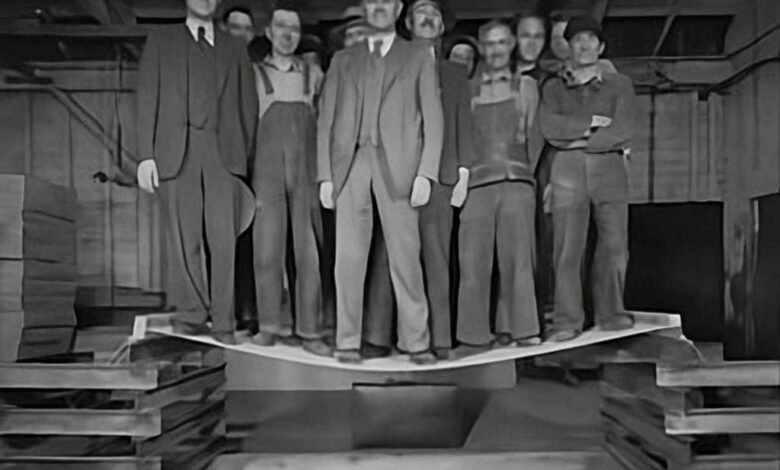
Illustrations, from above: Testing the strength of plywood for promotional purposes; plywood manufacturing, ca. 1960; and part of a full-scale house, built at the 1937 Madison Home Show to demonstrate the US Forest Product Laboratory’s plywood prefabrication system (courtesy of USDA Forest Service, Forest Products Laboratory).
Source link