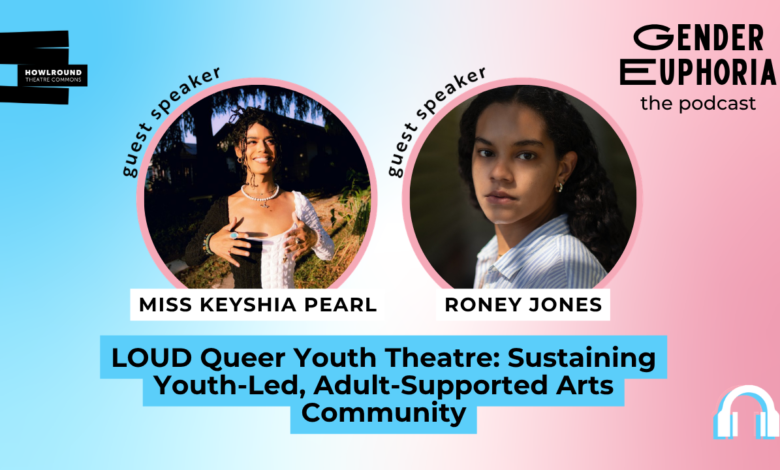
Nicolas Shannon Savard: Hello, and welcome to Gender Euphoria: The Podcast, a series produced for HowlRound Theatre Commons, a free and open platform for theatremakers worldwide.
In the second episode of season three, we’ll be continuing last episode’s conversation with LOUD Queer Youth Theater‘s co-director of theatre and performance, Roney Jones, and operations and development co-director, Miss Keyshia Pearl.
To give a brief recap, LOUD Queer Youth Theater is a New Orleans-based devised performance program primarily serving Black and Indigenous trans and queer artists ages sixteen to twenty-four.
In the first half of our conversation, we covered the ensemble’s theatre programming, their devising process, and the political education at the heart of the ensemble’s stage productions and rehearsal room practices.
In the upcoming discussion, we’ll dive deeper into how LOUD Queer Youth Theater builds and sustains a supportive queer intergenerational professional artistic community with the young people the program serves.
Without any further ado, let’s pick back up where we left off last week in my conversation with Roney Jones and Miss Keyshia.
Chorus of voices: Gender euphoria is bliss. Freedom to experience masculinity, femininity, and everything in between. Getting to show up as your own self. Gender euphoria is opening the door to your body and being home. Unabashed bliss. You can feel it. You can feel the relief. Feel safe. And the sense of validation and actualization. Or sometimes it means being confident in who you are. But also to see yourself reflected back. Or maybe not, but being excited to find out.
Nicolas: I’d like to talk a bit about LOUD as like community space a bit. There’s definitely that strong sense of peer-to-peer connection. But something that really struck me about what you were saying in your kind of introduction, Miss Pearl, was this sense of intergenerational queer community as well. Where there’s staff members who might be a few years older than the participants, but also queer elders that they might be connected to. I definitely want to hear from you, Miss Pearl. So maybe if you could start with that.
Keyshia Pearl: I guess I can, maybe it’ll help for me to talk about how I got into it in the sense of like first-person perception of before I became part of it.
Nicolas: Absolutely, yeah.
Keyshia: As such a demographic marker of what the organization serves… So, I came into contact with LOUD at a time where I really needed it. I had spent probably over half a decade at that point navigating social spaces as a young adult from like the time I started college in 2017. And I was all right for the most part. But there was definitely always, like, I am the only “me” in these parties. And keep in mind when I say my social—I have been blessed to have a very interesting social development where I got to develop socially in like the professional arts realm. Like music industry. All of my friends like having big girl jobs, you know, working on movie sets, producing albums, making music videos. You know, I was I was blessed to navigate that realm and be part of it.
But, there was always that element of not really knowing any other trans people. Not having that much access to queer friendship and even queer employment and knowing where to go and how to go and just etc.
I will say my safe space was lesbians for a long time. You know, like, the lesbian community really took care of me for a long time. But there’s still a big difference when you start to go into like, OK, but here’s that specifically like nonbinary trans community, which is just a little bit different and maybe fewer in the sense, you know, in the sense of numbers and demographic.
And, I was able to engage in LOUD and it was the first time where I was really properly supported to create a stage work. You know, to go and perform dance and stuff on stage and being able to experience creative production where I really was cared for. And I didn’t have to go through the complications which can come from being a trans femme—when you’re navigating mainstream cisgender dominated professional spaces, things come up. It can be very stressful and confusing.
And you experience like ostracism. And ostracism not necessarily as people with pitchforks telling you to get out, but more so like: I know I’m loved and I know I’m cared for, but I don’t know if y’all know how to do it all the way to the point where I need it. Whereas when you get around those other trans people, other queer people, other nonbinary people, there’s a level of like mutual understanding and also mutual privilege, mutual class relation, mutual relation to resources, different understandings of things.
Roney Jones: Community being a very tangible space where imperfection is the point. I think that that is something that is an element of community, whether it is artistic, spiritual, your neighborhood, your family, your loved ones. It is ideally a place where you’re allowed to speak and behave in first draft. And that’s something that we used in the space, that terminology of like, if you wait to say it perfectly, if you wait to write the perfect piece, if you wait to perform perfectly, you will not. So please trust us and yourself with that first draft. And I think that speaks to Miss Pearl’s point about imbuing them with a sort of self-confidence and self-love. I think speaking in first draft requires that. It requires so much self-love and self-trust, which is, I don’t want to say it’s dependent on any sort of external, but it’s definitely easier to practice when the external is something that is modeling love and trust and respect back to you.
Nicolas: Definitely supported by those around you.
Roney: Exactly. And I think for young people, we do have the privilege of occasionally being the first place where someone is allowed to be in “draft mode.” I think our schools and sometimes our home life and sometimes other places where young people are expected to be or welcomed, ask for a kind of perfection out of them that one erodes community and one erodes a sense of self. And getting to work with some of these young folks in either over the course of one semester or sometimes two, it’s not like we’re creating new people, but I think the spark of a person turns into a flame sometimes. You can see it happen over the course of that. And I think that that is what good community does. It’s not like it forces you out of your shell. It just is like, no, it’s actually safe when you’re ready to come out to do so. You’re more than just welcome here. You are celebrated. So yeah, I think that is, and not even just for our young people, I think it’s so easy to speak about because that’s how I felt joining LOUD as a staff member. I think out of our—we have a four-person staff—and I think out of those four, I am the only one who wasn’t also a participant in LOUD. I joined as an adult supporter. And so even from that, not external, but somewhat different perspective, I can say it extends to us as well. We get to be a member of the community. It’s not just something we’re creating for them to enjoy. We get to be a part of it and it’s very enriching and it feels good to be at LOUD, yeah.
Nicolas: That is really cool to hear that the majority of the staff currently was a participant at one point. And I feel like it’s part of—showing my cards here, I did a deep dive into your website—but LOUD is described there as a youth-led, adult-supported organization. And I’m wondering, could you talk a little bit more about what that means within the context of the ensemble and kind of how you put that into practice?
Roney: Two things come to mind for me with the youth-led and adult-supported. I think in a very tangible way, it is that everyone who participates in LOUD, both the ensemble members as well as the staff, thirty-five is the oldest that a staff member can be for LOUD before they should either be beginning or in the process of transitioning out and training the person to take over their role.
So making sure that the ages of the people who are on staff remains pretty close to the ages of the people who we are serving. So I think that’s a very kind of like cut and dry, bullet pointed answer. But I think the other part of it is that—kind of what we were talking about when it comes to our political education discussions—that the interests and desires and passions of the youth and the young people who are a part of our ensemble really guide what we do. So as much so as we will schedule and we’ll take care of venue and food and marketing, but what happens during rehearsal, what we create, is based on what they want to do. We provide the structure, the scaffolding, but they build the structure, I think is how I’d like to say that. We are the scaffolding and they build the structure. Yeah. But I’ll pass it to you Miss Pearl.
Keyshia: No, that’s that’s the answer.
Nicolas: Miss Pearl, I’m wondering, as someone who started as a participant and you’re now doing the role that you are now, what did that look like for you?
Keyshia: So it’s important to note I came along… there was like, they had a very small youth group like that semester was only like three people that they were having put on some solo performances and they were producing that and coordinating that. And one of the people dropped out and they got me like really last minute. And then in the following months or maybe it was actually like it was actually almost like for a year, we started the process of sort of starting to onboard me. I was going through a lot. I needed to finish school and just all kinds of things. So I actually had to stop. And it was like a lot for me, but I was given a lot of grace through it. And ultimately, I was able to come back to it, you know, later on. And that was a blessing. And maybe that speaks a lot to it. The fact that I was able to voice that I wasn’t ready, but was still able to come back and inherit such an important role as I have.
So I’m operations and development. So I keep up with like behind the scenes. And that’s also something when it comes to, when you say, what is it like for me being a part of it? I am profoundly capable of performance art. However, spiritually and mentally, I deal with a lot that makes it really hard for me to manifest from that forward facing space. And throughout the process of getting into LOUD and onboarding, it was always like, I really don’t want to be on the stage because at first it was like that was like a big effort. A big effort was trying to get me there. And it’s like, I don’t understand what I’m saying. I’m not just shy. I’m not just shy. Like, I really don’t want that. But I do want this over here.
And it was a blessing to be able to inherit something because my brother… I’d be singing around the house. And my brother was like, “you should have been in performance arts.” And I’m like, I am in performance arts, Malcolm. I just am in a different position. And it’s been a real blessing to be able to be so involved and to learn so much and to know that I am impacting and helping other people to be on that stage through just that monotonous, meticulous work: checking emails, doing payroll, writing grants, and just all kinds of stuff.
Nicolas: Scheduling the podcast interview.
Keyshia: Yes.
Nicolas: Being on the phone call with me.
Keyshia: But I do enjoy it because it allows me to be there and to be around and to be in it and technically part of it. But I’m also able to have that sort of sovereignty inside of myself. And that makes me feel good because, you know, I know that that’s not something that you necessarily will find everywhere where it’s like if you can’t do what they’re saying you have to do, then you aren’t involved.
And we try to especially, especially when it comes to trans youth, because it’s like you can’t say you serve trans youth, and then when trans youth start having trans access needs, like, no one cares or you can’t do anything or they don’t get to be involved in anything. And so we definitely try to consider whether it’s transness, neurodivergence, disability, if somebody wants to be involved, even if they can’t do what everybody else is doing, it’s like if we have it in our budget and we have the capacity to figure something out, we will try so that they can be involved and present and feel purposeful. And we can still give them that resume, the energy, the reference energy. They still get to have a job.
Nicolas: They still get to be part of the community.
Keyshia: Yeah. So I hope that answers.
Nicolas: That does. That does.
Roney: I don’t think we’ve mentioned this yet that a big part of our model is that we, the young people who participate, are paid. They’re treated like professional actors where you are paid for both the rehearsal process and the performance process. Which is, I think, incredible thing. I think it makes a huge difference in not even just the quality of work, although yes, in the quality of work, but knowing that you’re coming into a space where what you’re doing is valued both emotionally and also that it’s valued in the way that maybe, you know, capitalist structures aren’t our goal, but we are in a place where like that is how we honor your time in a way. We’re very grateful for you bringing your talent and your artistry here the same way that like when I go to act, yes, I love it. And yes, I am happy to be in that room. And I know I am respected because I can pay my bills at the end of it. So giving them that same kind of respect.
Nicolas: Paying the youth ensemble members for their time, not only does that communicate like “this is work and it is valuable for you to do this,” it’s also an access thing. I think a lot of the times, particularly in those later teenage years, early twenties years, you are working part-time, sometimes full-time jobs. And that ends up excluding people if that’s either something that you have to do just in your free time or for many programs, you have to pay to do it. That’s a completely different model in saying this time is valuable. And also, we’re going to make it structurally so that you can dedicate this time to it. I know we were talking before we started recording about other youth-focused theatre programs. I know the True Colors troupe through Theater Offensive in Boston also works on a similar model where the ensemble members are paid. And I’m so excited to know that there are more companies doing that.
Okay. Did a little research to confirm this. LOUD joins several LGBTQ youth ensembles who pay young artists for their work on stage. A few of those include Boston’s True Colors Out Youth Theatre, Chicago’s About Face Youth Theatre, and Pittsburgh’s Dreams of Hope, just to name a few. Okay. Back to Roney.
Roney: Yeah. I think it makes a huge difference. And it makes me very proud of the… And I think, yeah, I think pride is a big word because I think that’s also something that it instills in the young people with the work that they do. LOUD, very specifically, is not an after-school program. That’s something that really makes us different from a lot of the other youth programs, at least in New Orleans, where they’re typically attached to schools, whereas we are not, and very intentionally. And in that same kind of regard, the age range that we work with is very intentional as well. Just like you were saying, in those late teens into early twenties years, I think for a lot of Black youth, and not just Black, I think also queer youth and other minority groups, get aged up so quickly. They have to, because of external factors, focus on the adult world. Where… I know technically, after you’re eighteen, you are technically an adult, and I have immense respect for my eighteen-year-olds. And it’s a period of time where a lot of people who are more privileged have that benefit, that cushion time where they’re allowed to transition and initiate into adulthood, rather than having to have that strict cutoff, which gets earlier and younger and younger for Black and queer youth, where being thirteen, fourteen, fifteen, they’re already being viewed as adults. And I think that one of the big things that we try and do and why we work with that age range is to provide a place with some cushion where you, just like you’re saying, you will be paid, so your time is valuable. You don’t have to pick this or a job. This can be your job. And you can be with folks who are the same age as you, who are not asking you to know more than you know, to have it all figured out. And the people who are leading you or who are supporting you are in that same age range with maybe a few more years of experience, but close enough and familiar enough to remember what it is to be in that very unique and nuanced age range. So yeah, I think it’s really special the way we work with the young people who join us.
Keyshia: And then further, in a sense of LOUD’s community, something we were talking about earlier, in a sense of like how we pay our youth, we don’t only just pay them. We give them long-term support beyond just paying them. We remain steadfastly contacts in a way that’s not just about like using them for images and demographics and putting them on a website. You know, because we know what that feels like. We know what it feels like to age out of things and be in that space of like, I really wish I could have stayed there, you know, and you can’t.
And so with LOUD, we really hope to be a space where they have long-term community, long-term plugins to opportunity, long-term like advice space, but also for those who are interested, for those who are interested in just a little bit more rigor and really resonate with the program to such a degree that they might want to become young adult staff. We have programming measures and organizational measures, too, where the oldest we’re supposed to be is thirty-five. So you might not work here until you’re thirty-five, but the latest we should be here is by thirty-five, unless something is happening to where we’re really just needed that much. But the goal is to, at every moment, be working toward our own transitions so that there’s not that like, you know, that hyper-colonial energy that can happen in just any structure where people aren’t wanting to leave or people aren’t wanting to give up security, people aren’t wanting to be vulnerable. So they’re not allowing the proper phasing in and out in the release of that control. And so we want our youth to be able to… Like, if somebody sees my job and they’re like, Miss Pearl, I really want to become you, then it would be my responsibility to start to map out and figure out, okay, like it’s time for me to start having weekly meetings with this person. It’s time for us to start applying for grants accordingly, training them, taking them on, because of course we have to pay for it. We have to be able to sustain ourselves and we also have to be able to compensate them for the time once we start training them.
And that compensation is so important in relation to not just the compensation in terms of monetary, but we really try to offer them care and patience in a way that really affirms: yes, you can go to work and you can be safe and you can be well.
And I think just being able to engage staff and be like, we work well together. It’s not like pulling teeth. We don’t have to beg each other to handle things. Everyone’s effortful. Everyone’s empathetic. And we have a non-hierarchical structure. And it’s very interesting. I think maybe not until I’m standing in this moment, the significance of that: of choosing to do work in that model when we know that is not the dominant model. And being able to execute it and function in it and make stuff with it and be able to show like, yes, that way is one way, but there are other ways and we’re engaging one of those other ways. I mean, I have been told—I have been told vocally—you know, the care that you’re getting, you’re never going to be able to find this anywhere else. And it’s like, I don’t believe that because I know that the care I get is a reflection of my sense of self-worth. So with them, we want to instill that, especially as they’re—especially in 2026.
The veil is bust wide open. Like nobody is under, you know—well, I’m not saying nobody, but a lot of people are aware of how drastic so much is at this point. When we talk about the forces of evil, oppression, colonialism, capitalism, they have to be equipped with self-love and they have to be equipped with that sense of empathy. And so as a community space, a community organization, there’s a sense of we are a metaphysical community and we make at times that physical community in a sense of that gathering space we are all in. But like I said, we also are that long-term support, long-term potential job support and integration.
And I think with us, with our current staff iteration, I think we are bringing in something that is not as familiar where we’re bringing in the element of when we think about community, we’re really, really doing work to integrate environmentalism into our practice in a way that it’s like really as conscious as it can be. Because sometimes when we would like bring it up in certain contexts and situations, it would be like, “well, how does theatre connect to wildlife?” Like, where is the connection there? And over like the last semester that we had, where we were doing workshops and things, we ended up doing that integrating work. And I remember… I remember at one of the workshops we had, which was reflecting on Indigenous history, African-American history, and ecocide and how those things connect. But also in relation to theatre practice. Roney came up to me and she was like, “I’m not gonna lie. Like even I was kind of like, how are they connecting?” But then she said like after that workshop and after the semester was done, she was like, “I see it.”
And I bring that up because thinking about the responsibilities that we have as artists, like what is it to be an artist? Outside of the context of just making art and making enough money to like be comfortable and move somewhere wealthy and removed. But to be an artist as something that is like, I was given these gifts, so I have a responsibility to use them on behalf of the wellbeing of my environment. And it’s all connected and we want to help them to be able to know that and then say that, you know, to share it. But I’ll pause because these are topics that I clearly am passionate about. Yeah, that’s my answer.
Roney: My approach to the conversation of like LOUD and community and what we are attempting to do… The first thing I’m going to say kind of connects to something that Miss Pearl was saying about our individualized staff positions meant to be evolving and always looking towards the future, looking to those that come after us. And with this like intergenerational community, we as staff, and then of course also our youth participants, have those that had our current positions as touchstones as well. So we have the people who shaped LOUD before us and before them to look to.
When we were in the second half of 2025 mapping out this workshop series that we had started discussing, we, actually in a meeting with some of those folks that came before us, learned that that was something that LOUD had done in previous iterations. Although, you know, we had kind of come to it organically, it’s something that, you know, a couple of iterations before this current one, it had been done as well. When we’re kind of in an off non-programming season, how do we continue the work that we do? So we have those people as incredible resources and as a result of that are able to connect some of our elders to our youth. There’s so many cultural and spiritual practices that talk about the responsibility of looking forward and back at the same time.
I believe Sankofa, which is not necessarily something that LOUD always discusses by name, but I think we’re constantly doing it, which is kind of a symbol of this bird looking over its shoulder with an egg in its mouth. So representing like the present, the future ,and the past all converging at a single time. I think that that is a big… like, when we say community, I think that is part of what encompasses that.
Nicolas: On that lovely note, I’ll bring our conversation to a close. I asked my guests to leave us with a snapshot of queer joy and community, and Roney’s snapshot gave such a vivid encapsulation of the kind of artistic space and collective the LOUD Ensemble is. I’ll let them tell it. Here’s Roney.
Roney: The moment that comes up for me was at the end of our most recent show, Hello Neighbor. One of the of the trio shows had a trans woman as the lead, and the woman who we had participate in that, she’s a performer, but this was her first time acting. And watching her over the course of those rehearsal processes, like, just find so much like faith in herself. Because the memorization thing, I know, I think a lot of times actors make it out to be just like, oh, you know, it’s just what we do. But it’s a real skill. And also if it’s not something you’ve had to do much, I think it can be very intimidating. I think in the first few rehearsals, she was feeling some of that. And then on that last performance, to see her go out and just, just embody this really strong, revolutionary character was just so incredible.
And then I think the reason why the talkback came up was because, you know, getting to see any actor talk about their process is always really, really lovely. And getting to see these young people really just take hold of the conversation and talk about their process and their growth was really lovely.
It was also a beautiful day. We were in one of our community members, Miss Gloria’s Garden, who’s an elder from here, from New Orleans. I believe she’s in her mid seventies and she runs an entire garden space. And that’s where we did our performance. And so there were butterflies flying around and all of these beautiful blooming flowers. And I think there had just been a sun shower that started either like right as we were finishing up or right afterwards. It was visually just beautiful. And seeing the joy of like a job well done on their faces really just was, yeah, a picture perfect moment where you’re like, oh, yeah, I think we did some really good work.
Nicolas: This has been Gender Euphoria: The Podcast. Hosted and edited by me, Nicolas Shannon Savard.
The voices you heard in the intro poem were Rebecca Kling, Dillon Yruegas, Siri Gurudev, Azure D. Osborne-Lee, and Joshua Bastian Cole.
The show art was designed by Yaşam Gülseven. This podcast is produced as a contribution to HowlRound Theatre Commons. You can find more episodes of this show and other HowlRound shows wherever you find podcasts, including on noncommercial open source apps like Anytime Podcast Player for iPhone and AntennaPod for Android. If you loved this podcast, please share it with your friends, your colleagues, your students. You can find a transcript for this episode along with lots of other progressive and disruptive content on howlround.com. Have an idea for a meaningful podcast, essay, or TV event that the theatre community needs to hear? Visit howlround.com and submit your ideas to the knowledge commons.