 During the French and Indian War (1754-1763), many Mahican and Munsee-speaking people in the Hudson Valley felt themselves pressured to relocate to new areas both inside and outside of the Valley as the result of an ethnic cleansing project conducted by Sir William Johnson.
This created a refugee crisis that led to a varied of responses from both colonial officials and the Mohawks and other members of the Iroquois (Haudenosaunee) Six Nations.
“The ethnic cleansing project in the Hudson Valley region during the Seven Years’ War arose and then imploded for reasons particular to this time and place,” explains Tom Arne Midtrød in a recent article in the interdisciplinary journal Early American Studies.
“Its roots lay in provincial authorities’ and local whites’ shared distrust of local Natives. Colonial officials grappled with what they saw as a security threat from Native people whose loyalty they suspected but with whom they were not openly at war.
“After first attempting to restrict the movements of these people and place them under supervision, the government of New York moved to intern them in colonial towns.
“When this attempt at control only exacerbated tensions and led white settlers to murder local Natives, Sir William Johnson seized the opportunity to have these Natives removed from their homelands, first into Mohawk country and then farther afield. But this attempt to control them also failed — or remained incomplete.
“On the eve of the Seven Years’ War, the Natives of the Hudson Valley were vastly outnumbered by colonial inhabitants but maintained a strong presence in their homelands.
“The Munsee-speaking Esopus Indians lived in various parts of Ulster County, New York, between the west bank of the Hudson and the northern Delaware River, as well as in parts of Orange County to the south.
 “Wappinger people (also Munsee speakers) still lived in their historic homeland in Dutchess County east of the lower Hudson, but by the mid-eighteenth century Wappingers could also be found in parts of southern Orange and northern New Jersey, such as on the Pompton River.
“Mahicans (whose language was closely related to Munsee) lived on both sides of the Hudson, roughly from Catskill Creek northward on the west side and from northern Dutchess on the east. Mahican people resided in parts of the region between the Hudson and the Housatonic River to the east.
“The Protestant mission town of Stockbridge, Massachusetts, which by mid-century had become the center of Mahican politics, lay on the upper Housatonic; by that time Stockbridge had become a mixed settlement, home to both Mahican and white colonial families.
“Many Munsees living on the upper Delaware and in the Susquehanna and Ohio countries were descended from Munsee-speaking Hudson Valley people; Mahicans had also made these regions their home.
“The Schaghticokes who lived on the Hoosick River, an eastern tributary to the northern Hudson, descended from refugees from New England who had settled there after Metacom’s War [King Philip’s War, 1675–1678].
“All these Native groups had strong and cooperative ties to one another. Their relations with local colonials were historically peaceful; the last war fought between Natives and Europeans in the region was between the Dutch and the Esopus Indians in the 1660s.”
Upcoming Event June 4th
Midtrød, a PhD and an associate professor of history at the University of Iowa, will discuss how the outbreak of the War affected Mahican and Munsee-speaking populations in the Hudson Valley in a virtual Zoom program on Thursday, June 4, at 6 pm, ET.
The program is this year’s third of four of the Jacob Leisler Institute for the Study of Early New York History’s “Leisler Library Lectures,” in collaboration with the Columbia County Libraries Association and the Hudson Area Library.
The Jacob Leisler Library Lectures are made partially possible through the support of the Van Dyke Family Foundation, HRBT Foundation, and Bank of Greene County Charitable Foundation.
The Jacob Leisler Institute for the Study of Early New York History is an independent, not-for-profit study and research center devoted to collecting, preserving, and disseminating information relating to colonial New York under English rule. In the years spanning 1664 to 1773, New York province’s diverse European settlements and Native American and African populations fused into a cosmopolitan colonial territory with ties throughout the Atlantic World.
The Hudson Area Library History Room houses a collection that pertains to the history of the City of Hudson, Greenport and Stockport; as well as Columbia County. The History Room also hosts a local history speaker series at the library, offering free monthly talks on diverse topics related to local history.
These talks include the Leisler Lectures and the Speaking about History series, produced by the African American Archive of Columbia County.
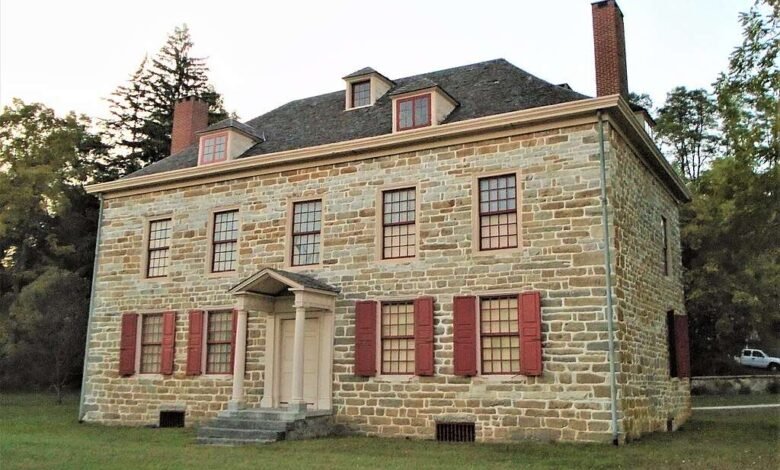
Illustration: Old Fort Johnson, a central location during the refugee crisis of Mahican and Munsee-speaking populations in the Hudson Valley during the Seven Years War (French and Indian War); and a map of the region during the French and Indian War (Seven Years War) by William Keegan.
Source link