 From October 26 to November 4, 1825, the display of three paintings by Thomas Cole (1801-1848) – in the windows of Colman’s bookstore on Broadway near Fulton Street in Manhattan – changed the course of American art.
The three paintings became an immediate success when purchased by renowned painters John Trumbull and William Dunlap and engraver Asher Durand. The display launched Cole’s career and gave birth to what is now known as the Hudson River School of landscape painting.
Through his work and his artistic exchanges with other painters, especially his mentorship of Frederic Edwin Church, Cole galvanized a generation of 19th-century American artists to embrace landscape painting.
His depictions of the Hudson River Valley and the Northeastern United States imbued nature with picturesque grandeur and a sense of the sublime, captivating the New York City art world.
Artists associated with the Hudson River School varied in their painterly style, ambition, travels, and commercial success, yet they shared a sustained engagement with the American landscape as a source of inspiration.
Cole’s work gave America a visual identity reflected in the still-vibrant concept “America the Beautiful.”
The Thomas Cole National Historic Site in Catskill, Ulster County, NY, is mounting a new exhibition, “Circles of Influence: Thomas Cole and the American Landscape Movement,” which explores the rapid influence that Thomas Cole and his work had on other 19th-century artists, and the role that they collectively played in extending the concept of “America the Beautiful,” still vibrant today.
The exhibition brings together the work of Thomas Cole with artists he was in direct contact with, including Frederic Edwin Church, Jasper Francis Cropsey, and Asher B. Durand; artist-members of the Cole family, including Sarah Cole and Mary B. Cole; and later painters who were shaped by his legacy and considered part of the artistic movement Cole founded, such as Ralph Albert Blakelock, Albert Bierstadt, Susie M. Barstow, John Frederick Kensett, Mary Josephine Walters, and Worthington Whittredge.
The exhibition will be presented in the historic site’s Library Gallery designed by Thomas Cole in the 1815 Main House where he lived from 1836 until his death in 1848. The gallery features an original decorative wall painting by Cole. The exhibition will run from June 20 through December 2026.
The exhibition brings to the public major works from private collections, including Thomas Cole’s iconic painting, “Catskill Mountain House,” 1846, from the Warner Foundation Collection. The collection was assembled by the late pioneer collector and appreciator of American Art, Jack Warner (1917-2017).
The Warner Foundation Collection is also lending significant works by Albert Bierstadt and Worthington Whittredge. Susan Austin Warner is lending from her private collection works by Frederic Edwin Church, Jasper Francis Cropsey, and John Frederick Kensett.
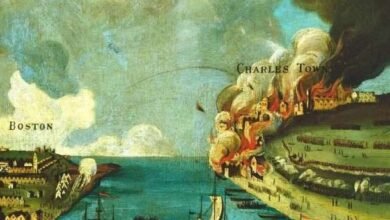
The exhibition also includes a distinctive work by Cole, “Distant View of Boston,” c. 1838-39, from the Collection of J. Jeffrey and Ann Marie Fox.
“The speed and impact of Thomas Cole’s influence in the 19th century is remarkable, as this exhibition demonstrates,” said Maura O’Shea, Executive Director of the Thomas Cole National Historic Site. “But it is Cole’s devotion to the American landscape – its appreciation, portrayal, and preservation – that has made his influence not only historically important but contemporary in its ongoing impact on artists today.”
“Made possible by the generosity of lenders, this exhibition honors the rich history of the home — marking the first time since the Cole Site opened to the public that an exhibition of Hudson River School works is presented in the space that Cole designed within his home to display landscape paintings,” said Amanda Malmstrom, Associate Curator of the Thomas Cole National Historic Site.
“The salon-style installation brings to light the diversity of artists associated with the major landscape movement sparked by Thomas Cole, and the intertwined complexity of their artistic exchanges. We hope visitors embrace this opportunity for reflection, a moment to reckon with the history of American national identity and the role art played (and continues to play) in shaping and disseminating it.”
The exhibition is part of a broader initiative of the Thomas Cole Site titled “Thomas Cole: Painting the Nature of America.”
This year, the 250th anniversary of the signing of the Declaration of Independence, is an appropriate time to recall the pivotal role that Cole played in creating the visual identity of the young nation.
The Thomas Cole National Historic Site, also known as Cedar Grove, is a National Historic Landmark that includes the home and studio of Thomas Cole. It is located at 218 Spring Street, Catskill, NY. Visit their website for more information.
Read more about Thomas Cole and the Hudson River School.
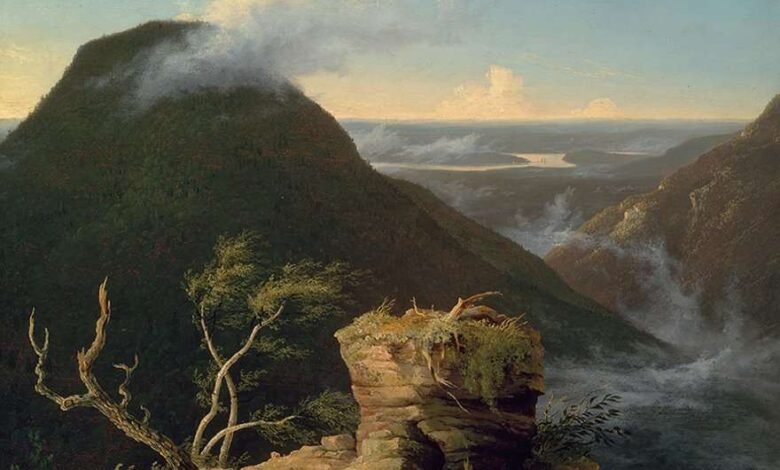
Illustration: Thomas Cole’s “View of the Round-Top in the Catskill Mountains (Sunny Morning on the Hudson),” 1827, showing the Hudson River in the background (Museum of Fine Arts Boston).
Source link