 $20,000 in 1968 is estimated to be worth about worth about $190,000 today. Would you pass that up if it were offered to you and it were legitimately yours? Clint Wescott would — and did. Missing from his hometown of Burnt Hills, NY, for 15 years, when he was finally found and told of his windfall, he was dressed in rags and had 44 cents in his pocket.
But his response to the windfall was “I’d rather stay at the bottom of the barrel. I’m not ready to go over to the other side. Not yet. Hand me a dollar. I’ll take it and buy a little drink, a little smoke. But I don’t want a wad of money like that.”
Clint Wescott was born in 1916 in Burnt Hills, in Saratoga County. Besides his mother and father, he had four siblings. The family lived near the corner of Church and Thomas Streets in Ballston Spa and before 1939 Clint owned land in Burnt Hills on the east side of South Street, now Kingsley Road. He lost part of that land due to unpaid taxes.
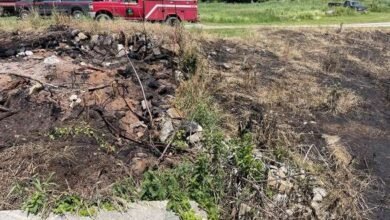
 By 1943, he left the area and was off to Arizona because the weather there was better for his asthma. He worked in the copper mines but shortly afterwards came back to Burnt Hills and built a gas station at the southwest corner of Route 50 and Lakehill Road on land he had purchased 20 years previously.
The gas station part of his life didn’t last long however and he was off again in 1953, traveling to Salt Lake City. This time, he was never to return to his hometown again.
For about 12 years, no one in his family heard anything from him – nothing, no mail, no calls. The gas station was leased and then closed. There was $19,219.68 owed to Clint upon the sale of that property. But where was he?
Coincidentally, in 1968 a reporter for the Los Angeles Times did a story about an odd man who was living in the weeds at the base of a cliff of Bunker Hill, under the 4th Street Bridge, in Los Angeles, California.
It turned out to be Wescott he had been there for some 10 years, longer than anyone else in the area and perfectly content to stay there forever. He got his clothes from trash barrels, read discarded newspapers, lived on donations of food, and had taken to drinking and smoking for entertainment.
The police all knew him and let him be. Little did he know that the New York Supreme Court had hired a legal firm to find him and give him his $20,000 — plus another $4,000 that he had inherited upon his father’s death in 1967.
 This LA Times story about Wescott was syndicated and carried to newspapers all over the country. One paper that picked it up was the Schenectady Gazette which covered the Burnt Hills area. Attorney John P. Brown of Burnt Hills, who had been involved in the search for the missing Wescott, saw the report.
At that point, Brown had been searching for Wescott for seven years and wanted to contact him to tell him about his newfound wealth. Of course the IRS came into the picture too and wanted a piece of the action.
They inquired of Brown about this money. He responded to their questions about Wescott’s tax liability with: “I assume everything he received since he became a bum could be called a gift and not taxable.”
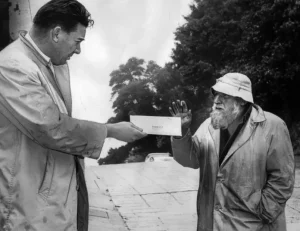
This is what sent reporter Charles Hillinger out in search of Wescott to give him the good news. And that’s when Wescott made it clear he was not at all interested in the money and wanted to stay just right where he was. He wasn’t going back to Burnt Hills; and he wanted no money.
After using every possible strategy he could imagine to convince Wescott to accept the money Hillinger gave up, but others who had heard the story did not. They bothered and badgered Clint Wescott for a long time.
Long lost “friends” volunteered to take his money and do various and sundry things with it. Some said they could use the money to feed their kids and others wanted to use it to create clubs for disadvantaged kids. Still others promised to marry him.
Thousands of letters came to Wescott, some of the letters addressed to “The Man in the Weeds, Los Angeles California” or to “Clint Wescott, Under the Bridge at Flower Street.” Wescott’s peace and quiet had been broken by the news reports and people’s desire to help him spend his money.
Not all the requests were from people wishing to help themselves secure a better life. One man, awaiting a plane at San Francisco International Airport, wrote that he had “no requests, just admiration for sticking to your beliefs. I’m making $20,000 a year, working three jobs, keeping a family of four, a wife, and also a friend. I envy you. I may join you some day.”
 An editorial in the Troy Times Record of September, 1970, entitled “What is Happiness,” copied by other newspapers in the country, gave quite a bit of credit to Wescott:
“There is no better illustration [of happiness] than Clint Wescott, who, up to 17 years ago, was an enterprising gas station owner in nearby Burnt Hills. Today he is a bum in Los Angeles. And he is happy to an extent that some of us might term idiocy…
“And yet, even though he has attained the state of happiness, he is different from others. He will remain so till the day he crosses over the Great Beyond. Nothing can ever take away from him one outstanding factor. He is happy, which is important. He is different, which is unusual. But above all he is a bum with a bank account.”
In 1968 Oswego’s Palladium Times voiced much of the same sentiment when it posed the question about Wescott: “Clearly, Clint Wescott lacks a certain sense of values. Or does he?”
His sister, Minnie Gately, whom locals knew well from her worked at Fo’ Castle Farm in Burnt Hills for 46 years, expected that she and her family would hear from him because of all the hoopla. She never did. The area he lived in was bulldozed and high-rise buildings were built there. Where did he go?
Wescott died in 1992 at the age of 76 and is buried in Los Angeles, where he spent so much of his life. Hillinger later wrote a book, California Characters (2000), and devoted one chapter to Wescott, the man who refused $20,000 and man who stuck to his principles.
Rick Reynolds has been the Ballston Town Historian since 2004. He is a retired social studies teacher at Burnt Hills-Ballston Lake Middle school and is the author of the book ‘From Wilderness to Community: The Burnt Hills-Ballston Lake Central School District.’
This essay is presented by the Saratoga County History Center.
Illustrations, from above: Richard L. Oliver photo of Clint Wescott refusing a letter from Los Angeles Times reporter Charles Hillinger about money he was owed (LA Times, Feb. 12, 1968); Westcott’s Gas Station in Burnt Hills; Cal Montney photo of attorney John P. Brown’s visit to Clint Wescott (LA Times, Nov. 11, 1970); and Westcott on the cover of Charles Hillinger’s book ‘California Characters’.
Source link