 Having been central to Catholic devotion for centuries, relics are physical remains of saints or holy figures, believed to be conduits of divine power. Displayed in cathedrals, monasteries, and convents, they invited the worship of churchgoers and pilgrims.
To them, relics connected the material with the immaterial, linked heaven and earth, and forged contacts between past and present.
Reformation figures such as Martin Luther and John Calvin blasted the veneration of relics as idolatrous. The shift caused a transformation of physical objects of devotion to “theatrical” artifacts.
Spiritual impact made place for aesthetic consideration – poetry and drama instead of religion. Shakespeare occupied a principal place in the process.
Religious Relics
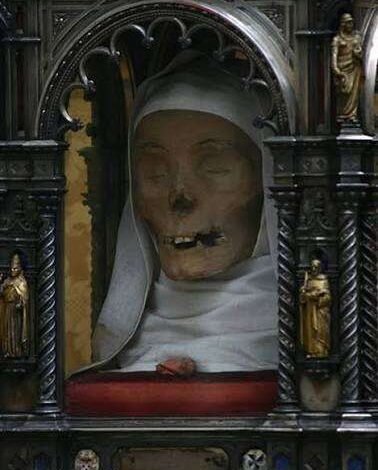
Medieval religion was relic worship. In Catholicism, “first-class” relics are the physical remains of saints or martyrs. Believers revered St. Peter’s bones, the skull of St. Thomas Aquinas, or St. Anthony of Padua’s tongue for their divine grace and healing power.
 The veneration of saintly bones was not a Christian invention. Many Egyptian holy places held body parts of its martyred God Osiris, but the Romans ruled against dividing corpses.
Early Christians kept this concern for corporeal integrity at burial in anticipation of the Last Judgment, although by the thirteenth century the practice of physical separation had become widespread.
The fall of Constantinople in 1204 set off relic mania in Europe. Having ransacked the city’s churches, an army of bone and skull carriers made its way to the West.
Madness and mania are never far apart. Churches claimed to have made extraordinary acquisitions such as Christ’s breath in a bottle; Mary’s mother milk; and even the tip of Lucifer’s tail. To the relic-hunter, remains of Christ incarnate would be irresistible, but the doctrine of Resurrection made that a theological impossibility – with one exception.
At least a dozen churches (often at the same time) claimed to own the “Holy Foreskin” removed at the circumcision of Jesus, attracting fee-paying pilgrims to experience the miraculous powers ascribed to it.
Relic gathering was wealth creation. It supplied religious houses with a steady income. At the same time, they promoted early tourism as significant reliquaries gave rise to a nascent hospitality industry.
The Catholic Church was an active collector of body parts. Long before the word “grave robber” came into circulation, clergy members acted as such if a body, or parts thereof, deserved reverence.
That ardor invited foul play. Deceit was part of the scramble. St. Augustine denounced impostors dressed as monks trying to sell spurious items. Unscrupulous crooks delivered bones on demand (St. John the Baptist must have had several heads).
Theft and trickery highlighted the dichotomy between the relics’s monetary value and its spiritual meaning.
Theatrical Relics
Relic displays during the seventeenth century became “dramatic” events, featuring colorful and carefully orchestrated processions to draw in the crowds. As the Church sponsored festivals to stage the sacred, the saint’s body became a spectacle. In the process, relics were reassessed as theatrical props. Value was no longer based on “divine” power, but on artistic importance.
An ongoing process of secularization accelerated the decline of devotion. In the modern era, the emphasis shifted from displaying the remains of saints to those of celebrities. Inspired by the Romantic Movement, travelers in the early 1800s chased non-religious relics.
Body parts of leading artists (Shelley’s heart or Beethoven’s ear bones) offered a visceral connection to creative genius. In the history of drama, “relics” functioned as reminders of noteworthy productions. Symbolically, they stood for theatrical lineage. Transcending the gap between past and present, they suggested the “immortality” of actors associated with them.
 Hamlet was the first early modern play to bring human remains on stage. Lifting Yorick’s skull (Act 5, Scene 1), Hamlet starts his monologue on the inevitability of death. A timeless dramatic image, no other aspect of stage presentation has made a similar impact.
It was a first too. Elizabethan impresario Philip Henslowe, manager of the Rose Theatre on London’s Bankside, kept a diary in which he listed many stage props used at the time. He did not mention a human skull.
While over time the skull tended to be a fake prop (made of wood, plaster, papier-mâché, or fibreglass), “real” relics were used as well, provoking protest and debate. Critics like Paul Hiffernan, editor of the literary magazine The Tuner, attacked the practice in 1755 as “repulsive.” Others saw the skull as a reflection on mortality, forcing audiences to confront the realities of death and dust.
The famous Hamlet scene coincided with an emerging Shakespeare “industry.” Collectors became obsessed with relics connected to his plays. Not singled out as significant during the staged moment, such items gained affective meaning once a performance run had ended. They drew value from their physical proximity to a celebrated actor or dramatic scene.
In 1899, actress Sarah Bernardt played the title role in a new French translation of Hamlet (by Eugène Morand and Marcel Schwab; Alphonse Mucha designed a now famous poster for its production) at her own theater in Paris. The play drew attention not only for a woman taking on such a major male role, but also for her presenting a real skull in the graveyard scene.
 Gifted to her by Victor Hugo after a much-admired appearance in his drama Hernani in 1877, the inscribed prop (held at London’s Victoria & Albert Museum) was a prized relic which she kept on her dressing table.
The actress was known for a fascination with memento mori, but the era itself was typified by a psycho-cultural mood of doom and morbidity. Art and literature embraced themes of death and decay; the macabre was fashionable. In less ghoulish times, real skulls on stage caused disagreement and ethical objections.
All Shakespeare directors and performers had to deal with the issue, from Richard Burbage to Thomas Betterton, from Sarah Bernardt to Laurence Olivier. Debate and controversy about Yorick’s skull reached Manhattan in 1810.
Stage Icon
New York’s rich history of Hamlet performances goes back to the 1760s. It includes the infamous 1849 Astor Place Riot as well as contemporary adaptations for stage and screen. A statue of Edwin Booth (the brother of Lincoln assassin John Wilkes Booth) as Hamlet stands in Gramercy Park, commemorating an actor who often performed the role on the New York stage. The play’s continuous reinterpretation reflects Manhattan’s changing cultural landscape over time.
Eighteenth-century print makers merged visual art with drama and opera. Iconic performers and dramatic events as well as London’s theatrical disputes, were recorded in engravings and caricatures.
The stage supplied ample material for artists such as William Hogarth, James Gillray, and others, who captured performances, costumes, and stage scenery. Their work highlighted the interaction between actors and audience. The era of “stardom” was imminent.
 Having made his professional debut in 1776, George Frederick Cooke (17556-1812) was a star actor on London’s stage, admired for roles such as Iago or Shylock. His portrayal in 1800 of Richard III at Covent Garden earned him the reputation of the nation’s outstanding tragedian. Cooke was Britain’s first stage celebrity, and images of the performer were in popular demand.
Cooke was his own worst enemy. A Richard Burton of his day, he was a notorious drinker. When on a bender, the actor would vanish for prolonged periods, and at times he stumbled upon stage too drunk to act.
In danger of torpedoing his career, he left for an American tour. Having departed Liverpool aboard SS Columbia on October 4, 1810, he arrived in New York on November 16th.
The actor’s reputation had stirred the anticipation of drama lovers in the metropolis, and his arrival was a major event. He made his debut as Richard III at Park Theater, Park Row, on November 21, 1810, for a packed house. Critics described his reception as triumphant but drink intervened.
By his third appearance he was intoxicated again, but the tour had to continue. Closely watched by producer and playwright William Dunlap, he performed to enthusiastic audiences in Boston, Philadelphia, Baltimore, and Providence.
Cooke never made it back to London. He was in the city of New York when the War of 1812 erupted. Stuck in the metropolis, he died of cirrhosis of the liver. His body was brought to St Paul’s Churchyard, Lower Manhattan, and placed in the strangers’ vault. This space was set apart for unidentified bodies and foreigners who had had been found dead in the locality.
 In 1821, when touring America, his Shakespearean protégée Edmund Kean erected a classical-style tomb monument for Cooke designed by William and John Frazee (Manhattan’s best gravestone carvers) after the actor’s body had been exhumed. But which part of the corpse was reburied?
Bones of Contention
Kean kept one of Cooke’s toes as a relic on the “altar” of his mantelpiece, until his wife threw the treasure out a window in disgust. He was not the only actor to cherish a bodily reminder of a great predecessor. Edwin Booth, a famous Hamlet himself, owned one of Cooke’s teeth.
The body being removed to a public grave, workers reported that Cooke’s cranium was missing. Years later, rumors spread that the skull had reappeared on the stage of Park Theater. Gossip turned out to be correct.
John Wakefield Francis was Cooke’s physician who performed the autopsy on his body (he also treated Edgar Allan Poe and Herman Melville). He took the opportunity to use the skull in a phrenology lecture and lent it for a single staging of Hamlet. Soon after, tales were told of a headless ghost haunting St Paul’s Chapel Churchyard and Lower Manhattan’s theater sites.
The skull eventually came in the possession of Jefferson Medical College (now part of Thomas Jefferson University), Philadelphia, for use in anatomy lectures. After being lost for a time, it was retraced amongst the college’s collections in 1938 and put on display in the Scott Memorial Library.
The skull was offered on loan to “responsible” institutions in search of a prop. In November 1980, Cooke’s skull was staged in a Mercer Community College production of Hamlet at West Windsor, New Jersey.
“Alas, poor Yorick!” has cast a spell over the history of the play ever since it was registered with London’s Stationers’ Company on July 26, 1602. Charles Dickens recorded the story of a man named John “Pop” Reed.
Employed as a gas-lighter for over four decades at the Walnut Street Theater, Philadelphia, he stated in his will (having died in July 1891) that his skull be bequeathed to this, America’s oldest playhouse, and represent Yorick on stage.
Nearly a century later, Polish-born concert pianist André Tchaikovsky attended a performance of Hamlet by the Royal Shakespeare Company (RSC) in Stratford-upon-Avon. On his deathbed in 1982 he requested donation of his skull to the RSC and its appearance in the graveyard scene.
His executor sent the remains to Terry Hands, the company’s artistic director. Actor Mark Rylance took the skull to rehearsals seven years later, but cast members were squeamish about its provenance, and a copy was used instead.
 It was not until David Tennant played Hamlet at Stratford-upon-Avon in 2008 that the skull was seen on stage in a live performance, provoking much (negative) attention and debate. Once the play moved to London’s West End, its producers decided to use a cast of the skull (featuring his gold teeth) rather than the actual remains. A relic no more.
The skull debate is part of a broader discussion on the public display of human remains in museums or anthropological institutions. Western society has an enduring fascination with the macabre and medical displays remain popular. Philadelphia’s Mütter Museum attracts a stream of visitors to see grisly curiosities such as pieces of Albert Einstein’s brain, the tumor removed from President Grover Cleveland’s jaw, or rows of Victorian skulls.
Those defending the inclusion of such exhibits stress their educational value, but critics and opponents have raised questions. What, if anything, can we learn from these exhibits? Are we indulging in morbid curiosity? Are museums justifying the criminal acts of grave robbers, body snatchers, and bone traffickers?
In October 2023, New York’s American Museum of Natural History decided to remove all bones and skeletons from public display, admitting that their acquisition history may have involved abuse, exploitation, or enslavement.
Aware of their role in the advancement of (now discredited) eugenicist theories, the museum’s curatorial staff considered further exhibition of bodies intellectually flawed and ethically unjust. It is unlikely too that we will ever see again a “real” Yorick skull on stage.
Read more about theatre in New York.
Illustrations, from above: Mary Magdalene’s alleged skull, displayed at the basilica of Saint-Maximin-la-Sainte-Baume, in Southern France; The mummified head of St. Catherine of Siena at the Basilica Cateriniana San Domenico in Siena, Italy; the title page of the Hamlet First Quarto, 1603; the real skull used by Sarah Bernardt in Hamlet, a gift from Victor Hugo (Victoria & Albert Museum, London); Thomas Sully’s “George Frederick Cooke as Richard III,” 1811 (Philadelphia Academy of the Fine Arts); Henry Farrer’s “The Cooke Monument at St Paul’s Churchyard,” 1876 (From Scenes of Old New York); and David Tennant using André Tchaikovsky’s skull in a performance of Hamlet by the Royal Shakespeare Company in 2008.
Source link