 Chauncey Olcott (1858-1932) celebrated his 71st birthday with a legion of friends at his home in Saratoga Springs, Inniscarra, on July 21st, 1931. Greetings arrived by mail, telephone and telegram. Less than a year later Chauncey passed away leaving his wife Rita with a house full of memories and mementos that told the story of his life.
Rita’s book Song in his Heart: The Story of Chauncey Olcott’s Life was published in 1939. In 1947 the biography was adopted as the film My Wild Irish Rose.
Chauncey grew up in the Buffalo area where his parents Margaret “Peggy” Doyle and Mellen Whitney “Jack” Olcott met along the banks of the Erie Canal.
As a child Chauncey learned the stories of the heart of Ireland from his Doyle grandparents who lived close by. Summers were spent with his Olcott grandparents in Ausable Chasm in the Adirondacks.
While in public school, Chauncey was known for singing “Father Look Up and See the Flag.” When Chauncey was 12 his father Jack passed away and Peggy was now the head of the family. Hoping to make a fortune, she went to Oil City, PA where she turned her meager sum into $50,000.
Returning to Buffalo she invested in real estate and tugboats. When asked about college or work plans after graduation, Chauncey replied: “I don’t want to work! I want to be a singer!”
 He sang his first Irish song on stage, “Where Did You Get That Hat,” in a local show and was stage-struck and more eager than ever to follow his dream.
Chauncey set out to find a way to sing on stage by joining a minstrel show in a nearby town where popular Irish-American minstrel performer Billie Emerson (1846 – 1902) came to hear Chauncey sing “Maggie Mae,” a traditional Liverpool folk song.
Emerson invited Chauncey to join his minstrel show in Chicago where he experienced everything from singing ballads to counting the house. Bill Foote signed Chauncey on with Haverly Minstrels for an 18-week theatre tour of England.
On opening night at Her Majesty’s Theater in London Chauncey received a double encore singing “Scotch Lassie Jean.”
[In the 1890s white impresario William Foote’s Afro-American Company show included a range of black popular performance, including minstrel song and dance, jubilee choirs, social dance and concert singing.]Despite this recent success, Chauncey was tiring of minstrelsy. One night while performing in a show at Niblo’s Garden in New York City Lillian Russell was in the audience with her husband Edward Solomon, a composer.
Impressed by the rich purity of Chauncey’s voice, they signed him on to the production of Pepita, or The Girl With the Glass Eyes, a comic opera. Although the operatic interlude ended abruptly for Chauncey, he would never again be satisfied with minstrel shows. He could do so much more with theatre.
 New opportunities came along. In 1890 Chauncey returned to England for voice lessons and on to Ireland to learn the Irish brogue for his role as Patrick Julius O’Flanagan in the play Miss Decima. Although happy in London, he soon returned to the American stage.
In 1893 William J. Scanlan (1856 – 1898), among the finest portrayers of Irish Characters at the time, was seriously ill, leaving Augustus Pitou, his manager, in need of a new actor and composer.
[William J. Scanlan was born in Springfield, Massachusetts. After finishing his 100th performance of Mavourneen in December of 1891 he became violently ill and was taken to Bloomingdale Insane Asylum in White Plains, NY, where he died six years later.]Chauncey accepted Augustus Pitou’s offer to replace Scanlan in Mavourneen. Chauncey was an immediate success in his first role as a star. Chauncey’s composing career began at Pitou’s urging as more songs were needed for The Irish Artist.
Playwright Rita O’Donovan (1879-1949) met Chauncey outside Delmonico’s in New York City after a show at the Fourteenth Street Theatre. They hit it off and met every day for horseback riding in Central Park.
When it was time for Chauncey’s show to move on to Boston, he invited Rita to join him there and they married in 1899. On a trip to Ireland a young boy was singing in Gaelic while rowing their boat.
Rita inquired about a clump of pale pink flowers. “Why mam, those are wild Irish roses!” This was Chauncey’s inspiration for “My Wild Irish Rose” in a new play A Romance of Athlone.
They first came to Saratoga Springs in 1901 to look at property to build their home. Saratoga Springs was the perfect place for the Olcotts to settle down and relax during the summer breaks from touring.
 Although a blizzard was raging the first time they saw the property out Clinton Street, with its outline of apple trees. Architect Charles Barton Keen (1868-1931) created a design that from its inception treated the house and garden just as the Olcott’s envisioned. The home was completed in 1902 and the Olcotts named it Inniscarra.
Saratoga Springs Town Hall Theatre (now The Anthony “Skip” Scirocco Music Hall in today’s City Hall) was located two miles from Inniscarra making it a convenient venue for Olcott’s plays, rehearsals and openings. In August 1906, the Saratoga Daily Hotel Reporter announced the opening of Eileen Asthore (Eileen My Treasure) – music, lyrics, and play by Chauncey Olcott.
“My Wild Irish Rose” reached its greatest popularity when sung between acts of Ragged Robin. The play opened in 1910 in the Town Hall Theatre. Chauncey said it was the biggest first night of his life.
On July 6, 1914 The Heart of Paddy Whack, a new comedy written by Rachel Crothers (1870-1958) featured a half-dozen new Olcott songs when it opened at Town Hall Theatre. Brunner’s Book Store, located in the Arcade Building on Broadway, sold tickets for .50, $1.00 and $1.50 for the best seats in the house.
Henry Miller was Chauncey’s new manager after Pitou retired. They opened their new partnership in 1913 in Town Hall Theatre with the production of Isle of Dreams featuring the song “When Irish Eyes are Smiling.”
 The play made more money in a single year than any other play of Chauncey’s career. It ran for forty weeks in a variety of locations and brought in some $150,000.
Saratoga was Chauncey’s first love. Each afternoon of the Spa racing season found Chauncy at the Saratoga Race Course and he and Rita frequently entertained at Inniscarra after the races. Chauncey enjoyed playing golf at the Saratoga Golf & Polo Club since its opening in 1896.
Rita chaired the St. Peter’s Parish Annual Summer Bazaar, and Chauncey would sing for the crowds. In 1923 Rita, as vice chair of the Skidmore College campaign, arranged a benefit ball at the Canfield Casino in Congress Park.
Chauncey’s last stage role was in Richard Brinsley Sheridan’s The Rivals in 1925. When the show had reached Ann Arbor, Michigan, he collapsed when the final curtain came down.
When released from the hospital, Rita continued to nurse him back to health to enjoy his retirement years. The remaining summers of his life at Inniscarra provided more time for his garden, golfing and the races. Entertaining family and friends were the highlight of their summers.
Every November they returned to their winter home in Monte Carlo, where the view of the sea under a great blue sky was their constant companion.
In the winter of 1932 Chauncey’s health declined. It was March 17th, St. Patrick’s Day, and everyone was sending him shamrocks. He took one, blessing himself with it and tried to put it in his buttonhole. But there was none in his dressing gown, so he put it in his pocket and decided to lie down.
“Good night, everybody” he said, “it’s late.” Chauncey passed away that night.
Olcott’s life story was told in the 1947 Warner Bros. film My Wild Irish Rose starring Dennis Morgan as Olcott, based on the biography by Rita Olcott.
Read more about New York Theatre.
The essay by former Saratoga Springs City Historian Mary Ann Fitzgerald is based on Rita Olcott’s book, Song in His Heart: The Story of Chauncey Olcott’s Life (1939). This essay is presented by the Saratoga County History Center.
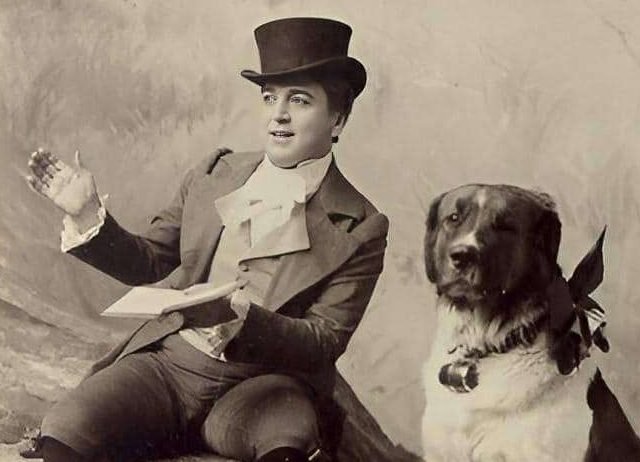
Illustrations, from above: Chauncey Olcott publicity photo; Olcott ‘The Irish Tenor’ cabinet card by Garnett Launey; Olcott in ca. 1896 (photo by W.M. Morrison); postcard view of Chauncey and Rita Olcott’s home in Saratoga; and Olcott during his time in Saratoga, ca. 1918.
Source link