 Every city has its own character shaped by a dynamic interaction of physical, socio-cultural, and historical features. As a “living, breathing thing,” the process of urban identity formation is in flux, not static, and never final.
Over time, creative milieus have clustered in poor city areas. Affordable housing attracted immigrants, artists, and students. Densely populated sites were crowded with workshops, cafés, bars, and brothels. Maze-like streets were impossible to police, offering cover to radicals and activists.
Interactions between settlers were intense, forging community bonds. Variant ethnolinguistic, cultural, and gastronomical characteristics made certain metropolitan districts differ from others.
One such areas was Manhattan’s “French Quarter” where from 1871 to the 1890s an enclave of immigrants and exiles had settled, creating a neighborhood known to some as “Little Paris.”
Spirit of Barricades
Following a police raid on The Stonewall Inn on June 28, 1969, riots broke out on Christopher Street, Greenwich Village, in which barricades played a key role, mirroring and reversing the Parisian uprisings of the nineteenth century.
In an ironic inverted defensive action, police officers had barricaded themselves inside the establishment in fear of the crowd’s fury for years of harassment (inspiring expansion of the LGBTQ+ movement). The protesters themselves set up barricades trying to stop support forces from closing in.
The word barricade originates from the French “barrique” (barrel). On May 12, 1588, residents of Paris challenged King Henry III’s authority, compelling him to flee the city.
The momentous event became known as the “Day of the Barricades.” The uprising set a precedent. Barricades became the strategic ploy of nineteenth-century riots, transforming narrow streets into rebel strongholds.
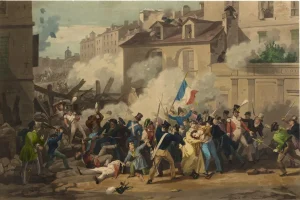
 Made of barrels and cobblestones, barricades invited street-by-street combat. They entered the nation’s collective memory after the July 1830 Revolution when residents and students forced the abdication of Charles X, the last Bourbon monarch.
The occasion inspired Eugène Delacroix’s iconic painting “La Liberté guidant le peuple” (Liberty Leading the People, also known as “Liberty on the Barricades”).
That victory solidified the barricade as a weapon of urban confrontation, used in 1848 and again in 1870, and a symbol standing for a clash of social forces – the poor masses versus an oppressive regime.
At the same time, the barricade was a sight of suffering as evoked by Victor Hugo in Les Misérables, describing the failed June Revolution of 1832 against the rule of Louis Philippe.
After the defeat of the 1848 rebellion in which over 1,500 barricades spanned the city, a military dictatorship took control before Louis-Napoleon Bonaparte became President of France. Prevented by the Constitution from re-election in 1852 he seized power, proclaimed himself Emperor, and assumed the name of Napoleon III.
 His scheme to modernize Paris was implemented by Georges Haussmann, an engineer from Alsace who flattened the city’s medieval quarters and designed wide boulevards to ease troop movement at times of social unrest.
Despite this transformation, barricades reappeared in 1871. The brutal repression of the uprising was the theme of Victor Hugo’s poem “Sur une barricade,” published in his 1872 collection L’Année Terrible (The Terrible Year).
Following the July Revolution of 1830, the barricade had evolved from a defensive barrier into an icon of collective defiance. It was a “Theater of Revolution,” the stage for making political demands and pressing popular concerns, and the ultimate “weapon of the weak.”
French exiles exported their utopian dreams to London and Manhattan.
Fitzrovia
During the nineteenth century, two waves of French emigration were separated by a single generation. The first surge occurred in the aftermath of the failed 1848 Revolution. The second group fled in the early 1870s.
 The Paris Commune (“Republic of Workers”) was established on March 18, 1871, when anarchists, socialists, artisans, women, and students took over the running of the city.
The Commune lasted for seventy-two days before being crushed by the Versailles government in an orgy of violence now known as La sémaine sanglante (The bloody week).
Communards were shot or deported to the South Pacific French territory of New Caledonia. Those who escaped retribution went into exile. Many of them fled to London and remained there until an amnesty in 1895 allowed some to return to France.
Central London’s Fitzrovia was a destination of choice for exiles. The district offered cheap housing and had a tradition of sheltering freethinkers. Its French residents remained politically active.
In 1885 some of them formed the “Club Autonomie.” Located at Charlotte Street (later at Windmill Street), it was subjected to regular police raids; the press reported on perceived anarchist conspiracies.
Undercover officers patrolled the streets and closely watched the clients of Amand Lapie’s French bookshop in Goodge Street. Books were as dangerous as bombs. The legendary Louise Michel lived at 59 Charlotte Street. She set up a school for children of exiled families at Fitzroy Square.
Fitzrovia became known as London’s “Old Latin Quarter” for its bohemian (a French word) and intellectual character, but also for its food shops, cafés, saloons, and the “smell of coffee.” Refugee author Charles Malato described the enclave as a small “anarchist Republic.”
At the same time, the Commune articulated conflicting visions of a centralized socialist regime versus the anarchist concept of popular control. In the end, this antagonism caused the fragmentation of (French and international) left-wing movements.
Greenwich Village
French emigration to the United States also peaked around the moments of political upheaval. The numbers may have been comparatively small, but the impact was considerable. Having arrived in New York City, most exiles opted to settle in Greenwich Village.
Distinguished from the rest of the metropolis for its narrow streets and irregular patterns, it gave the Village a feel of “independence.” When Thomas Paine, on his return from Europe in 1802, settled at 309 Bleecker Street (formerly Herring Street), he helped set a trend of creative talent moving into the area.
The “communards” created a community just south of Washington Square. It became Manhattan’s French Quarter, revolutionizing the streetscape. Some 20,000 to 24,000 immigrants brought cafés, bakeries, butchers, and an absinthe culture to buzzing streets where workers, artists, writers, and activists had gathered.
 There was prostitution too. During the 1870s and 1880s, sisters Marie and Mathilde Hermann owned half a dozen French brothels in an infamous block, including one disguised as a cigar store.
In 1879, eight years after the Commune’s collapse, Scribner’s Monthly published an article that featured an exploration of the French Quarter. With the eyes and ears of a nativist, the author described an “alien” world. The environment was American, but its residents were French, and French was the language of the signs over shop doors.
The community was poor but political, a multitude of “swarthy faces” that had “gladdened in mad grimace over the flames of the Hôtel de Ville” (a reference to the burning of Paris City Hall during the riots). Amongst the French Quarter’s “queer patrons,” the Commune had its “emissaries” who met in dark drinking dens where they plotted their schemes.
Exiled communards created a hectic atmosphere of Parisian-styled radicalism. It laid the foundation for the lasting “red” reputation of Greenwich Village. Adding a rebellious edge to the immigrant community, activists were under police and press inspection for harboring revolutionary ideologies.
Founded in 1871, the Société des Réfugiés de la Commune was a mutual aid organization. Its mission was to support communards hit by poverty, as well as keeping the revolutionary spirit alive in the French Quarter.
Booksellers moved into the area. Henry de Mareil had been active since the 1860s as an importer of books from Europe. He also published Le Messager Franco-Américain, a newspaper serving New York’s French-speaking community during this period of increasing immigration.
 Exiles brought basement eateries to the Village such as Au Chat Noir in West 28th Street and Taverne Alsacienne on Greene Street. Offering a reasonably prized menu that included crouton soup, French fries, gruyère cheese, tripe, and wines, these locations served as socio-political meeting spots to the locals.
The most notable site was Restaurant du Grand Vatel on Bleecker Street (named after François Vatel, 1631-1671, a famous seventeenth-century chef who committed suicide because a fish delivery for Louis XIV had been late).
French exiles mingled here with emerging Manhattan artists and authors. The eighth anniversary of the Commune’s founding was remembered at the Grand Vatel.
French Flats
By the 1890s, many residents of the French Quarter had dispersed and moved to West Chelsea, settling around 26th Street and Sixth Avenue. By then the French presence and influence had widened from politico-philosophical discourse to the physical environment. New York City became obsessed with French fashions and aesthetics.
Napoleon LeBrun (1821-1901) shaped the “French face” of Manhattan by adapting classical styles to modern demands, defining the city’s skyline with early skyscrapers, firehouses (he designed over forty buildings for New York’s Fire Department), and commercial structures. His Catholic parents had fled
France because of political and religious instability.
Vermont-born Richard Morris Hunt (1827-1895) studied architecture in Geneva, before being admitted to the École des Beaux-Arts in Paris, the first American architect to enter this prestigious institution.
Back in the United States by 1856, he became one of New York City’s most prominent architects with designs for the Metropolitan Museum, the Roosevelt Building, and many mansions (including Vanderbilt’s estate on Fifth Avenue) based on French neo-classical and Renaissance models. Almost single-handedly, he replaced English High Victorian public building with his interpretation of French classicism.
What affected the metropolis even more was the introduction of the “French Flat.” The term referred to early apartment buildings inspired by the Parisian model of shared city living in “stacked” homes. It served to entice residents who wanted a home with modern amenities but could not afford a property in Manhattan.
 Built in 1870, the Stuyvesant Flats on East 18th Street was considered the city’s first apartment building (demolished in 1958). The Jeanne d’Arc block at 200 West 14th Street was constructed in 1889, the centenary of the French Revolution. It has a statue of Jeanne d’Arc above the entry.
The Village was all French (from 1942 to his death in 1968, Dadaist artist Marcel Duchamp (1887-1968) lived just down the road at number 210). Changed housing conditions promoted a communal lifestyle.
The Gilded Age was an era of French-inspired cultural snobbery. New wealth legitimized its status by living in mansions that mirrored the grandeur of the Loire Valley or Versailles. American dealers flocked to France to buy up antiques, tapestries, paintings, and fine art from impoverished aristocrats.
Marriages between titled Frenchmen (old bloodlines) and American heiresses (new money) multiplied. Employing a “haute cuisine” chef and French-speaking governesses was a status symbol; wearing the latest Parisian couture a pre-condition of entering Fifth Avenue ballrooms.
This is the paradox. New York City’s social elite copied the opulent lifestyles of a rigid social order that had been overthrown during the French Revolution. That rebellious spirit was rekindled on the Parisian barricades by communards calling for a social revolution and relived during their years of exile in Manhattan’s French Quarter.
Black Berets
On January 23, 1917, six artists (including Marcel Duchamp) and intellectuals broke into the Washington Square Arch, climbed to the top, and declared the Village a “Free and Independent Republic.” The spirit of barricades had not died.
Artists, writers, and intellectuals flooded into Greenwich Village after the Stock Market Crash and turned the area into a political hotspot. From 1929 to 1940, it experienced the so-called “Red Decade,” when radical ideas took hold. The Village was alive with socio-political manifestations, folk music, and experimental poetry or drama, expanding the cultural landscape.
 In the post-war era, Village intellectuals and writers were inspired by the artistic milieu of French existentialist thinkers. Poets, beatniks, and progressives adopted the black beret as a signature look of political resistance, creative freedom, and counter-cultural identity. It became an icon of defiance. As such, the beret was an extension of the barricade.
In 1979, chef Hugo Uys opened a bistro named Paris Commune on Bleecker Street. He later moved the restaurant to 99 Bank Street in the West Village. Thriving in the 1980s and 90s (eventually closing in the early 2000s), its communal atmosphere carried on the legacy of both 1871 Paris and that of the exiles living in the French Quarter.
The memory of the distinct ethnic enclave may have faded, but the Village keeps its French heritage through bistros and cafés, and through its continued reputation as a vanguard hub of creativity. The Village is still at the heart of New York’s cultural identity.
Read more about the history of Greenwich Village.
Illustrations, from above: “Defense of a Barricade, 29th July 1830“ by an unknown artists of the French School a barricade during the July Revolution in Paris (Musée Carnavalet); what is believed to be the first photo of a barricade, a daguerreotype by Charles-François Thibault, on the current rue du Faubourg-du-Temple in Paris, on the morning of Sunday, June 25, 1848; André Devambez, “La Barricade ou l’Attente” (The Barricade or The Waiting), 1911, depicting the an 1871 Paris Commune barricade (Versailles Palace); “The French Quarter of New York” in Greenwich Village, Manhattan, described in Scribner’s Monthly, November, 1879; “French Bakery in Greene Street,” Greenwich Village (Scribner’s Monthly, November 1879); Statue of Jeanne d’Arc (Joan of Arc) above the entrance to the apartments of 200 West 14th Street, Manhattan; and Columbia University students climb a barricade during protest, May 21, 1968, over the University’s links with the Department of Defense and plans to build a gymnasium in Morningside Park (NYPD Photo Collection, NYC Municipal Archives).
Source link