 My first sighting of a cecropia moth was from a boat. It was a sunny morning and I was paddling along the lakeshore, expecting to see familiar birds. Instead, my eye was drawn to a large brown spot covering an alder leaf.
My first thought was that it was a discoloration, perhaps from a fungus. Paddling closer, I saw it was a moth – a very, very big one.
The cecropia (Hyalophora cecropia) is North America’s largest moth, similar in size to a giant swallowtail butterfly. It’s one of several species of giant silk moths in the Northeast; this family includes the ethereal-looking luna moth, which has long, pale-green wings.
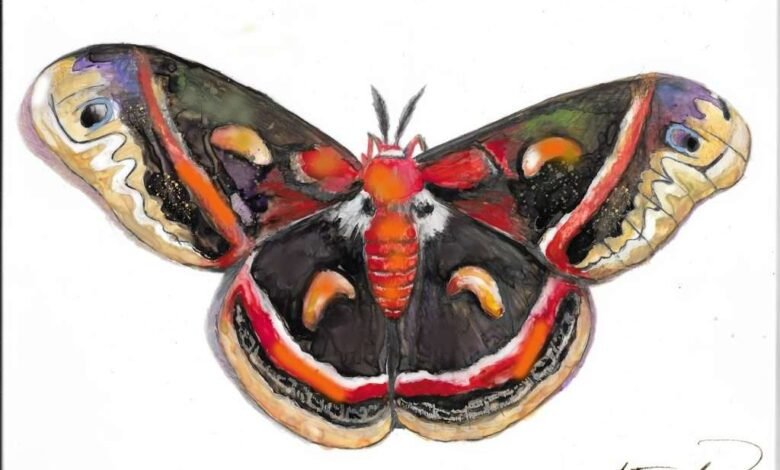
The cecropia moth has a furry red head and body with big, feathery antennae. The male has especially large antennae.
Its brown-gray wings, spanning up to seven inches, are edged with color and have red, purple, gray, and tan markings. Each of the four wings bears a pale, crescent-shaped, red-rimmed false eyespot.
Besides the fact that the cecropia moth is well-camouflaged and typically works the night shift, there is another reason it’s not commonly seen: it spends a mere one or two weeks as an adult.
In late May or early June, a cecropia moth emerges from a large, brown cocoon. From here on, it’s a moth with a mission: to mate and reproduce. It doesn’t eat, and in fact, has no functional mouthparts or digestive system. It survives solely on fat stored over the winter.
June is peak flying season for cecropia moths. New Hampshire Audubon Biologist Lindsay Herlihy recommends looking for them near a porch light or on a window or door screen.
Hanging up a pale sheet at the edge of the woods and shining a light onto it (with a cool-toned white light or UV bulb) can also increase your chances of spotting one.
“The sheet reflects the light back out so it looks bigger and brighter,” Herlihy said. “This also gives you a good chance of seeing a luna, since their flight period overlaps.”
Having the sheet up for an hour or two has minimal impact on wildlife, Herlihy shared, but leaving it out for longer periods could disrupt birds and insects.
Female cecropias secretes pheromones that can attract males from more than a mile away. If mating is successful and the females don’t get eaten by a nightjar or a bat, they can each lay up to 100 eggs on the leaves or stems of the host plant, which is often a deciduous tree such as a maple, cherry, or birch.
In 10 to 14 days, the eggs hatch into tiny black caterpillars, which eat their egg cases and then start feasting on the leaves of their host trees.
Cecropia larvae have five stages of development, outgrowing their skin four times. Many of these soft, protein-packed caterpillars become snacks, but the survivors turn into fantastical bright green creatures that are four or five inches long and as thick as your thumb.
Their backs are dotted with predator-deterring red, yellow, and blue bumps topped with stiff black spikes. At the end of the summer, a well-fed cecropia caterpillar spins a spindle-shaped or bag-shaped silk casing around itself.
Although large, the cocoon is easily overlooked as it blends in with twigs, leaves, and grasses. This is where the cecropia spends the longest stage of its one-year life cycle, transforming into a moth.
Sam Jaffe, director of the Caterpillar Lab in Dublin, New Hampshire, has seen many thousands of cecropia moths and caterpillars, but they take his breath away every time.
“Visitors often are shocked to learn that a cecropia moth is a native creature that could be living out their lives close to them,” he said.
“The shock of seeing such a large and colorful species right here at home makes people reconsider what can be just outside their doors and want to find out more.
“Many people who have become deeply engaged with the natural world tell stories of that first cecropia moth they found under their porch light or along the edge of their yards.”
Herlihy calls the cecropia moth her “spark bug” for this reason.
Unfortunately, these sightings are becoming rare. “They’re getting less and less common, particularly up north,” entomologist and author Doug Tallamy said.
“Outdoor lights are hard on them, and so are parasitoids such as the tachinid fly. Switching to yellow lights outdoors can help save these beautiful creatures.”
Laurie D. Morrissey is a writer who lives in Hopkinton, New Hampshire. Illustration by Adelaide Murphy Tyrol. The Outside Story is assigned and edited by Northern Woodlands magazine and sponsored by the Wellborn Ecology Fund of New Hampshire Charitable Foundation: nhcf.org.
Read more about New York’s moths.
Source link