This artist who was just awarded one of the most prestigious awards for artists in the country was, along with the other five recipients, on the screens in one of the most surveilled, most commercially driven spaces in the world. She stood there and looked up at herself and facetimed her mom. That moment is beautiful and necessary in its humanity as well.
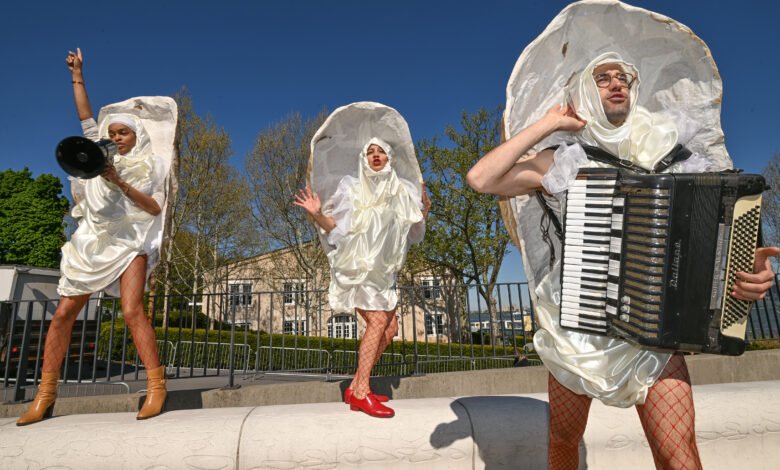
Times Square is emblematic of commerce and commercial viability, of who and what our culture decides has value. For one day, artists got to occupy that space in recognition of their impact and their contributions. Not because they had sold the most units or generated the most revenue, but because, like the oyster, their labor sustains something essential in us that no market can fully account for.
May Day was the beginning.
From May Day to Labor Day, Creative Labor, Creative Conditions moves across the country—Hawai’i, the Bay Area, Boston, Newport, New Orleans, Minneapolis. City by city, artist by artist, asking one consistent question everywhere we go: What does it take for creative people to truly thrive? Not survive, thrive. Materially, creatively, sustainably, joyfully.
I have spent my life in rooms where artists are asked to do what is both necessary and impossible. They are asked to hold complexity without flinching while translating grief into meaning. Their job is to imagine a future when the present feels unbearable. Repeatedly, I have watched artists step into moments of rupture—social, political, cultural—and offer language, form, and vision when other systems have failed. What I have seen just as consistently is how rarely the conditions surrounding that labor are designed to sustain the people doing it. We celebrate the work while neglecting the worker. We depend on artists to help us make sense of the world while offering them instability, precarity, and silence in return. We celebrate the “starving artist” while benefitting from their labor.
Creative Labor, Creative Conditions names this contradiction and insists that we address it directly.
Throughout my leadership at Oregon Shakespeare Festival, my vision was to recenter the purpose of the institution itself. To reimagine the theatre not as a site that primarily serves patrons and donors, but as an intentional platform designed to serve artists and support them in doing their work. I believed, and still believe, that when artists are centered, when they are given the conditions, trust, and autonomy to fully inhabit their craft, the world benefits. The regional theatre model has long behaved as if the space of the theatre exists for the audience and institution rather than as a shared civic commons rooted in artistic labor. Shifting that orientation proved difficult because it challenged deeply held assumptions about who the theatre is for and whose needs come first. Yet the audience’s deepest benefit comes from encountering work shaped by artists who are not extracted from but fully supported. When artists are centered, culture moves and the world is reminded of how expansive our empathy is, how connected our humanity is, and how simple it all is. Not simple as in easy. Simple as in elemental. I am not saying the world should only be joyful. That is not the goal. The goal is that the world be willing to see both joy and pain as a necessary part of how we evolve, how we create the conditions for greater acceptance and deeper understanding. That we are reminded that at the center of every moment of our humanity is love and joy.