 The New York Provincial Congress on May 26, 1775, appointed a “standing committee of correspondence” and the next day ordered all the counties in the Province of New York to name committees for the counties, towns and districts and to have the “general association” signed, in order to execute the orders of the Second Continental Congress.
Every citizen was to be invited to sign the “association” and by July 1775, all the non-signers (loyalist, or otherwise) were to be reported to the Provincial Congress.
In Schenectady the committee repeatedly asked the people to sign the association. Those who did so in Albany County, and probably elsewhere, were given certificates. The non-associators were boycotted. For example the Schenectady committee ordered an employer of carpenters to dismiss those who were non-associators and engage only associators.
 Cumberland County (part of the New Hampshire Grants, now in Vermont) had a committee by June 21, 1775. The Albany committee in June 1775, was cooperating with the Provincial Congress in improving the military situation on Lake Champlain.
In August the county committees were ordered to purchase or hire all arms fit for service and turn them over to the recruiting colonels. Two committeemen or more in each district were asked to help organize militia companies.
General Nicholas Herkimer, as chairman of the Tyron County committee, asked the Provincial Congress on August 12th what to do with the Loyalists. In September the local committees were authorized to punish by a fine or imprisonment all persons who aided the enemy.
Those who opposed the authority of the Continental Congress and the New York Provincial Congress were to be disarmed at first and if the offense was repeated put in jail.
By 1776 every county in New York, except possibly Kings (Brooklyn), had its committee and subcommittees in the towns, manors and districts. These county committees varied in size, in method of election, organization and procedure. The committees of the political subdivisions also differed in size, character and activities.
New York County alone seems to have had no subcommittees. At the meeting of the Ulster County committee in May 1775 it was recommended that a day be set aside in the colony for fasting and prayer.
T hese county committees performed a multitude of functions. They paid the bills for the poor; offered bounties to the soldiers; recruited troops; bought supplies such as rum, bacon, pork, salt, flour and powder; paid the troops; repaired guns; secured wagons and sleds for transportation; guarded stores; advanced cash to finance the war; regulated the price of tea; and even sent a stove from Albany to the Provincial Convention at Fishkill, in Dutchess County.
They also conducted the elections of the delegates to the Provincial Conventions and Congresses.
The blockade of the port of Boston (a result of the Boston Port Act) aroused the indignation of the New York patriots. The committees generously offered aid. The committee of Schenectady raised £75 for the “relief of the poor of Boston” on December 12, 1775, and the fund was increased later to over £128.
Finding that it would cost £6 and 16s to have the money taken to Boston, the economical committee waited until June 23, 1777, when it was forwarded in flour with instructions to bring back a gift of salt for it.
The minutes of the Albany Common Council end on March 25, 1776, and there is no record of any meetings for two years. Presumably the revolutionary committee ruled the city until April 17, 1778, when the Common Council was elected and after taking an oath of allegiance to the new state, reconvened.
Committee Hierarchies and Special Committees
Theoretically under the committee system the Continental Congress stood at the head. Then came the Provincial Congress with its statewide committees. Next in the scale appeared the county committees. At the bottom were the numerous local boards.
The lower bodies looked to the higher ones for instruction, advice and guidance. Indeed one finds all sorts of problems sent from the local committees to the county boards, and in turn from the county boards to the state bodies.
Before August 3, 1775, local committees, especially those of the counties, followed their own initiative and judgment, but with the enactment of laws by the Provincial Congress, the committees had a common guide.
Special committees were named also for specific purposes. For instance on November 22, 1774, the city of New York elected 60 men as a “committee of observation” to succeed the Committee of 51 chosen to enforce the ongoing boycott of British goods.
It suggested the election of delegates to the Second Continental Congress and advised the counties to send deputies to the Provincial Convention on April 20, 1775, to choose the delegates. It also urged the counties to select representatives to a Provincial Congress to meet on May 22, 1775.
The committee system became the popular method of having everything done in carrying on the war. If a fort was to be built, a committee was assigned the task. If the Indigenous nations were to be appeased and induced to make treaties, a committee on Indian Affairs was appointed.
Special committees dealt with the Loyalists, punished them, and sold their confiscated estates. Early in 1776 local and county committees forbade strangers coming into their regions without having a card showing that they were patriots.
After Lexington & Concord
The arrival of an express rider Israel Bissell in New York City about noon on Sunday, April 23, 1775, with news of the skirmish at Lexington four days before, opened the eyes of the patriots to the fact that civil war was upon them.
Marinus Willett said that this information “produced a general insurrection of the populace,” and Cadwallader Colden, then acting Governor, wrote that a “state of anarchy and confusion,” and of “disorder and rage” prevailed.
T he arsenal was broken open and about 600 muskets with ammunition were seized and distributed among “the most active of the citizens” who formed a “voluntary corps and assumed the government of the city.”
They took possession of the customs house and the public stores. They paraded about the streets. All business ceased. The posts were stopped and the letters read.
Two sloops laden with provisions for Boston were unloaded. The Loyalists were threatened with the gallows. “The whole city became one continued scene of riot, tumult and confusion,” Loyalist judge Thomas Jones wrote.
This was certainly rebellion, if not revolution, and significantly expressed New York’s answer to Lexington and Concord.
The next day Colden summoned the City Council for advice. He was told that the militia were all “Liberty Boys” and would not aid the government.
The mayor, Whitehead Hicks, said that his “authority was gone.” The Council refused to act. Assurance was given, however, that all was quiet in Dutchess and Queens counties.
On April 26th the Committee of 60 in the metropolis alarmed by the sudden turn of affairs and perhaps wishing to shift responsibility to a new and larger body, unanimously proposed that a new Committee of 100 should be elected by the freeholders and freemen and that at the same time 20 deputies should be chosen to a Provincial Congress to meet on May 22, 1775.
The next day a broadside proposed 100 names for the committee, and the Committee of 60 asked the counties to elect their delegates to the Provincial Congress.
On April 29th there was a rush to sign the “association” in which the subscribers vowed to obey all orders of the Continental and Provincial Congresses “for the purpose of preserving our Constitution” and to resist the execution of “the arbitrary and oppressive acts of the British Parliament” until peace should be made on “constitutional principals.”
The people hauled the cannon from the city to Kingsbridge to guard the Harlem River approach. The bridge there connected Manhattan Island to more-loyal Westchester County.
On May 1, 1775, the Committee of 100 was chosen to act “in the present alarming emergency” and twenty-one delegates were elected to the Provincial Congress. On this new committee 55 members of the Committee of 60 sat and seven of the 45 new members had been on the Committee of 51 while the remaining 38 apparently had had no committee experience.
Both Whigs and Loyalists were well represented, the former predominating, however. It was this body that called the people to arms, that ordered the militia to patrol the streets, that prevented provisions from being taken out of the city, that assumed the general direction of the province in the absence of the Provincial Congress, and sent a letter to the lord mayor and magistrates of London.
Colden complained that this committee “assumed the whole power of government.” It took over the supervision of the mails and the control of the customs house.
It protested against the continuance of the duty on tea, the “oppressive restraints” on colonial commerce, the blockade of Boston, “arbitrary government,” the unconstitutional admiralty courts, the denial of trial by jury, and the “hostile operations” of the British troops in America.
But it hoped that “further effusion of human blood” would be prevented and that the “union, mutual confidence and peace of the whole empire” would be restored.
A letter from New York on May 4th said: “It is my opinion, from the present spirit of the people, that there is a determined resolution to die with arms in their hands, or establish the liberties of the country on a permanent footing.”
Benjamin Franklin was highly pleased to find New Yorkers “arming and preparing for the worst events.” The most pronounced Loyalists like Dr. Myles Cooper, president of King’s College (now Columbia University), were forced to flee.
Colden was warned to prevent the landing of British soldiers in New York. On May 27th he advised Major Isaac Hamilton to “get five companies on board the Asia as soon as possible” but to keep their departure a secret.
The Provincial Congress asked the people to let the troops depart peaceably. The King’s birthday was celebrated on June 4, 1775, on the warship Asia but the city remained significantly silent.
On June 6, 1775, to avoid a clash with the excited people, the British troops were embarked on the Asia for Boston. When Marinus Willett and his friends learned that the departing troops “were taking with them sundry carts loaded with chests filled with arms,” they decided to capture “these spare arms.”
Willett stopped the carts and told the commanding officer that the Committee of 100 had not given its consent to remove any arms except those the soldiers carried. The crowd of citizens turned the carts out of the procession.
The soldiers were harangued to desert and challenged to fight. A few deserted but the rest “embarked under the hisses of the citizens.”
Colden’s report gives a slightly different version, charges the “violent outrage” to “a few desperate fellows,” and says that the deputies of the Provincial Congress and the committeemen disapproved of the act because it tended to discredit their authority.
Other guns and ammunition were sent aboard a “sloop of war” to circumvent their seizure by the patriots.
These incidents show that New York was not lagging behind the other colonies in taking measures that precipitated the Revolution. Colden protested to Mayor Hicks, who sent the letter to the Provincial Congress.
That body on June 10th resolved that every person who had a gun or any equipment taken from the British troops should immediately deliver it to the mayor. Somewhat earlier than this occurred the seizure of a quantity of royal military stores at Turtle Bay.
On the 25th the people gave General George Washington a noisy and joyous welcome, while Governor William Tryon (1729-1788) who reached New York the same day received little notice.
(Tryon was both the governor of the Province of New York and also of North Carolina. As with many colonial governors, the Lieutenant Governor – in this case Cadwallader Colden – ruled in place of the absent Governor.)
On December 15th, the Committee of 100 adopted rules for the night watch of the city and ordered the officers to obey the Provincial Congress.
On February 2, 1776, the Provincial Committee of Safety recommended that the Committee of 100 be reduced to a Committee of 50 to enable it to act more expeditiously. The new body was chosen on February 8th for six months and 21 members constituted a quorum.
The Continental Congress on June 14, 1776, particularly urged New York “to make effectual provision for detecting, restraining and punishing disaffected and dangerous persons in that colony.”
The next day a “Committee to Detect Conspiracies” was appointed by the Provincial Congress. Rumors of Tory plots were rife, some of them involving the lives of Israel Putnam, Washington and others.
On June 22nd warrants were issued against the Tories in the city of New York, and arrests followed, among them that of Mayor David Mathews (c. 1739 – 1800), the last colonial mayor of the city of New York.
Meanwhile the city was filling with Continental troops in anticipation of an attack. The British warships in the harbor kept the people in an agitated state of mind. The inhabitants were continually moving away. The public records were taken to a place of safety.
Many houses, empty because of the flight of the people from the city, were used for barracks, and business was greatly disorganized. The city was put in a state of defense.
The city committee was ordered by the Provincial Committee of Safety on April 4, 1776, to prepare barracks and stables for 12,000 soldiers. Among the buildings seized for troops was King’s College.
With the creation of a regular constitutional government after 1777, the responsibilities of the committees decreased. Indeed the Legislature of the State was disposed to take the ground that the new government provided for by the New York Constitution of 1777 superseded the temporary committee system.
The newly created Council of Revision on February 20, 1777, asserted that the State Constitution recognized no committees, and that hence they had ceased. But so valuable had they proved to be as agencies of government that they were continued throughout most of the war. The Schenectady committee was operating in 1779.
The committees’ importance as a piece of revolutionary machinery can not be overestimated. They created public opinion and served as a channel through which it might flow; they carried on the propaganda that produced the war; they were the germ of republican government.
Five kinds of committees came into existence: (1) those for a special emergency; (2) local committees; (3) committees of correspondence; (4) state committees to carry on the work of government or some phase of it; and (5) the committees of the Legislature which were assigned some particular task and acted under law with a greater degree of caution.
The Continental Congress appreciated the usefulness of the committee system and sought to employ it to enforce the “association” and to accomplish other important matters.
Since this system was in successful operation in the various colonies, it was felt that these agencies could best carry out the recommendations of the continental body. Congress also had its own special boards such as the Committee of Correspondence.
All the early committees reiterated and stressed their loyalty to the established imperial government. Later their loyalty was limited to the king alone. Finally it was restricted to their own revolutionary program.
In fact from the outset the committee was an agent of revolution. As a rule a new group of men appeared in these committees — more democratic men who had not served on the provincial Council or in the Assembly but came directly from the people.
Special pains were taken to change the committees frequently by new elections. In this way the committees represented the growth in public opinion, reflected the people’s will more directly, and accustomed a large number of persons to political responsibility.
These committees were one of the most powerful democratizing agencies of the American Revolution.
Read more about New York’s Revolutionary War Committee System.
This essay is drawn, with minor editing and additions for clarity, from “The American Revolution in New York; its political, social and economic significance. For general use as part of the program of the Executive committee on the one hundred and fiftieth anniversary of the American revolution,” published by the University of the State of New York’s Division of Archives and History in 1926.
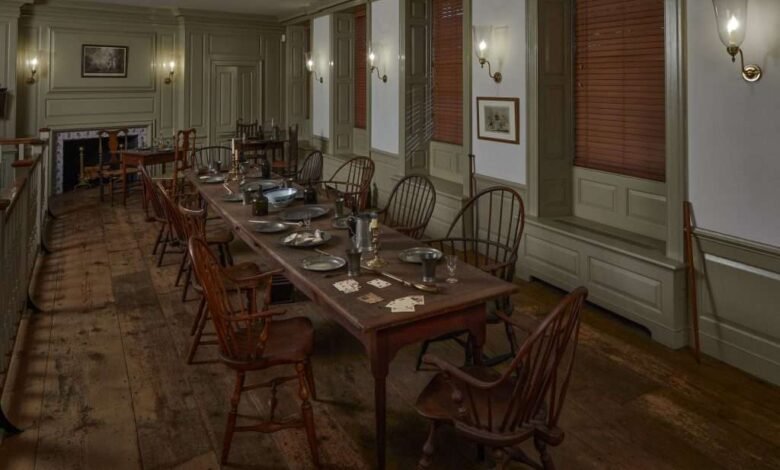
Illustrations, from above: The Long Room at Fraunces tavern, a secondary meeting place for the Provincial Congress in 1775 (2022 photo by John Bigelow Taylor); The Districts of Albany County, New York, 1772; Map of the Province of New York, 1664-1777; and illustration of Marinus Willett seizing British arms in New York City in 1775.
Source link