 Daniel Talbot did not simply show movies. He helped teach America how to watch them.
My father was born in the Bronx in 1926 to Polish Jewish immigrants. He came of age during the Depression and World War II, part of a generation that understood culture not as decoration, but as a way of thinking about the world.
He was tough, funny, exacting, deeply humanistic, and unmistakably New York.
Before he became a theater owner and film distributor, Talbot came to film through literature, publishing, and criticism. Educated at New York University, he developed a passion for cinema that grew out of a broader love of books, art, politics, and ideas.
At a time when film studies was only beginning to emerge in American colleges and universities, his 1959 volume Film: An Anthology helped introduce students and serious moviegoers to film as an art form worthy of close attention.
That background matters. Talbot was never simply “in the movie business.” He was building an audience. He believed that films from Europe, Japan, Latin America, Africa, the Middle East, and elsewhere could open new worlds to American viewers. His work rested on a simple but powerful conviction: difficult, beautiful, politically challenging, morally serious films deserved to be seen.
For more than six decades, Talbot operated or helped shape some of Manhattan’s most important art-house theaters, including the New Yorker Theater, the Cinema Studio, the Metro, and Lincoln Plaza Cinemas, creating the Upper West Side as one of the great centers of American film culture.
The theater was his workshop. The audience was his classroom.
In 1960, Daniel Talbot opened the New Yorker Theater. Five years later, he founded New Yorker Films, the distribution company that would become one of the most important channels through which foreign, independent, and politically adventurous cinema reached American audiences.
The New Yorker Theater was not only a palace for repertory, independent, and foreign films. In my father’s words, it was “the family store.”
And it really was. My grandmother Bella ran the concession stand. My grandfather Joseph “counted the house” and kept an eye out for pickpockets. During my high school years, my after-school job was “film inspector.”
After my father founded New Yorker Films, I examined, cleaned, and spliced 16mm prints when they were returned from screenings, many of them from college film departments around the country. Years later, I also worked as night manager at Cinema Studio.
As a child, the New Yorker Theater was my babysitter. I went to elementary school a few blocks away. After school, I would sit on the red leather banquette near the concession stand, do my homework, help my grandmother scoop popcorn, and then slip into the theater to watch films until it was time to go home.
It was a charmed childhood.
A practical problem helped change the direction of American film distribution. Talbot wanted to show Bernardo Bertolucci’s Before the Revolution, but the film had no American distributor. Rather than give up, he became the distributor himself. From that decision came New Yorker Films.
The company eventually handled hundreds of titles and became a pipeline through which American audiences encountered some of the most important cinema being made around the world. These were not always easy films. That was the point. Talbot had an instinct for work that stretched the viewer — politically, morally, aesthetically, and intellectually.
Through New Yorker Films, American audiences encountered directors and movements that mainstream distributors often considered too risky or too uncommercial.
 The catalog included work associated with the French New Wave, New German Cinema, postcolonial African cinema, Latin American cinema, Iranian cinema, Asian cinema, Eastern European cinema, and other traditions that expanded the vocabulary of American moviegoing.
Among the extraordinary directors whose films Talbot distributed were Yasujirō Ozu, Ousmane Sembène, Werner Herzog, Rainer Werner Fassbinder, Andrzej Wajda, Agnès Varda, Bernardo Bertolucci, Pedro Almodóvar, Louis Malle, Abbas Kiarostami, Jean-Luc Godard, Chantal Akerman, and Claude Lanzmann.
Lanzmann’s monumental documentary Shoah played at the Cinema Studio for more than a year. For Talbot, such films were not simply entertainment. They were acts of witness, memory, and cultural responsibility.
That is why Daniel Talbot matters. He did not simply distribute films. He helped create the audience for them.
The New Yorker Theater also embodied a distinctly New York mixture of seriousness and eccentricity. It was part classroom, part salon, part neighborhood gathering place, and part circus. Patrons debated repertory choices, attended all-night marathons, argued about directors, wrote in the lobby guest book, and treated the theater as a second home.
There were wonderful oddities.
 When silent films were shown, the marquee might announce “Arthur Kleiner at the Piano.” Kleiner, a composer, arranger, and remarkable accompanist, brought silent films to life for audiences who understood that old movies were not dead things. With the right music, they breathed again.
Then there was the annual Horror Cycle, which brought classic werewolf, zombie, Frankenstein, vampire, and psychological horror films to the screen. Films such as I Walked with a Zombie, Curse of the Werewolf, and The Innocents gave audiences chills.
My parents forbade me to see The Innocents because they feared it would be too frightening. Naturally, I rushed to see it in secret. It terrified me, and I had awful nightmares — but since I had been forbidden to see it, I could hardly confess.
There was also the famous screening of Robert Bresson’s Pickpocket. Reports circulated that actual pickpockets attended the film, perhaps to study technique, and relieved several moviegoers of their wallets.
Complaints were made, and a detective was summoned. According to family lore, the policeman’s own pocket was picked. The cop supposedly asked my father, “What kind of operation are you running here anyway?”
The lobby guest book had its own personality. In a book titled “Films I Would Like to See,” patrons carried on written arguments with one another. One entry suggested focusing on Eisenstein and Pudovkin, “but we could do without Alexander Nevsky.” Directly below, another patron replied: “The damn fool who wrote the above wouldn’t know a classic if he saw one.”
 Another entry pleaded: “Please do not pay any attention to the lunatic fringe that requests such horrors as Brigitte Bardot films and early Cinemascope.”
This was not passive movie-going. It was citizenship in a republic of film.
Talbot’s work earned wide recognition. He received the Gotham Award for Industry Lifetime Achievement in 2004. The National Society of Film Critics honored him for his contribution to film culture, including recognition in 1971 and again, posthumously, with a Film Heritage Award in 2018. He also served as a juror at the Berlin International Film Festival.
His writings and reflections on film continued throughout his life. His essays and reminiscences were later gathered in In Love with Movies: From New Yorker Films to Lincoln Plaza Cinemas, published by Columbia University Press in 2022 and edited by Toby Talbot. Columbia University also holds the Daniel Talbot Papers, including correspondence, guest books, production materials, and records documenting his long career in exhibition and distribution.
Talbot was also connected to documentary film as a producer of Point of Order! Emile de Antonio’s influential film drawn from the 1954 Army-McCarthy hearings. That project reflected the same instinct that guided much of his career: film could illuminate power, politics, memory, and public life.
Today, in an age of streaming platforms, algorithms, and endless digital abundance, Daniel Talbot’s legacy feels more important, not less. We have access to more films than ever, yet it can be harder to know what deserves our attention.
Talbot represented a different model: human curation. He chose films not because they were guaranteed to sell, but because he believed they mattered.
Before streaming, before world cinema was a category on a menu, before college film departments could easily assign international classics, someone had to find the films, buy the rights, bring the prints into the country, book the screenings, persuade the critics, and trust that audiences would come.
Daniel Talbot did that.
His reputation rests not only on the films he distributed, but on the audience he helped create. Talbot, he turned movie-going into a New York cultural experience — intimate, argumentative, adventurous, and alive. Through New Yorker Films and the theaters he operated, he helped make foreign and independent cinema visible in America.
His work reminds us that culture does not preserve itself. Someone has to recognize value before the marketplace does. Someone has to take the risk. Someone has to say: this deserves to be seen.
Daniel Talbot was that someone.
Nina Talbot is Daniel Talbot’s eldest daughter. Nina is a painter of historical themes. She has exhibited her work in many local and international exhibitions including The Brooklyn Historical Society (now named The Center for Brooklyn History), The Bronx Museum of Art, and several venues in Poland. Nina taught arts-in-education in schools for The NY City Dept. of Education for over three decades and was an adjunct professor at Brooklyn College and Mercy College.
Matt Breitenback was a Social Studies teacher, elementary school principal and superintendent at Corinth Central School in Saratoga County. Matt is a museum tour guide at The Museum of Jewish Heritage: A Living Memorial to the Holocaust, The Fraunces Tavern Museum, and previously at The Ellis Island Museum, all in NYC.
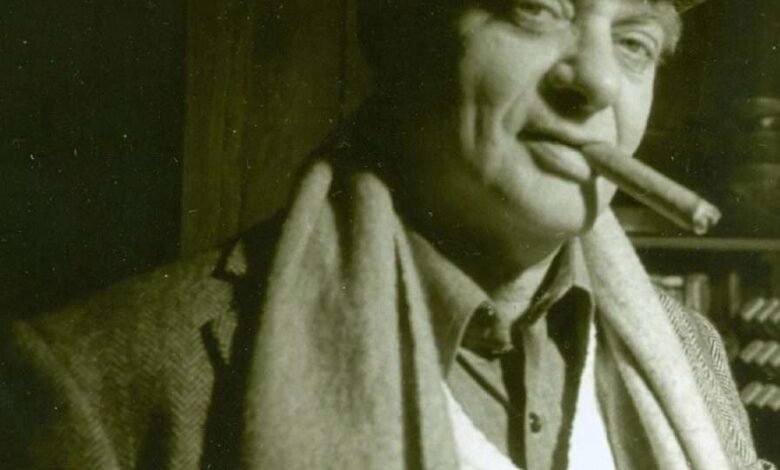
Illustrations, from above, courtesy of the Talbot family: Daniel Talbot in 1986; Talbot with Alfred Hitchcock in the lobby of the New Yorker Theater, in front of a showcase featuring international film directors, 1965; New Yorker Theater marquee announcing “Arthur Kleiner at the Piano”; Talbot with Hitchcock and the theater guest book, “Films I Would Like to See.”
Read more about film history in New York.
Source link