 During the first year of the second Trump administration, roughly 350,000 federal employees left their positions. Through a combination of layoffs, deferred resignations, early retirements, and illegal dismissals, the federal workforce shrank by more than 10%.
Public lands agencies have been especially hard hit. Since January 2025, the National Park Service has lost nearly a quarter of its employees, while the U.S. Forest Service, Bureau of Land Management, and U.S. Fish and Wildlife Service have each seen their staff decline by almost 20%.
Most recently the Forest Service, which manages 193 million acres of public land, including 154 national forests (Finger Lakes National Forest is one) and 20 national grasslands, is currently undergoing a massive structural reorganization and relocation.
These changes have been spurred by Trump’s commitment to close all nine regional offices and approximately 57 of its 77 research facilities across 31 states.
These agencies have been affected at all levels, from senior executive management to seasonal hires. It’s not hyperbole to say that the country’s public lands face one of the greatest crises in their history.
It’s easy to feel overwhelmed by this type of data. Would a collective rather than an individual response be more effective in addressing the challenges public lands workers now face?
Could organized labor play a role in addressing the administration’s current attacks and in planning for a new, likely very different future? What does it look like to be part of the public lands labor force at this moment, and what role might unions play in shaping its future?
Living Landscape Observer will host Rudy D’Alessandro, longtime president of the National Treasury Employees Union (NTEU) Chapter 296, which represents non-supervisory staff at the National Park Service headquarters, to discuss these questions during their virtual April meeting of the Public Lands Reading and Discussion group on April 23, 2026, from 2 pm to 3 pm ET.
Unions currently represent only a small fraction of public lands workers, though membership has increased in recent years. During this discussion, participants will learn more about organizing and collective bargaining in the context of public lands, with a focus not only on the Trump administration and its restructuring of the Departments of the Interior and Agriculture, but also on workers’ rights more broadly.
To attend this session and receive a list of suggested readings, email PublicLands_ReadingGroup@proton.me.
New York Almanack is reporting on Donald Trump’s regime impacts in New York State, but we can’t do it without your help. Please support this work.
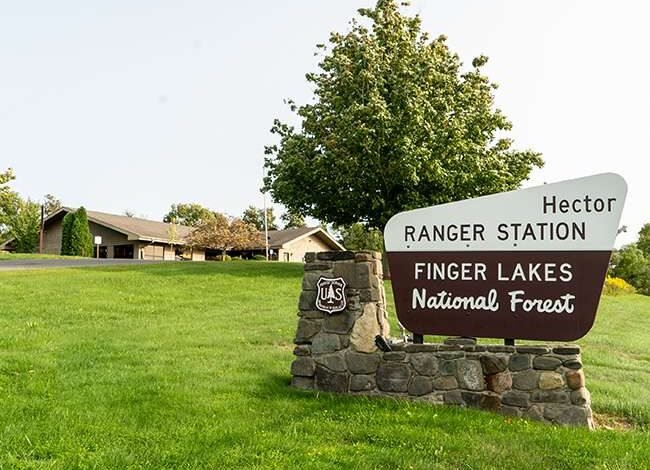
Photo: Finger Lakes National Forest’s Hector Ranger Station.
Source link