 The Allied invasion of Normandy (D-Day) on June 6, 1944, was the moment that cemented the “special relationship” between the United States and Great Britain. The operation required full integration of military planning and intelligence sharing, forging a transatlantic bond that shaped the post-war era.
Winston Churchill coined the phrase in 1946 at the beginning of the Cold War. Today, it is a myth that perpetuates the illusion of British influence, concealing an unbalanced alliance. Ever since the 1956 Suez Crisis there has been an asymmetrical dynamic in which Britain plays a minor role.
The “special” partnership was born out of necessity and followed a long spell of Anglo-American friction and antagonism – the seven-year occupation of New York City by British troops, the War of 1812, American support for Irish independence, and a suspicion that American diplomats favored the demise of British Empire.
Previously, America had interacted with dozens of independent German states. Immigrants had been arriving from there since the end of the seventeenth century when many of these territories suffered the economic fallout of the Thirty Years’ War (1618–1648) and the persecution of Christian minorities.
 Numbers fluctuated but migration lasted into the twentieth century. Today, more than 40 million people claim German ancestry, including President Trump. Having evaded mandatory military conscription in Kallstadt, Bavaria, his paternal grandfather Friedrich Trumpf (Frederick Trump) arrived in the city of New York in 1885.
The United States supported liberal revolutionary movements in the German states during the 1848 uprisings and welcomed political refugees when the efforts failed.
The German states supported the Lincoln administration (although officially neutral) and many German immigrants served in the Union Army. During the Franco-Prussian War (1870-1), Americans (again, although officially neutral) sided with Prussia.
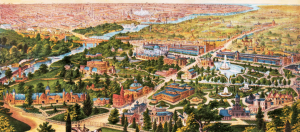
The 1876 Centennial Exposition in Philadelphia marked one hundred years of American independence. Having celebrated its unification in 1871, Germany embraced the event.
More than that. As one of the largest foreign exhibitors, its presence dominated the show, revealing an entrenched German influence in Pennsylvania and beyond.
 Centennial & World Fair
On June 26, 1876, President Ulysses S. Grant issued Proclamation 229, proposing that citizens observe July 4th as the Centennial Anniversary of the nation. Urging Americans to celebrate the event at their place of worship in prayer and thanksgiving, it fused patriotism with religion.
The proclamation coincided with the Centennial Exhibition in Philadelphia which set out to spotlight American progress from a rural backwater to an industrial power. The President approved the original Declaration of Independence for public display.
Visitors were struck by its fragile condition. Appeals for action brought together representatives of the Smithsonian, the Library of Congress, and the Interior Department, to plan the precious document’s conservation for future generations.
Music highlighted the Centennial experience. In exhibition halls, along walkways, and in restaurants, visitors enjoyed concerts, marching bands, recitals, choirs, and minstrel shows.
Many of them flocked to hear Steinway’s Centennial Grand Piano in concert (only 424 models of the iconic instrument were built by this family of German immigrants).
The Great American Restaurant offered a beer garden with music, and the Restaurant of the South featured an “Old Time Darky Band.” The show featured a plantation-style exhibit where African Americans performed an old dance, originally known as the “chalk-line walk.” It would become known as the cakewalk.
Elizabeth Duane Gillespie, great-granddaughter of Benjamin Franklin, presided over the Women’s Centennial Executive Committee (WCEC). She made sure that the show featured the work and contribution of American women.
The committee raised over $30,000 to construct its own exhibition space and the Women’s Pavilion included over eighty inventions patented by females.
 Its input went further than that. The committee offered German composer Richard Wagner an astronomical fee of $5,000 for an orchestral occasion piece to open the Exhibition. Theodore Thomas was invited to conduct its premiere.
Born in Esens, East Friesland, on October 11, 1835, Theodore Thomas showed an early talent for playing the violin. In 1845 his parents emigrated to New York where the youngster gained recognition as a prodigy.
He joined the New York Philharmonic Society’s violin section in 1854. From 1877 to 1891, he performed as the Philharmonic’s highly respected conductor. Throughout his career, he promoted Wagner’s music in America.
Musical ceremonies on opening day began under Thomas’s direction with “Hail to the Chief” upon entrance of the President and his wife, followed by Wagner’s “Grosser Festmarsch” or the “American Centennial March.”
Although the composer had been moved by the “inspiration of the beautiful ladies of America,” his composition was little more than a concoction of empty grandeur and schmaltz. He did not bother to attend its premiere and privately admitted that his financial reward was the best thing about the piece.
The concert finished with a rendition of Handel’s “Hallelujah Chorus,” accompanied by the Centennial Chimes (consisting of thirteen bells representing the original states), factory whistles, and a hundred-gun salvo.
National Pride
Officially named “International Exhibition of Arts, Manufactures, and Products of the Soil and Mine,” this was the first World Fair to take place in the United States.
Running from May to November at a massive site in Fairmount Park, it featured about two hundred buildings, thirty-seven participating countries, and some 30,000 exhibitors. Almost ten million visitors attended the Fair.
It was here that Americans first learned about the Statue of Liberty. Her torch-bearing arm had been transported from France and displayed at the Exhibition. A multifaceted symbol of hope and enlightenment, the torch both reflected and contradicted the mood of the show.
 The spirit of optimism was raised by the spectacle of a multitude of technical inventions. Offering an overview of American and global activity by some 1,900 exhibitors, the massive Machinery Hall drew most visitors.
It was a rich cabinet of inventions, including George Henry Corliss’s revolutionary steam engine, Alexander Graham Bell’s first telephone, Thomas Alva Edison’s automatic telegraph, and E. Remington’s Model One typewriter.
The exhibits proved America’s technological ingenuity. The novelist and diplomat William Dean Howells, writing for The Atlantic Monthly, noted that no one could experience the Fair “without a thrill of patriotic pride.”
The German contribution to the Exhibition was significant and not just as a participating nation. There was a more direct link.
Having served as a lieutenant in the Bavarian Army, Munich-born engineer Hermann J. Schwarzmann emigrated to America in 1868 and was employed by the Fairmount Park Commission. Appointed as the park’s chief planner, he landscaped Philadelphia Zoological Gardens (opened in 1874).
That same year he submitted a design proposal for the Beaux-Arts Centennial Art Gallery (now Memorial Hall). Its acceptance led to his nomination as the Exhibition’s principal architect, creating its site plan and many of the buildings. He later moved to New York City to set up a private practice, designing Broadway’s Mercantile Exchange in 1882.
Weapons & Books
An ominous presentation of war machines at the Exhibition contradicted the enlightened spirit of belief in human reason and peace. The show’s narrative focused on advances in the production of firearms, notably the Winchester “Centennial” rifle, alongside Colt’s rapid-fire Gatling guns.
The Civil War had accelerated innovation. The U.S. Army Ordnance Department displayed pioneering machinery that enabled automation in the making of small arms. Visitors could watch on-site manufacturing of rifles and ammunition. It attracted many spectators, but another exhibit stole the limelight.
 Warmly welcomed by the Centennial’s organizers, Germany showed pieces of heavy machinery at the Exhibition, revealing the industrial might of the newly unified state. It was in Philadelphia that Americans first took notice of a steel and arms manufacturer named Alfred Krupp, nicknamed “The Cannon King.”
His firm displayed artillery equipment in the Machinery Hall, including gigantic steel breech-loading cannons (“killing machines”). These weapons caused both interest and concern.
Many visitors were impressed; others alarmed. Germany was seen as a rising power; a potential threat to the political status quo. In an act of power posturing, the Krupp corporation seized the opportunity at America’s first World Fair to display Germany’s military might.
Whilst showing off this weaponry, curators of the German section were also keen to assert the country’s status as a “Kulturnation” (a cultured nation). They concentrated their efforts on pottery and printing.
An array of German ceramics was on show in the Main Building, highlighting a creative tradition of porcelain and stoneware design. German input played a key role in shaping the future of American ceramic art.
Greenpoint, an industrial site in Brooklyn, was home to a dozen potteries, including Thomas Carll Smith’s Union Porcelain Works (UPW). Located at 300 Eckford Street, he was a manufacturer of doorknobs, tiles, and fireplace ceramics. But Smith had bigger ambitions. He wanted to compete with Meissen porcelain.
The Exhibition offered an opportunity to American firms to improve the quality of their wares and seize a market share from foreign rivals. Unwilling to copy European motifs, Smith resolved to use original designs and create American patterns.
 In 1874 he employed sculptor Karl L. H. Müller to design wares for the Centennial Exhibition. Born in 1820 at Koblenz, Rhineland, Müller moved to New York in the aftermath of the 1848 Revolution. His most notable contribution to the Exhibition was the “Century Vase,” a work covered with a profusion of patriotic scenes.
Bison heads served as handles; a portrait of George Washington embellished each side; six biscuit-relief panels around the base depicted historical events such as the Boston Tea Party and others. As a showpiece at the Exhibition, it shaped a stylistic direction for future developments and created a vogue for “Americana.”
Germany being home to Gutenberg, Goethe, and Schiller, it dedicated a Book Pavilion to literature and publishing. Intended to stress the nation’s cultural heritage, the display highlighted traditional printing skills rather than mass-produced items – quality rather than volume.
This general attention to artistry in pottery or printing contributed to the emergence of the Arts & Crafts Movement. Furniture maker Gustav Stickley, America’s most prominent representative of the trend, was a second-generation German immigrant. Born Gustavus Stoeckel, his parents originated from the Baden region along the east bank of the Rhine River in southern Germany.
The contrast of deadly weapons with delicate porcelain and fine books at the Exhibition exposed an unfolding tension between cultural enlightenment (the “Weimar spirit”) and Prussian authoritarian militarism.
Tragically, the split between these societal forces was uneven. Bismarck and Krupp, not Goethe or Schiller, decided Germany’s political direction.
The Krupp exhibit foreshadowed an era in which devastating factory-made artillery would define warfare. Philadelphia’s showroom of weaponry set the stage for a competitive and global arms race.
As such, it was a prelude to the First World War.
Read more about German-American History in New York State.
Illustrations, from above: Philadelphia Centennial Exposition of 1876 map chromatic view; Geburtsurkunde von Friedrich Trump (Birth certificate of Friedrich Trump); Presidential Proclamation 229 of June 26, 1876, by Ulysses S. Grant calling for a special observance of July 4, 1876 as the Centennial Anniversary of the nation; flags of the nations which participate in the centennial exhibition of the United State in 1876 (Huntington Library); lithograph of the the 1876 Centennial Exposition Machinery Hall, 1876, by HJ Toudy & Co (John S. Phillips Collection); The Krupp Gun Exhibit at the 1876 Philadelphia Centennial Exposition; and Karl L. H. Müller’s “Century Vase.”
Source link