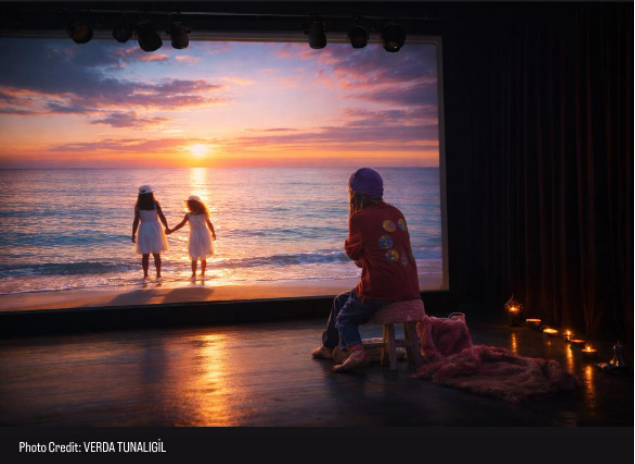
On 18 December 2025, International Migrants Day, a lone woman stands on a small stage in İstanbul and speaks, not to explain herself, not to accuse, but to think aloud. This is Medea’s Head, Esen Özman’s staging of Andreas Flourakis’s contemporary monologue Medea’s Burqa, and it is less concerned with retelling a myth than with asking a question that feels urgent far beyond the theatre walls. What does it mean to exist as a thinking subject when one’s body, language, and history are constantly read by others as evidence against oneself?
This Medea does not arrive trailing the familiar aura of infanticide and divine revenge. She arrives carrying consciousness itself, fractured, pressured, vigilant. What unfolds is not a tragedy of action but a tragedy of perception. The drama lives in how thought forms under surveillance, how memory interrupts the present, and how a woman learns to speak when silence has long been demanded of her.
Migration, Memory, and Displacement
Medea’s Head foregrounds the temporal and geographic conditions of its performance as integral to its meaning. İstanbul as a city of geographical, cultural, and linguistic crossings, where migration is not an abstraction but a lived truth, and where questions of belonging, visibility, and positioning are continually reconfigured, intensifies the work’s force.
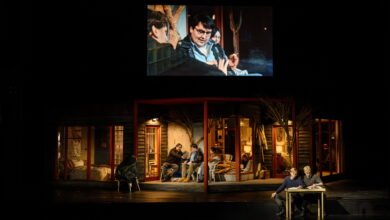
Premiering on International Migrants Day, the production acquired a distinct symbolic dimension. According to the United Nations, the day is intended to spotlight migrants’ contributions, rights, and lived realities worldwide. In Medea’s Head, however, migration is not presented as a policy issue or a sociological category but as an internal condition experienced through memory, language, and self-perception. This is achieved theatrically by shifting attention away from the physical act of border crossing toward the inner experience of displacement. Rather than recounting a chronological journey, Medea’s monologue unfolds through fragmented memories, interrupted trains of thought, prolonged silences, and repeated moments of self-questioning. The projections that intermittently interrupt her speech further externalize memory, allowing past and present to coexist within the same theatrical moment. Exile unfolds within the body and the mind long before it is recorded at borders or checkpoints. Medea repeatedly returns to experiences of estrangement, not through descriptions of physical movement across national frontiers but through memories of being perceived as permanently out of place, carrying histories that remain unintelligible to others, and negotiating identities that are continually questioned or misread.
Medea’s story, reframed through a contemporary lens, becomes a way of asking why people who are perceived as socioculturally different continue to be reduced to simplified narratives rather than acknowledged as individuals with agency, moral complexity, and their own perspectives. The question is not only “what happened to Medea?” but “why do we need her to be monstrous in order to look away from the systems that produce her isolation?”
A Decisive Dramaturgical Shift from Body to Mind
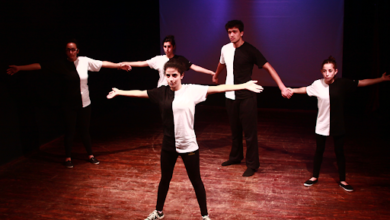
Earlier stagings of Andreas Flourakis’s Medea’s Burqa have largely emphasized physical endurance, rhythmic intensity, and the political body under pressure. My observation of Özman’s İstanbul production, by contrast, reveals a decisive shift toward cognition and interiority. Departing from this performance lineage, the body withdraws from spectacle to make room for thought itself, which becomes the primary stage action.
Across its performance history, Medea’s Burqa charts a clear evolution in embodiment, moving from a politically charged physical language in 2014, through expressionist, ritualistic, and explicitly political bodies in 2016 and 2017, toward visual dramaturgy in 2022, and finally extreme corporeal endurance in 2023–24. This developmental arc sets the ground for comparison with Medea’s Head, which emerges from this lineage as both continuation and transformation. Drawing on these accumulated approaches, the 2025 İstanbul premiere, performed and directed by Esen Özman, internalizes the trajectory, distilling Medea into a “mental Medea” shaped by consciousness and memory. The myth’s violence is no longer enacted primarily through the body; here it is reconfigured as an act of psychic survival within a contemporary landscape of exile, identity, and belonging, marking a decisive shift from experience to internalization.