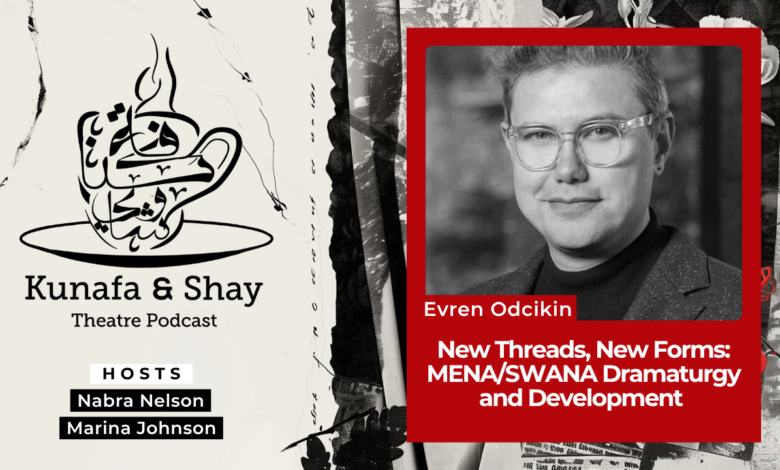
Nabra Nelson: Salam Alaikum! Welcome to Kunafa and Shay, a podcast produced for HowlRound Theatre Commons, a free and open platform for theatremakers worldwide. Kunafa and Shay discusses and analyzes contemporary and historical Middle Eastern and North African, or MENA, and Southwest Asian and North African, or SWANA, theatre from across the region.
Marina Johnson: I’m Marina.
Nabra: And I’m Nabra. And we’re your hosts. Our name, Kunafa and Shay, invites you into the discussion in the best way we know how, with complex and delicious sweets like kunafa and perfectly warm tea, or in Arabic, shay.
Marina: In each country in the Arab world, you’ll find kunafa made differently. In that way, we also lean into the diversity, complexity, and robust flavors of MENA and SWANA theatre.
Nabra: Season six of this podcast marks a double milestone, the thirtieth anniversary of Golden Thread Productions, the oldest MENA theatre company in the US, and my first year as the theatre’s new artistic director. Across ten episodes, we use Golden Thread as a case study to revisit landmark productions from 1996 to 2026, and trace shifting tropes, political urgencies, and aesthetic strategies that shaped the company’s early decades.
Marina: This season also expands to reflect on the past three decades for MENA theatres across the US, not as a closed chapter, but as a living archive, one that illuminates where we’ve been and where we’re headed.
Nabra: In this episode, we dive into new threads and the evolving dramaturgies of MENA and SWANA performance with Evren Odcikin. Together, we explore how new play development becomes the site of cultural translation, experimentation, and refusal, where artists shape form as much as content. What distinguishes MENA and SWANA dramaturgies from dominant US theatrical structures, and how do they hold multiplicity, migration, memory, and politics simultaneously?
This conversation traces how new threads and other MENA and SWANA new play programs have nurtured bold, formally inventive work while building a national pipeline for playwrights, redefining the field. Evren Evren Odcikin is a Turkish-American director, writer, and arts leader based in New York City and San Francisco. He is a celebrated champion of historically excluded voices in the American theatre through work that is heart-centered, politically-engaged, globally-minded, and centers joy as resistance. He is committed to building his work with and for communities it represents. He is the proud 2024-25 Artist-in-Residence at Golden Thread Productions and a 2025 Iris Lab Fellow with UC Santa Cruz. Recent directing includes Soho Rep, Play Co., Woolly Mammoth, ART, Guthrie Theatre, OSF, Marin Theatre, Portland Center Stage, Geva Theatre, Northern Stage, Berkeley Rep, Prague Shakes, Marin Shakes, Magic Theatre, and Playwrights’ Center, amongst many others. As a playwright and translator, he has received commissions, workshops, and productions from Cal Shakes, NYU Abu Dhabi, Golden Thread, Crowded Fire, and Custom Made. Evren served as the interim artistic director at Oregon Shakespeare Festival in 2023, where he was associate artistic director and director of artistic programming from 2019-2023. Evren serves on the boards of the MENA Theatre Makers Alliance, and Golden Thread Productions.
We are so excited to have you here again on this podcast, Evren.
Evren Odcikin: So nice to be back. I can talk to you all day.
Nabra: We have an hour, unfortunately, but we do want to talk to you all day.
Evren: That’s the biggest violence is doing a SWANA podcast that’s only an hour.
Nabra: I know. You’re completely correct, actually. And we always butt up right against the hour. And that’s exactly because of that. We just want to keep going.
Evran: Exactly. But you know, we’ll manage.
Nabra: We will manage.
Marina: You have developed new work at Golden Thread and other arts institutions as well. When we say new play development, what does that look like in general? And what can it mean, especially in the case of MENA or SWANA plays?
Evran: I mean, new play development, I think, in my mind, has to be part of any theatre’s purview. Even if you’re a classical theatre, I think… I think of theatre as a very present tense endeavor. That if you are doing Shakespeare, you still have to figure out why you’re doing that Shakespeare today for this audience, in what way.
And on the flip side, with playwrights, of course, living playwrights, I think there is, they need, all generative artists need space, time, and resource to be able to develop their work, to make it production ready. And although new play development, I think around the country, less so now with the financial limitations, but for a long time has touched on new plays, at different places in their development. So it can be very early idea, commission kind of moment. It can be sort of we’re in the middle first draft, you’re reading it and trying to see what’s their moment, or the final workshop before a production where you’re really actually working with your collaborators to get it ready moment.
But I do like to always think about new play development towards production. Plays are meant to be produced. So I think it’s really important in the early stages that there’s an idea towards what this will do in front of an audience.
So those are sort of some of the ways I think about it and try to be quite responsive as a programmer or as a director to what each artist needs. Because I also think there is a big range of things different artists need as they develop their work. And that can be about audience, that can be about the artists in the room, that can be about music, that can be about they actually need to stage.
I sometimes joke that the music stand is the enemy of good when it comes to new play development, because we force so many playwrights to develop their plays to work at music stands when that’s not actually our form’s form.
So, I a lot of times really love when theatres, and Golden Thread has done this quite a bit, provide artists with ability to move and do ensemble generative work and other ways of development that’s not just about a person writing at a laptop to be read beautifully by amazing artists for an audience.
Some writers, some plays work really well that way and others don’t and need different kind of development. For MENA/SWANA, I think it’s not that different actually from other communities that have been left out of the center of the mainstream, who have not been purposefully centered in what gets developed and what gets given resource over the years, is much more of a responsive need to artists’ asks.
And again, that can be about politics, that can be about cultural specificity, whether it be in casting or dramaturgical support, but it can also be in how they run their process. I find that MENA rooms, this is a generalization, tend to work—there’s a lot of over-talk, there’s a lot of tangents, there’s a lot of storytelling, there’s hopefully a lot of food. So there is sort of a different kind of culture in the room when we’re amongst ourselves, I find, in the way that I like to make work. And I sometimes have to leave that at the door when I’m working at PWI’s predominantly white institutions, because I need to fit my process into what they consider to be real professional work, versus say at Golden Thread, there is a much more of an expansive understanding of what a good rehearsal might look like. So those are some of the ways I think about when I’m working with MENA artists. And again, I’m generalizing, there are many MENA writers who do a very traditional process, and good on them, I love that. Very happy to provide that too.
Marina: No, that makes sense. And can you talk to us a little bit about New Threads then, Golden Thread’s new play development process?
Evren: Of course. It’s one of my favorite programs at Golden Thread, and not just because I restarted it. I can’t say that I started it, I think it happened, I should know the year, but Torange had used that brand a few years back from 2011 when I restarted it, but felt like she herself did not have enough capacity to be able to do the main stage of that. And once I was coming on board, at that time as a volunteer staff member, I believe, I wasn’t getting paid yet. Back in the day when we did work without getting paid, remember those days? It actually worked really well for me, so I can’t complain too hard about it, to be honest.
But when I restarted New Threads, we had a dual purpose. One was about our artists, and one was about our audiences. It became really clear that when you’re a smaller company that can only do two to three projects a year, that we were not able to touch enough artists, we were not able to give enough employment to our actors and directors, but also we were not able to support enough writers. And when you’re saying that you represent as wide-ranging a region, if it’s a region, as SWANA, from Tunisia to Afghanistan or Pakistan, depending on how you want to parse our countries, you need a lot more touch points.
And New Threads was a simple, more affordable, but also more thoughtful way for us to be able to touch more writers and also provide writers with an ability to work on their plays towards production, whether that be at Golden Thread or not. And it was a great way to meet artists, to be honest. That was something that was really important to me, was to have Golden Thread have more of a national presence. Torange, as the mother of Middle Eastern theatre, the founder, certainly provided a good deal of that through her connections. But because I was coming from a slightly different space, I wanted to make sure that these writers that were working in New York and LA and Chicago and Minneapolis and all over felt like Golden Thread could be, in a small way, a home for them as well. So New Threads really provided us with that sort of container.
And secondarily, again, if you’re trying to talk to an audience that’s coming from so many cultures, it is important that they feel like we are providing them with a play about their specific culture as well. And not to say New Threads has done every culture represented in the Middle East. It has certainly helped us cover more base and to be able to actually speak to our audience in a more personal, direct way.
And lastly, Golden Thread, Torange (Yeghiazarian) started this. I think I did my part. Sahar (Assaf) has done such a beautiful work with this. And I can’t wait to see what Nabra and Wynne do of cultivating our audience to be curious, to be art first, and to be not afraid of thorny edges, whether that be politically or artistically. And we have a core of our audience that really loves feeling like they’re connected to the artist making the work and are able to see the work when it’s not done yet and be able to play a part in it. And a lot of theatres around the country have done a pretty good job with this, but I have to say I’m so proud of the way Golden Thread has been able to do this and has been able to build a community around that newness and that community has come out personally, politically, and financially as these plays move towards production. I think it’s been a great pipeline for us to have a deeper engagement with our audience, which in a very nuts and bolts way also builds your donor base, builds your audience base, builds your community ambassadors who are willing to go out there and convince others to come and support you in the audience. So New Threads has been sort of a really lovely, key, small program that has had, I would say, many ripple effects on the way that company has grown.
Nabra: And I love how you’ve elevated how new play development is the art itself, the way that it is sharing stories, it’s representing communities, and it is community engagement very similarly to a main stage or full production. I’ve always loved to have stage readings of my plays, even if they’re not development, because I’m like, this is also sharing this art with an audience. And I’ve seen a lot of theatres consider the new play development as like this quiet thing that happens in a room, right? And it’s not actually supposed to be part of engaging audiences and sharing work. So I love that that’s always been the intention of New Threads.
Evren: For Golden Thread, I would say for sure. And that has been certainly a conversation we have with our artists who are in the program, right? That New Threads has many flexibilities, but it is our public-facing new development program. So it is about you being in front of an audience, right? Your work being in front of an audience, whatever state it’s in. And because we are who we are, I think we have a good deal of trust with our artists that they trust us to be able to contextualize the work so that it will be received with generosity and met at the level that it is, right? But we have certainly done new play development that’s been closed door, right? But that’s not part of New Threads. That’s Kimia (at Golden Thread) and there’ve been many other projects I think Torange has started. And with our artist-in-residence program, there’ve been a lot of development that’s actually either very invited-audience or closed-door. And that’s important too. It’s just not the purview of New Threads because that is really specifically about how the art meets the audience.
Nabra: Mm-hmm. And you’ve been a part of creating or recreating or building other new play development programs across the US and other SWANA new play development programs across the US. Can you talk about the other programs that you’ve been involved with in your various roles?
Evren: Of course. I mean, some of it is more administrative, I would say, but Middle East America program, which was a commissioning program that was a collaboration with Silk Road Rising, which was called Silk Road Theatre Company back then, I think. They’ve changed names a few times. Golden Thread and The Lark, RIP. I miss The Lark every day. A New York-based new play development center that had to close due to financial reasons, which has been a huge loss for our community, but in general, in the new play development space. And what’s been really interesting about that is Adriana Savan, Yussef El Guindi, and Mona Mansour were all commissioned and those plays were written and quite a few of them had quite a few productions and workshops. So that was an amazing, of course, national project, but it also ended up being the rooting for what has now become, in a certain way, MENA Theater Makers Alliance, because that specific program started the national convenings at The Lark, in San Francisco. And it was really an artistic idea. And to see, I remember when we showed up to the first one and there were like, I think, fifty people and we were all so surprised anybody showed up because we weren’t quite sure who was out there. And then I remember by the second and third one, we had hundreds of people and the people were demanding things, which at the time was a little annoying, but looking back was such a great thing. I’m like, oh, we’ve arrived enough that our community feels like they can make demands. They’re not just happy to be there.
So in a way, that specific program is something I’m super proud of. That was, of course, very much a Torange, Jamil Khoury at Silk Road (Cultural Center), Catherine Coray, and John Eisner at The Lark, but I was sort of the organizer behind the scenes at the time of a lot of things and I was a reader and very, very happy to be part of it. And then MENA Theater Makers Alliance, which is, again, much more of an advocacy group, but one of our missions, I’m on the board, Nabra is on the board very proudly. It’s a national organization that is trying to increase the number of plays and artists that are featured from our cultures on mainstream stages, as well as everywhere. We just want more of our work produced. So it is a more administrative task. We have a big award program and a grant program that’s launching right now, the MENA Theater Makers Fund for organizations and artists, but it’s a different way to support the new play development because most of the organizations, I assure you, who are going to get that grant are going to be quite new works focused, and that’s just how our sort of community works.
Marina: I’m curious. So often SWANA plays are read first through a lens of geopolitics, but how do you advocate for aesthetic complexity beyond that lens? What are things you’re looking for there?
Evren: You know, I had to come through such an awakening about this myself in my artistry as someone who very specifically decided, I grew up in community spaces. I always say I was raised at Golden Thread. Golden Thread is the reason I have a career. Golden Thread is the reason why I have such a strong spine of who I am and what I like. But I decided like a few others that I would take that experience and then see if I could make it and make more space for us in mainstream PWI, the scary big white theatre, American theatre, right?
And when you first make that change, the thing that gets you in the room is content, who you are and what you represent from their perspective, right? And when I got the National Directors Fellowship many, many years ago, Nan Barnett, the amazing Nan Barnett, who’s still the executive director at NNPN, they would put us in front of artistic directors to talk about our work and I did that over and over again for a few months. And then she pulled me aside after one, she said, you haven’t talked once about style or what you like. You keep talking about content, about what the plays are about. And it was this sort of, because I’m actually an artist that does have a very specific visual metaphorical voice, I do like structurally adventurous plays. I am always looking for things that can only happen in the theatre. And it took that poke from a non Middle Eastern person, if I may underline that, right? Someone who loves artists and playwrights and has worked with Middle Eastern artists, but is not one herself, for me to really think about what part of my artistry can I talk about as Middle Eastern or Middle Eastern American, right?
I was born there, I’m an immigrant, but a great deal of my visual and music taste, the way I think of good acting, the way I think about emotional performance is very much rooted in where I’m from. And so it took a little bit of an awakening in my own work to be able to even think about this for other artists.
The thing I say, my biggest job in the American theatre as a director and a new works person, a programmer that works with Middle Eastern SWANA plays, is to cut exposition. That’s my service to the American theatre, because a lot of our works, if they’re produced or developed in predominantly white spaces with a white American or other culture director or dramaturg, usually clarity, political clarity becomes the driving factor, and people have very little trust in their own ability to understand something. So our writers are usually forced to, in certain ways, to add very unnecessary exposition, where two Egyptian people will be sitting at a cafe and talking about political things that happened in Egypt yesterday in great detail, with no shorthand, in a way that Egyptian people have never once talked in their lives.
This happens all the time, and when that play shows up at Golden Thread and they’re talking to us and we go, you don’t have to do that, we all know that, or that’ll be clear later, the release in the writer, and of course once they are released that, then they have an easier time accessing their actual gut and their actual story they want to tell when they don’t have to translate themselves before they even start writing their play.
So I think that becomes a big driving factor for me about, is this necessary in this play? Is this actually clear? Is this how people would talk to each other? Exposition is very important, but there’s an artful way to do exposition, and there’s a terrible way to do exposition, and I think a lot of Brown and Black writers tend to get pushed into that terrible way of doing exposition over and over again. So that’s one reflection for me.
And our artists are very varied in terms of their access to their culture, their access to the politics, or their interest in the politics. For a lot of us, the politics is, I think Middle Eastern writers understand that the political and the personal are not different. I think because of lived experience in the US and back home, if they actually have that access, they understand the personal impact of the political decisions that are being made. I think a lot of Americans are starting to understand this very personally these days, so it’s kind of an interesting moment of pivot maybe for dramaturgy in general. But a lot of us actually think of politics as context. It’s where these people live. It’s not what they’re doing, right? A lot of us are interested in writing family stories. A lot of us are interested in writing very big, funny farces that take place in the context of a political landscape, but so does every other play.
You know what I mean? So I actually feel like there needs to be a cultural competency in the room with regards to how things are represented, of course, but the actual dramaturgical, the meat and potatoes aspect of dramaturgy, of what makes a good play, rhythm, story, character, arc, big event, release, all those things are not that different for us. I just think we are not really given the benefit of that feedback, right? And the most recent thing I’ll talk about, which has happened with me, I realized in the last few years, I’ve been getting a lot fewer notes on my plays, on my directing from artistic leaders, because I think there is a fear of getting it wrong, or they feel like if they didn’t understand something, if they say that, they’re being problematic. And that might be true, but I need notes. I’m an artist who wants to do better, and you are the person who’s hired me, so I want to be in conversation with you. Be careful, of course, listen to me if I’m saying that doesn’t apply, et cetera, et cetera, but also letting Brown artists, just kind of letting them alone, is not the solution either.
So I feel like there’s been a real journey with regards to how our plays are contextualized politically, and what that means on a day-to-day basis of making our art.
Nabra: Along these lines, there are a couple of questions that are coming up, but I’m wondering if there’s a specific situation where you felt like you had to protect something that didn’t feel legible in the mainstream dramaturgical frame, or the other way around, where you maybe had to push a specific example of that dramaturgy not quite gelling or connecting during a new play development process.
Evren: These are both production new work processes, that’s what’s sort of coming to me right now. One is about Heartland, which is Gabriel Jason Dean’s play that sort of focuses on Afghanistan, and I was part of the rolling world premiere for that, and it ends in a Muslim prayer, and every production I think before ours shortchanged it because a Muslim prayer is quite long, and it’s actually deeply not performative. There’s visual things that are very, but you don’t actually speak out the prayer. It’s an individual solo experience, so in a way, and that was really important to him, and I was like, well, if you’re going to use the Muslim prayer in this play, we’re going to do it, and we’re going to have to figure out how to rewrite this ending so that it supports the full length and process of this Muslim prayer, and it was a very metaphorically important thing, so we were able to figure that out, and I had to sort of really work through that. And I am Muslim, but I’m quite secular, work with other Muslims who are actually much more connected to this daily prayer practice to figure out if there were certain things that could happen faster or not, and if the answer is not, then we’re not doing that, because this play is for and by the community that it represents, and I want anybody who’s a devout Muslim who comes to this play who’s Afghan and might actually pray to feel like we did it right and that we didn’t shortchange their experience for other people’s experience of being bored by something going on for too long.
So those kind of things, cultural representation things, are non-negotiables for me. We can certainly have a conversation about how it fits into the theatrical framework and theatrical time, but we’re not questioning the if.
If you want to use that in your play, then you’ve got to write your play to do that, you know.
Similarly, and this is a much simpler experience, but I directed This Is Who I Am by Amir Nizar Zuabi during the pandemic times, which was a very sort of, it wasn’t Zoom, but it looked like Zoom play. It was a very complicated high-end tech thing behind the scenes to be able to do high-quality streaming, but there was this New York apartment in which the play talks about sumac a lot because it’s this specific baked good that uses sumac and it’s all about good sumac versus the sumac that’s available in Palestine versus what’s in New York, you know. There’s like a whole bunch of conversation in it, and the New York kitchen had, I think, six spice containers and one of them was sumac, and one of our non-Middle Eastern artistic directors was like, he needs to have more. That makes no sense that he would have sumac as one of six. That’s just very distracting, and literally me and Reza Behjat, who was the lighting designer, had to take our computer to our spice cabinet and open it, and both of us had at the front the same Sadaf sumac bag in the front of everything. We’re like, no, seriously, this is how it works. Sumac is one of the top three, you know, and she backed off after that because there were enough proof, but it was one of those things. It’s such a silly, small thing that I would never think about, but it was actually kind of a useful moment for me as a creator being like, oh, this is throwing you off. Am I going to change it, or am I making this so that, like, because no one Middle Eastern was having that question, right? Like, they weren’t like, why is there sumac as one of however many spices? That makes no sense. I’m like, no, it does.
So it was, you know, these are like two sort of examples of how I think about cultural representation, right? What is negotiable and what is non-negotiable?
And one is sort of deeply important, the Muslim prayer, and sumac thing is not that important.
I don’t know if, but it like, for Reza and I, it was really important. In that moment as creative artists, we were both like, no, this is how it needs to be, because this is how it is, right? And for us to feel represented, that had to be part of it. So I don’t know if those are helpful examples, but those are the two that are coming up.
Marina: Those are great examples, but also, so I’m curious, in this instance, it was someone who was not Middle Eastern talking to, you know, people from the Middle East, but in rehearsal rooms, what happens when they’re, how do you hold space for the tensions and disagreements that happen between potentially the same group of people, or people who are from similar cultural backgrounds? I mean, in the instance of the Muslim prayer, like you might have people who just have different practices too, but I mean, assuming holding space and being able to hold those tensions simultaneously is an important part of the process.
Evren: This is where me being raised by Golden Thread is incredibly helpful, because Golden Thread, from its founding, right, Torange Yeghiazarian, our founder, is an Iranian-Armenian-Muslim-Christian woman who’s queer, and, you know, like she lives in so many intersections that, of course, the company she founded not only doesn’t reject those intersections or those moments of tension, but actually is built on it.
And I had to learn as I was leaving home, Golden Thread, and going other places that the level of, you know, respectful, I’d like to think, argument and disagreement that I considered very normal and very, like, the point of a creative process was actually not the case anywhere else, right? And that we have decided that the way we disagree with each other is actually through a very WASPy white lens that sort of has co-opted some Buddhist ideas, in a way. You know what I mean? It’s a lot of white women using Buddhist ideas to silence dissent is how it feels sometimes, creative practices.
And I’m like, that’s not how we talk, though. And this is the thing is like, I don’t, because I’m a tall enough, old enough, white enough man, cis man, I have to think carefully about how I disagree with people, especially in positions of power, because it can have a silencing effect on the room, which is never my intention. But it is also true that I must be allowed to speak the way I speak and the way I process, if you want me to have my best ideas, which is sort of everybody in the room wants to have their best ideas. And I think we put great deal of importance on agreement and feeling good in artistic processes, which is so much better. This is an overcorrection that was long overdue. It was such an abuse of terrible space, theatre rehearsal rooms, and now it’s better. You know, I’m not trying to make American theatre great again, just so we’re clear, because it wasn’t great for anybody. You know, but having said that, that like, we must figure out how to be in disagreement, because that disagreement is a much more interesting theatrical device.
That dissonance, that sort of dissonance that’s centered on the joy of disagreement. This is the thing, like, our disagreement does not have to mean that we don’t like each other, it could actually mean that we really like each other, and we’re not seeing eye to eye. And the solution might be that, that disagreement might be the solution. That might be what the play is about. And I think when we take away that ability of our people, whose whole cultures are based deeply on argument, you know what I mean? That is what our cultures are based on. We don’t agree with each other. That is literally, I’ll speak for Turkish, that’s like grounding for Turkish culture, is that nobody agrees, right?
So if you push our stories into a space where we’re all supposed to agree, we’re going to make inauthentic bad work, right? And again, how do you intersect that, though? And this is where a dramaturg and a director and a producer’s work becomes really important. And this is where I feel like I’ve been raised right by Golden Thread, of introducing the process, like, from the beginning as the conversation is the point, the disagreement is the point, what happens in the room is the product.
Because I really do believe that if a rehearsal room has healthy, robust, respectful, loving disagreement and argument, the work has that in it. It’s in the water, it’s in the soil, and the audience feels it, and you can feel the electricity in the audience in how they need it. Now you have to be really careful. There’s a great deal of harm that can happen in that kind of passionate argument, right? Especially when you’re dealing with people who have a very personal, sometimes difficult relationship with their own identities, where they’re from, where their parents are from, that distancing, do you speak the language or not speak the language? Who’s the expert of being Turkish, right? That can be in the space, and I personally find that just pointing to it releases it to a certain extent.
Just saying, by the way, we all have different levels of comfort with this, just to say, you’re all welcome here, please speak from the “I”. I just did this with, I just did a production of English (by Sanaz Toossi) at the Alley Theatre. It was one of those dreamy processes where it really happened beautifully, and there were many people in that room coming from such different access points to Iran, actually being there, to the language, to accents, to cultural norms of Iran, where they do not actually take that on. We had mixed race folks who had, half their family has this culture, half their family has a whole other kind of way of being. Can they bring that into the space? Yes, and in a way, you have to sort of welcome people as they are, and then allow people to speak from that experience, and I think most of the time, we always deal with a-holes in any business, right? That happens, but most of the time, it actually ends up being not just welcome, but desired.
I think we all have a desire to talk about these things, and those rehearsal rooms are little protected spaces where we can, and in a way, we actually do ourselves a disservice as people if we don’t allow that to happen. I hope that rambling response helps. I just think about this a lot. I mean, Nabra and I talk about this on and off. I just want theatre to be, not just SWANA theatre, but all theatre to be a place where we can argue about big ideas and personal things, and let’s talk about how we create protective layers around that so that people are taken care of, but also, you come to rehearsal because you want to take a risk.
I think that’s my desire for my rehearsal spaces is that everyone is willing to go a little further than they thought they could, and if you don’t actually create a space in which where that kind of disagreement or tension can happen, everybody will stay safe, and then we will make a beautiful show, I’m sure, but it’ll be lacking something, and that something is what I’m after every day.
Nabra: Wow. That’s so well said. I know that, you know, I think I’ve heard you talk about this in moments of disagreement in spaces that we’ve been in, and it so beautifully contextualizes that and roots us back in our own cultural experience because absolutely, argument is just so integral.
Sometimes, you know, I always say like my grandma always yells, like she just speaks in yelling. That’s just now her volume, so you know, some of us just, that’s, we talk in this like way that sounds like we are angry, but it’s that passion, that deep passion that’s so rooted in so many of our cultures that comes out, and I’m wondering, you know, thinking about difficult decisions, moments, and challenges, what would you say is kind of one of the most challenging programming choices or maybe the bravest programming choices that you’ve made in new threads or maybe a different new play development process that you had leadership in?
Evren: Such an interesting question. I’m not dumb, but I don’t think in terms of bravery a lot. You know, I don’t think like of myself as someone who’s being brave when I’m making decisions, and I do think I am. Like, I’m not, again, I’m not, you know, I’m not an idiot. I understand that some of the things I’m putting forth are certainly, might not be what people are asking for, but, and Golden Thread, you know, New Threads, although I held a great deal of power, it was, you know, collaboratively with Torange and if I know anybody who’s brave in terms of programming, that would be Torange Yeghiazarian, so in a way, I never had to think that way.
Now, one project that’s really coming to mind, when it was produced at Golden Thread, I think it was Scenes from 71 Years by Hannah Khalil, who’s a Palestinian-Irish playwright and developed this in London, I believe, and it’s a play that talks specifically about what it feels like to be a Palestinian living under Israeli occupation, and not in the big war, you know, the kind of things we’re seeing in Gaza, the genocide, none of that, you know, it’s not actually about that part. That part, in a way, for me, sometimes I’m like, this is news, like, this should be covered by the news. This one is about what it means to live day-to-day, and what that small, big, and medium violence is due to Palestinians and Israelis, actually, in the play. There’s some really interesting Israeli characters, and programming that at Golden Thread wasn’t that weird. This is the kind of play we do all the time. Golden Thread has been committed to Palestinian storytelling and artists for a very long time, before I even showed up.
But what I brought to it was the play needed a crowd, and the play, when I read it, felt like more than a play, so I really, really wanted to see if we could do it with a mix of professional actors and community actors, so actually get folks from the Palestinian community to be on stage to represent these characters that might actually be incredibly close to them. In that process, finding the people, convincing the people, building trust with the people. Some people were very willing. Other people had many questions about who else was going to be in the room and why we were doing this, right? Because I wasn’t Palestinian, and Torange isn’t Palestinian, so even within the context of Golden Thread’s work, there is some trust-building you have to do, and it was a really joyous, wonderful process, and what it ended up being was an experience that was more than storytelling. It was actual representation. You had an actual older man playing the grandfather in the play that’s going back to her, his village, which that specific actor had never done, right? So when he’s acting that part, it’s very different than a beautiful professional actor playing that part, and that’s what the play ended up becoming about, and thankfully Malek Najjar, beautiful director academic, did the production of that, and they actually held on to that original idea of including non-professional or at least community-based actors. One of the actors was professional back home and hadn’t done it in twenty-five years, but it was sort of coming back home for him in a certain way.
So in that beautiful way, that was sort of a decision I made or an artistic idea I put forth that really always I hold very dear, because again, New Threads, that play could be done with five professional actors and be amazing, but we were doing at Golden Threads something else, and we didn’t know if that something else was going to work. It could have been terrible. It wasn’t, thankfully, but it was actually a big experimental risk, and we also certainly in previous times certainly worked with Israeli writers who are trying to write about what’s happening in Israel and Palestine, and we sort of supported them in doing that.
These are all sorts of, we’ve had Iranian queer writers writing about their personal experience being raised by Iranian parents that our audience might have had a strong reaction to because it was quite a negative depiction of those parents, which was true to that writer’s experience and as such deserves to be put on stage, but how do we contextualize it for our audience and for American audiences? You know, those are conversations we would have all the time, and again, it’s just such a part of our programmatic process, and at this point my personal programmatic process those conversations. It doesn’t feel brave. That just feels like making art.
Marina: I love that. Well, and we’ve talked a little bit about you as a playwright in this process that you were talking about, you know, making sure you still get notes because you’re an artist who is always developing, which I appreciate, but can you tell us a little bit about your own new play development processes, and also one of your plays was featured with New Threads last year. I was in Palestine, so I didn’t get to see it or experience it, but would love to hear you talk a little bit about that process as well.
Evren: You know, I was such a secret writer for so long, I feel like. I don’t know why. Because I was known as a director, designer, dramaturg, producer. Writing—and I was working with such exceptional writers, I think I felt a little shy about saying I’m one of them because I’m like, if Mona Mansour and Yussef El-Guindi exist, what am I doing writing a play? You know what I mean? It’s a funny way to think about it, but I think that was a big part of it. So I found my way to writing through translation and adaptation, actually, for some reason that felt safer.
And it was always a little accidental how I sort of stepped into that seat. I was like, I love this play and this translation isn’t right, so I’m going to do it. And it was just like a solution of a play I was directing. And then after a while, I was like, oh, I really like doing this, I might be pretty good at it.
So the first full-length play, which was the play at the end that was featured in New Threads, was Oriental or 1001 Ways to Tie Yourself in Knots. That’s the full comedic farce title. And that was actually a commission by Cal Shakes under the leadership of the amazing Eric Ting, which I co-created. It was at that time called 1001 Nights, a retelling that I co-wrote with Leila Buck, the amazing Lebanese-American writer. And we co-created this really beautiful, political, funny, not funny play that was supposed to be produced in 2020, and then it got canceled for the pandemic. And a few years later, Eric approached us and asked if we would want to redo that. And it was such a play of a moment, for a moment, that to do it again would require a full rethinking of the whole thing. And at that time, I was at Oregon Shakespeare Festival, Leila had just had a baby, and both of us looked at each other and said, I don’t think this is the moment either of us can face this project again.
And we had a very amicable breakup, although I can’t even call it that, like we’re talking all the time about the project still. But I was able to take sort of my portions of the play, and then after OSF, I dug into it, and it became this super meta farce about my experience as a Turkish-American queer writer being asked to engage with my work, with my culture, for the benefit of white audiences and white artistic leaders. And the play is a very, I like to think, funny, but also emotionally truthful representation of that experience. And talking about notes and other things, I, since going out into the big bad American theatre, you know, to face and represent my cultures, that also means that you’re on the receiving end of quite a bit of harm.
And some of it can be very light and funny, and some of it can be quite deep and traumatizing. And I’ve been lucky mostly that nothing has been super deep. But, you know, someone will say something to you, and you have to figure out if you’re going to fight back, you’re going to correct, or you’re just going to swallow and do your work.
And my solution to that after a while was that I had a note app on my phone, so I just write it down. And that act of writing down what was said was a very interesting way of taking away the power of the thing, because it was real. And what ended up happening as I developed Oriental is that I realized that all those things, at least a good deal of them, could end up in the play, that I could put it into the play within this very comedic, politically comedic way. And that was incredibly healing for me.
In the processes, I found incredibly healing for the artists involved, the Middle Eastern artists involved, and actually quite joyous for the audiences. And what ended up happening with New Threads is I was the artist-in-residence at Golden Thread, and I knew that in this big pivot moment where I was going from co-writing to solo writing, and I put myself, a character that’s me, in the play, I sort of decided to make it quite vulnerable and sort of open-hearted about what I go through personally, which was the only way I could make sense of the play. I knew that that had to happen at Golden Thread. I could not trust anyone else in that moment of pivot to hold me correctly. And Torange was my dramaturg who’s probably known me the longest in the American theatre and has seen, I don’t know, 90 percent of all plays I worked on and produced half of them. So I was just really surrounded with beautiful people who knew me, who loved me, who were willing to shake me up and slap me around when that was needed and hug me and support me when that was needed. And that includes the audience, what was the sort of beautiful surprise.
So many people were in the audience who came because they love my work, like they know, they’ve seen my work, and that was an amazing reminder of the relationship one can build through a community organization like Golden Thread. And that was such a beautiful moment for me in development, because those talkbacks were amazingly helpful and were really, people were understanding what I was saying. In a way, I don’t think if I did my first big workshop of that specific play elsewhere, would have happened.
And now I’m sending it to all sorts of new development opportunities, to producers, because now I feel like I was able to get that moment and I want Golden Thread to look at it, and I want everyone to do the play because I’m now ready, like the play is ready and I feel bolstered through that experience, to know the play is good. And now I can get the terrible notes or the non-notes and I can withstand it. And I think that’s what New Threads and Golden Thread provided me, and I’d like to think that’s what it was founded for, to provide that moment of care and grace and love and support in that really, really vulnerable moment where a playwright is really revealing something. They’re actually writing from the “I” in a way that we might not feel comfortable doing elsewhere, but we’ll do it at Golden Thread. And that care was really provided to me, which was, it’s a really beautiful thing to make a thing and then be the recipient of its sort of impact, is a really lovely full circle moment. And that was really quite emotional, actually.
Nabra: I feel like that example is just such a synthesis of so much of what we’ve been talking about when it comes to the uniqueness of MENA dramaturgies, but also how they integrate into established new play development processes and the importance of building that community and understanding among both the collaborators, the producing theatre, and the audience. So thank you for sharing that whole process, your insights on that process, and we’re excited to also see where that goes.
Evren: I’m so excited. I mean, it’s really, in a weird way, that process allowed me now to be able to work on other plays. I think that specific play had become a bit of an obsession of trying to get it right. And I don’t know if it’s fully right. I don’t think it is. A play is never done, as far as I’m concerned. But I really felt like I was able to get the support I needed to get over that hump. And all of a sudden, all sorts of other generative ideas could bubble up and take up space in my psyche to be able to work on other things. And I do think for a lot of MENA writers, or writers, again, coming from cultures, immigrant cultures, or other cultures that are not represented or misrepresented, we can get really stuck on that play. You know what I mean? That happens a lot. I see it over and over again. And the ability to see that play sing so that you can move on is also, actually, one of the services that Golden Thread provides, I think, for different writers.
Nabra: Oh my gosh. The cliffhanger, too, of what your next projects are. I can’t wait to hear what they are, find out what they are, see them everywhere. And our prediction came true that we are out of time. And you’ll want to be. And yeah, it’s just I feel like we’ve really ended with a cliffhanger, which means that you’re going to be on a future season talking about your next projects, I am sure.
Marina: For sure. Evren, thank you so much. It’s always so good to hear you talk about your work, and all the work that you’ve supported, and this programming that you’ve created. It’s just really incredible. Thank you.
Evren: Thank you all so much. I mean, it’s so wonderful to have the opportunity to talk in this way, because when you’re trying to make it work, I think it’s really easy to just feel like you’re doing and not really think about both how you do it or your impact on others as you’re doing it. So these moments of reflection are actually incredibly moving and helpful to feed you so that you can keep doing it. So I just want to say that this specific podcast has been an incredible gift to the community and me as an artist personally.
Nabra: This podcast is produced as a contribution to HowlRound Theatre Commons. You can find more episodes of this show—and other HowlRound shows—wherever you find podcasts, including on noncommercial open source apps like Anytime Podcast Player for iPhone and AntennaPod for Android. If you loved this podcast, please share it with your friends. You can find a transcript for this episode, along with lots of other progressive and disruptive content, on howlround.com.
Marina: Have an idea for a meaningful podcast, essay, or TV event that the theatre community needs to hear? Visit howlround.com and submit your ideas to this knowledge commons.
Marina and Nabra: Yalla! Bye!