 St. Vincent’s Hospital in Greenwich Village began in 1849 with a simple, but radical mission: to care for all those in need regardless of race, creed, or financial means. For more than 160 years, the hospital carried out that work, serving notables and the nameless alike, from impoverished immigrants and those stricken by devastating nineteenth-century epidemics to AIDS patients and the victims of the attacks of 9/11.
Part of the former Saint Vincent’s Catholic Medical Centers healthcare system in New York City, St. Vincent’s closed on April 30, 2010, was demolished two years later and has become luxury condos.
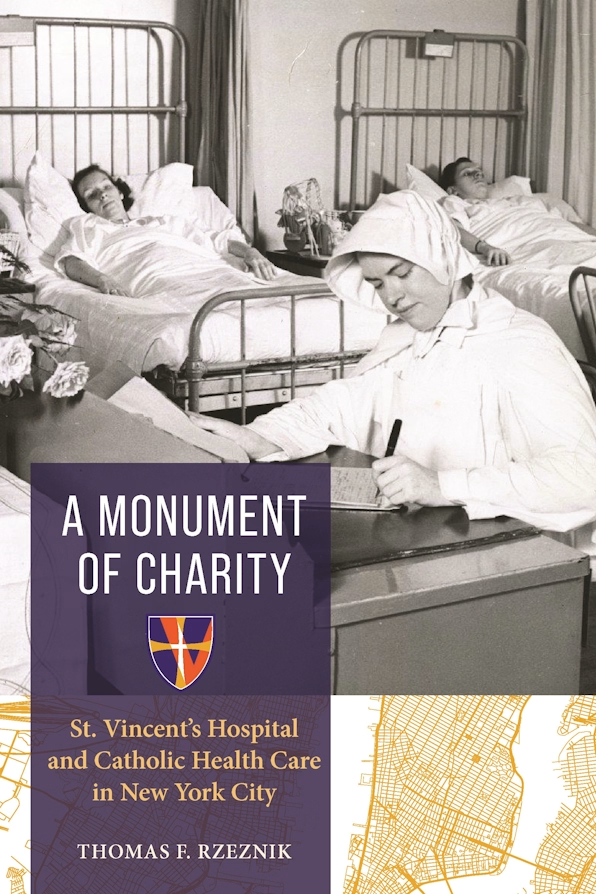
A Monument of Charity: St. Vincent’s Hospital and Catholic Health Care in New York City (NYU Press, 2026) by Thomas F. Rzeznik provides the first comprehensive history of this remarkable institution, from its humble beginnings to its abrupt closure.
St. Vincent’s earned distinction not only for the quality of its medical programs, but also for its unwavering dedication to the poor. The hospital was a testament to the vision and labor of the Sisters of Charity, who founded, staffed, and administered the hospital.
This captivating account documents St. Vincent’s growth into one of the largest and most prominent Catholic medical centers in the United States, as well as its struggles to sustain its religious mission within the ever-changing and increasingly competitive medical marketplace.
The original hospital building opened during a cholera epidemic under the direction of Sister M. Angela Hughes, the biological sister of Bishop John Hughes. It quickly filled to capacity. In 1852 it filled again, this time with victims of a typhoid epidemic. In 1870, the hospital introduced its first horse-drawn ambulance. In October 1892, it launched a School of Nursing.
In 1911, St. Vincent’s Ambulance, manned by hospital interns, responded to the Triangle Shirtwaist Factory Fire. They watched helplessly as those trapped in the fire jumped to their deaths onto the street below.
In 1912, St. Vincent’s received and treated victims after the sinking of the RMS Titanic, while mourning the loss of attending physician Francis Norman O’Loughlin, who died in the disaster.
The Sisters admitted patients regardless of religion or ability to pay. The doctors from Bellevue Hospital worked at the hospital.
St. Vincent’s also operated a soup kitchen. According to an 1892 New York Times article, St. Vincent’s was distinguished from other hospitals in the city by now for its large number of “tramps and other destitute persons.”
In addition to medical history, the book has much to offer those interested in LGBTQ+ history. Many Americans only know St. Vincent’s from its establishment of the first AIDS ward on the East Coast in 1984.
Jonathan Larson’s iconic musical Rent (first produced in 1993) references the neighborhood’s reliance on the hospital during the height of the epidemic and Angels in America, Tony Kushner’s Pulitzer Prize-winning play and its 2003 HBO miniseries, highlights on the hospital’s role. Larry Kramer’s play The Normal Heart and its 2014 HBO film adaptation prominently feature St. Vincent’s.
Despite conflicts over issues like safe sex and condom distribution, St. Vincent’s was one of the few healthcare facilities in New York City that did not turn away HIV/AIDS patients in the early 1980s.
The hospital became “Ground Zero” for the AIDS-afflicted in the city and was practically synonymous with care for AIDS patients in the nation in the 1980s, especially poor gay men and drug users. St. Vincents became one of the best hospitals in New York State for AIDS care and included a large research facility.
In September 1989, members of the AIDS Coalition to Unleash Power (ACT UP) protested in St. Vincent’s Hospital’s emergency room after a gay man was forcibly removed by security for kissing their lover.
Rather than press charges, the sisters met with the protesters to better understand their concerns. The direct action and subsequent meetings led the hospital to change its rules and implement staff sensitivity training to ensure same-sex partners were recognized as family.
In 2016 the New York City AIDS Memorial was dedicated “to honor New York City’s 100,000+ men, women and children who have died from AIDS, and to commemorate and celebrate the efforts of the caregivers and activists.” There memorial is located in St. Vincent’s Park, in the shadow of the former hospital.
Going beyond such important historical moments, A Monument to Charity highlights the immense contributions of Catholic sisters to health care in the United States as well as the enduring legacy of all those who worked alongside them to care for the sick and alleviate suffering.
Thomas F. Rzeznik is Professor of History at Seton Hall University and co-editor of the quarterly journal American Catholic Studies. He is author of Church and Estate: Religion and Wealth in Industrial Era Philadelphia and co-editor with Margaret M. McGuinness of The Cambridge Companion to American Catholicism.
Upcoming Author Event: Greenwich Village branch of the New York Public Library, June 7, 2 – 3 pm
Book Purchases made through Bookshop.org support both your local independent bookstore and New York Almanack’s mission to report new publications relevant to New York State. Purchases via this Amazon link also support the Almanack.
Source link