 Through the nineteenth century in the Empire State a system of “blue laws” at every civic level were enforced, prohibiting all types of activities on the Christian Sabbath. As the twentieth century began, these “blue laws” prevented Sunday baseball.
The sport of baseball had swept the nation, and was popular since the Civil War; played anywhere a bat and ball could be put in use. Americans were baseball mad, they had the fever, and had it bad.
At Geneva, on the northern extremity of Seneca Lake in mid-July of 1902, a game was organized between the local nine and the Dunn & McCarthy Shoe factory team from Auburn, at Pre-Emption Park on a pleasant Sunday afternoon.
Five hundred lovers of the game saw only four innings of their beloved sport before the appearance of the police and the arrest of the two contesting teams brought the game to an untimely end, bringing the Sunday Baseball question to an immediate head.
The game of baseball rapidly outgrew the sandlots and town greens of its infancy with the development of professional leagues, where fans paid admission, and grown men were paid a salary for playing a boy’s game. The present day National League was formed in 1876.
 The ball clubs that did not play in New York and Pennsylvania quickly experienced high admissions which could be collected on a Sunday afternoon. This certainly frustrated the professional clubs in and around Gotham, as the loss of the weekend date severely handicapped gate receipts.
A second Major League was formed in 1901, and by 1903 the nascent American League placed a team in New York to compete with the National League’s Giants in Harlem, and the Brooklyn Trolley Dodgers.
The Brooklyn owner, Charles Hercules Ebbets (1859-1925), looked for a legal loophole to evade the law by putting a price on the score cards instead of tickets, in a ruse to evade the New York State law against charging admission to Sunday ball.
At Washington Park in mid-April 1904, Ebbets drew 12,000 rooters to cheer Brooklyn over Boston at the Park Slope grounds, where the police enjoyed the game. However, in subsequent contests, after the first batter, police officers would arrest the pitcher and catcher, and remove them from the field.
Across town, the New York Giants watched closely what was going on in Brooklyn. Certainly the situation was further complicated with the election of Charles Evans Hughes as Governor in 1906. The son of a Baptist minister, Governor Hughes’ anti-gaming reforms derailed several personal liberties.
The Giants were managed by John J. McGraw (1873-1934), who hailed from Truxton in Cortland County, and was a management partner in the “Jints,” anxious to increase the crowds at their home park, which was the Polo Grounds at 155th Street in Manhattan.
McGraw was known to be bold and forthright, having honed his skills as a player and manager in a different era, before baseball was sanitized and made family-friendly. In the off-season, he would often perform a comical baseball routine on various Broadway stages, and became ingratiated with the fraternal Lamb’s Club and many performers through the Theatre District.
John McGraw had a special animus for the rival American League, and was so impetuous and obstinate that he actually refused to let the New York Giants participate in the 1904 World Series, and no series took place that season.
His team shared Manhattan with the upstart league, whose entry was called the Highlanders, with the New York scribes frequently shortening that handle to “Kilties,” as in a highlander’s garment of choice. Mercifully, the team would eventually relabel themselves as the Yankees.
 Upstate voices also weighed in on the Sunday Baseball matter. George F. Johnson, who practiced “industrial socialism” with his Endicott-Johnson Shoe factories in the Binghamton area, was a supporter. He utilized immigrant labor, realizing this valuable resource of mainly Eastern European workers was an asset to his operations, while providing integration to American life for his dedicated employees.
Johnson’s company-sponsored medical and dental care, housing and mortgages, and also bakeries and cafeterias. He also fostered a strong community with the creation of parks containing wonderful carousels and swimming pools, libraries, recreation centers and dance pavilions.
Critics of Johnson felt his “Square Deal” went to great lengths to keep labor unions out of his shoe factories; however his benevolence remains legendary in the Southern Tier of New York.
Johnson built a minor league ballpark and was a strong advocate of Sunday afternoon baseball, which he felt complemented morning religious ceremonies. His new stadium was in the village of
Lestershire, adjoining Binghamton; that community would be renamed Johnson City in his honor.
George F. Johnson told the Syracuse Journal, “I have been, and am, in favor of Sunday afternoon baseball, properly conducted, under proper restrictions… I will take my chances on Eternity.”
In April 1912, fate took a hand in the Sunday baseball issue in an unusual chain of events, with the unfortunate sinking of the White Star Liner R.M.S. Titanic and its resulting loss of life, and suddenly dispossessed survivors. People in New York realized that when the rescue liner Carpathia docked at the Cunard pier, the survivors of the calamity would be discharged with only the clothes on their backs.
The April 18 edition of the New York Times flashed the headline, “City’s Arms Flung Out To Survivors.” John McGraw and his friends on Broadway, along with team owner John T. Brush, hatched a charity fund raising event to benefit the survivors, employing a special game between McGraw’s Giants and the New York Highlanders at the Polo Grounds as the funding mechanism.
The cagey manager realized that no police officer, clergyman or politician with a basic understanding of Machiavelli’s wisdoms would risk opposing this altruistic groundswell for what had come to be called the “Titanic Game.” The event on Sunday April 21 would feature celebrities and chorus girls moving about the Polo Grounds crowd in the style of vendors, collecting donations.
The Giants home field was affectionately referred to as “Coogan’s Bluff” due to the geographic land form which framed the unusual stadium. Along the roof facade all the pennants of the National League cities fluttered at half mast, as well as the national emblem on the high pole in center field, framed by the Harlem River and the Bronx.
 No tickets were sold for the Titanic Game, in order to comply with the Sunday ban. Instead scorecards needed to be purchased at the gate “Brooklyn style” for seventy-five cents, which allowed the donor-spectator inside.
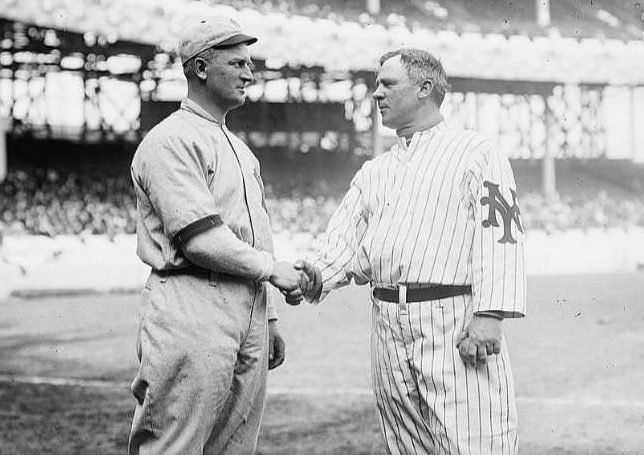
John McGraw welcomed the Highlanders manager Harry Wolverton before they played the exhibition Titanic Game, and explained the unusual dimensions of the Polo Grounds, which stood between the overlooking bluff and rail yards, creating a cavernous centerfield and a pair of short-distance foul poles.
Both teams wore uniforms emblazoned by the interlocking letters N and Y; the Giants in home whites, and the Kilties togged in road grays. Manager Wolverton gave his regular starters a rest, while Manager McGraw would not consider being upstaged on his home grounds.
Always a zealous competitor, some of his novel strategies were at the least impolite, and pushed the limits of the baseball rulebook, leading those who considered his type of play just beyond clever, to refer to him as “Mugsy.” This particular sobriquet also was a reference to his pugilistic tendencies on the ball field.
John McGraw had a very contentious nature, leading to his 131 ejections from ball games, a major league record for decades which was just recently broken.
The Giants scored five runs in the first, and another five runs in the fourth inning, with all base runners stealing, turning the exhibition Titanic Game into a “laugher,” with Manger McGraw making sure each player on his bench got into the game.
It was a chance for McGraw to try his new short-stop, an Upstate New York lad from Rochester named Heinie Groh (1889-1968). Due to his diminutive size, many in the stands thought McGraw had sent in his bat-boy into the exhibition game.
John McGraw had Spalding Sporting Goods produce a specialized bat, with an extremely turned-down handle and an abruptly thick barrel where the bat met the ball. The bottle bat became Heinie Groh’s trademark throughout his long career.
 Entertainer George M. Cohan (1878-1942) sold copies of a Special Edition of The New York American through the stands, which commemorated the Titanic Game. Cohan himself made a contribution of $5,000 for the first paper, and held up plenty of other “big-shots” for their contributions, garnering $200 from William Randolph Hearst and $50 from Mrs. Hearst.
The final score of the Titanic Game was New York Nationals 11, New York Americans 2. The New York Sun wrote the next day that “the conjoint desire to contribute to the Titanic relief fund and to see the Giants and their fellow townsmen the Highlanders meet in a game of baseball attracted 14,083 persons to the Polo Grounds yesterday.”
The Titanic Game demonstrated that the sky would not fall if baseball was played on a Sunday in the Empire State, with the “blue law” ban ending for baseball with the start of the 1919 season.
Library of Congress photos, from above: Giants manager John J. McGraw (home whites) welcoming the Highlanders manager Harry Wolverton (road grays) to the Polo Grounds before the Titanic Game, April 21, 1912; Chorus girls soliciting donations for survivors during the Titanic Game (two images); Heinie Groh with his wife before a Titanic Game with vendors behind (in those days a stadium vendor was referred to as a “butch” or “butchy,” as in “hey butch, two Cracker Jack over here”); and George M. Cohan peddling copies The New York American Special Edition.
Source link