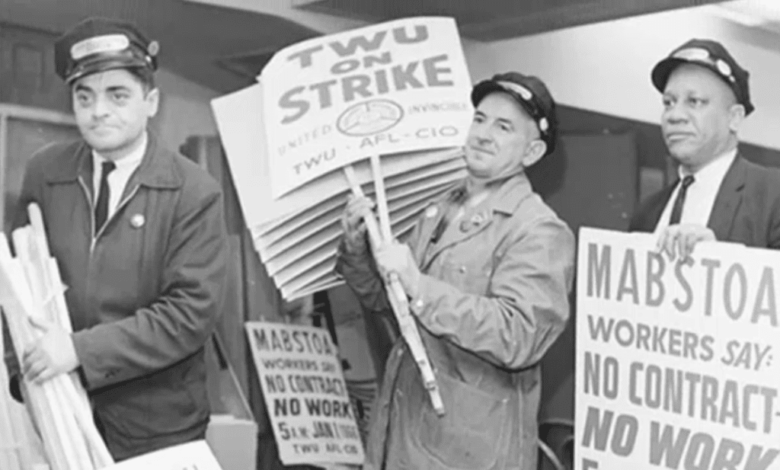
 The twelve-day New York City transit strike in January 1966 is considered the first major citywide shutdown of subways and buses. About 33,000 workers, led by the Transport Workers Union, paralyzed the city on Mayor John Lindsay‘s first day in office.
This strike led to the creation of the still controversial 1967 Taylor Law (Public Employees’ Fair Employment Act), legislation that bars most New York State public employees from striking, or even expressing support for a strike, including state workers, teachers, and municipal employees.
There was also the 2005 New York City Transit Strike, another major labor action, and there have been recent fears that railroad workers on Long Island will go on strike within the next month.
On May 1, 1950, transit workers in Utica, NY initiated a strike. As reported in newspapers such as the Oswego Palladium Times and the Syracuse Post Standard, a collective 230 bus drivers and mechanics employed by the Utica Transit Company (UTC), represented by the Amalgamated Association of Electric Railways and Motor Coach Employees of America (AAERMCE), called the strike as part of a fight for better wages.
The Binghamton Press, among other newspapers, reported that the goal of the strike was to establish a 17 cent pay raise for drivers and mechanics, though one paper noted that the union demanded a nearly 30 cent raise.
Workers at that point were paid $1.25 per hour, and in response the company only offered a 5 cent increase. This strike left between 100-150,000 Utica residents unable to utilize bus services.
Since the UTC provided the only bus service in the city, the effect of this strike on these residents was almost immediate. In the May 2 edition of Gloversville and Johnstown paper, The Leader-Republican, stated that “workers are shoppers were pelted by heavy rains yesterday as they walked about the city.”
 Carpooling efforts were made to deal with the absence of buses, and taxi services were still available. But there were only so many taxis available in the city, so while local taxi companies saw record business, many still endured the rain.
The Schenectady Gazette noted that due to the influx of cabs in Utica’s street, one operator “was unable to promise service in less than 20 minutes despite two-way radio contact with his vehicles.” A city ordinance blocked taxis from cruising on Genesee Street, which further complicated the situation.
There was conflicting information concerning whether or not strikers and representatives of the UTC were in negotiations. The Leader-Republican and Rome’s Daily Sentinel reported there was a meeting on May 2, but other outlets denied such a meeting had taken place.
The Binghamton Press and the Albany Knickerbocker News quoted UTC a spokesman Thomas J. McAndrews saying that there was no meeting between the two parties that day, nor was there one scheduled for the future, and that he had “nothing to report” on the matter.
The status of the May 2 meeting was clarified by The Niagara Falls Gazette, which stated that the meeting “did not materialize.”
A meeting did take place on May 3rd. The Glens Falls Times explained that this meeting materialized after the union reduced the amount they demanded for a raise from 17 cents to 7 cents. With the help of Utica Mayor Boyd E. Golder, the union and the UTC reached a compromise – drivers and mechanics would accept a 6 cent raise, well below their initial target.
Beyond the wage settlement, a larger compromise effected the actual contract of the AAERMCE. A new contract was adopted that was made retroactively effective as of May 1. This new contract removed an arbitration clause present in the old agreement, something that likely made negotiations more difficult in future disputes.
Buses returned to their normal schedules on May 4. While the end of the strike meant a win for those in Utica who relied on buses and a definite win for the Utica Transit Company, it’s difficult to call the result of this strike a true win for the drivers and mechanics.
Read more about labor history in New York State.
J.N. Cheney is an independent historian focusing on the labor movement, radical politics, and community action where he lives in the Mohawk Valley. His book is Women, Immigrants, and the Working-Class Battle in Little Falls, New York: The Textile Strike of 1912-1913 (Algora Publishing, 2025).
Illustrations, from above: The 1966 New York City Transit Strike; and a Utica Bus of the 1950s (courtesy Around Town).
Source link