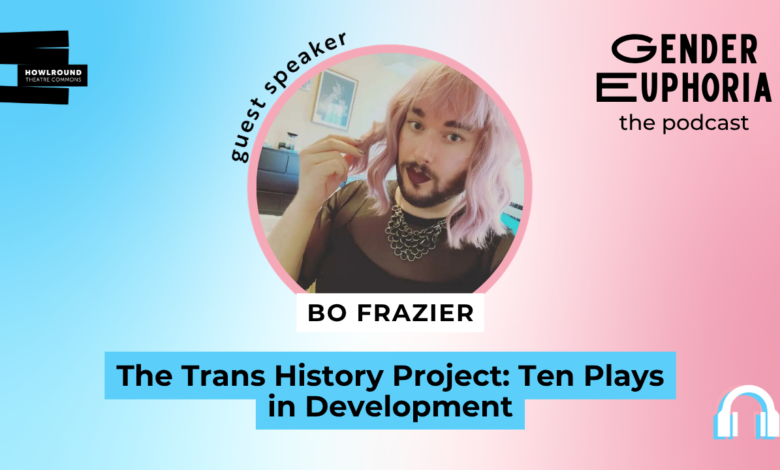
Nicolas Shannon Savard: Hello, and welcome to Gender Euphoria: The Podcast, a series produced for HowlRound Theatre Commons, a free and open platform for theatremakers worldwide.
I’m your host, Nicolas Shannon Savard. My pronouns are they, them, and theirs.
Today we are talking trans history, specifically in the context of the multi-playwright, multi regional theatre, multi-city undertaking that is the Trans History Project.
The Trans History Project is a revolutionary national initiative created by Bo Frazier, Baltimore Center Stage’s artist-in-residence and led by Baltimore Center Stage and Breaking the Binary Theatre. This project aims to commission, develop, and publish ten new plays about the real history of gender nonconformity, which has existed across all cultures since the beginning of time.
Beyond that epic description, part of the project’s purpose is “an effort to teach the world our TGNC history and build a trans canon.” Part of the mission that spoke to me as I was planning this season of the podcast was the commissioning trans and nonbinary playwrights to “tell stories of trans and gender nonconforming folks from history and folklore and how they relate to the aggressive legislative attacks seeking to, quote, unquote, eradicate our community from the society.”
That link between past and present, looking back and bringing forth queer and trans histories, honoring and building upon their legacies of art and activism will be a major throughline over the course of season three.
In this episode, Bo Frazier and I will dig into why amplifying trans voices and shedding light on trans histories is deeply necessary work in 2026. We’ll unpack what the Trans History Project is doing to offer counter-narratives in a political moment defined by trans erasure and give you a taste of the stories the first cohort of playwrights have in development.
Here’s my conversation with Bo.
Chorus of voices: Gender euphoria is bliss. Freedom to experience masculinity, femininity, and everything in between. Getting to show up as your own self. Gender euphoria is opening the door to your body and being home. Unabashed bliss. You can feel it. You can feel the relief. Feel safe. And the sense of validation and actualization. Or sometimes it means being confident in who you are. But also to see yourself reflected back. Or maybe not, but being excited to find out.
Nicolas: Hello. Welcome to Gender Euphoria, the Podcast. I’m your host, Nicolas Shannon Savard. My pronouns are they, them, and theirs. I am here today talking with Bo Frazier about the Trans History Project, which I am super excited about.
And before we dive in there all the way, Bo, could I have you introduce yourself?
Bo Frazier: Sure. My name is Bo Frazier. Pronouns are they, them. I am currently based in Baltimore. I am a theatre director, producer, nonbinary baddie, originally from the Midwest. But I’ve sort of jumped all over the world. Did five years in London, and New York, Chicago, and now ended up in Baltimore. And very, very hashtag blessed to be able to do this work.
Nicolas: Alright! So we’re here today talking about the Trans History Project. As a scholar of trans history, I am very excited to nerd out about that. So could you just give us a broad overview of what the Trans History Project is? What kind of programming is involved?
Bo: Sure. So the Trans History Project is a new play development program. We are, over the span of four years, commissioning and developing ten new plays about trans and gender nonconforming history from across all cultures. It is a fairly large partnership. The main sort of theatre that is producing and commissioning is Baltimore Center Stage, where I am the artist-in-residence. We do co-produce this project with Breaking the Binary Theatre in New York, which is a really wonderful TGNC-focused theatre company. And then we’re also partnering with regional theatres who are then developing the pieces.
It is a pretty large undertaking. And we are very fortunate to have gotten a very large grant from the American Theatre Wing to make this happen. For those that don’t know, the American Theatre Wing is the organization that does the Tony Awards. So it was pretty major. One of five companies to get this grant.
Nicolas: Big deal. Big deal.
Bo: Just a little bit. I think the day I got that email, I cried, for sure. So yeah, that is the program.
Nicolas: So start diving into a little bit of the content of the project. So you’re specifically focused on commissioning stories about real historical figures who, although, you know, language varies across time, cultures, we understand them today as transgender nonconforming. Can you talk a little bit about why you chose that historical lens for this project?
Bo: Yeah, I was never a history girlie. I sort of fell into the history of, specifically around queerness and transness, later in life for sure. I was always, in my twenties I was very much like new, new work, new forms. It was not as concerned with creating work around history, but also very respectful of history. So just personally, I came out as trans nonbinary pretty late in life at thirty-one. And of course, I had my like, “Ring of Keys” moment where someone in grad school was like, so openly, very not conforming to any sort of gender. And I was like, oh, that’s it. And that was like a beautiful moment. And we’re still friends today. They’re a playwright and we work together. But…
Nicolas: Don’t we all have that “Ring of Keys” moment?
Bo: We do. We do. Which is, again, why this work is so necessary because people need those moments.
Nicolas: Quick bit of context. The “Ring of Keys” moment we’re referring to there has a couple of layers. First, it’s a reference to the song “Ring of Keys” from the musical Fun Home, adapted from Alison Bechdel’s graphic memoir of the same name. In the scene, young Alison is sitting in a diner with her father when a delivery woman, an old school butch, comes in. And for Alison, it’s this moment of immediate recognition and connection, a vision of what queer butch adulthood could look like for her. That lays the groundwork for layer two. My, or Bo’s, or another queer or trans person’s “Ring of Keys” moment gets to be kind of a shorthand for describing our own experiences of the beginnings of the formation of our own queer identities. Often, those very brief but no less powerful moments of clarity of what a queer future or a trans future could look like for yourself, specifically because you’re seeing someone else embody it and own it.
Okay, back to Bo.
Bo: But when I came out, I did a really just a quick Google of history of nonbinary people. And there is such a breadth of history that I found on the internet with just a quick Google search. But obviously, we were not taught that in school, weren’t even taught about Stonewall or even, you know, gay rights or any sort of trans folks. And it was like fascinating to me, and also so affirming to me that like some Native American tribes recognized five genders, and you know, Indian hijra people are revered beautifully in society. And just all these cultures have these examples. And I never knew. And I was like, why don’t more people know about this? Obviously, we know why systemically, but like more people need to know about this. Theatre is my form of choice as a creator. And I sort of like, originally envisioned this as one play, that I was like, going to get ten playwright friends together, and we can write one play with like ten vignettes of like, different cultures, TGNC history figures.
And I pitched it to my playwright friend, C. Meaker, who’s a fellow nonbinary artist. And they were like, we deserve more, dream bigger. And I was like, great, let’s go. So then that’s where like, this was birthed. I was like, okay, instead of ten vignettes, we’re doing ten whole plays. And Stevie Walker-Webb, our artistic director at Baltimore Center Stage, is all about this. He was very excited when I pitched this. And they’ve been very, very supportive.
So the history of it all is like, I firmly believe that if we were taught that history, and if, you know, the colonizers had not erased cultures and indoctrinated us with Christian, Western beliefs, like, I know that we would not have the hatred and the violence that we have today. And so it’s part of my mission with this project to tell those stories and tell the history and prove that we have always existed. And not only tell those stories, but also like humanize trans and nonbinary folks, because we are so villainized by such a large group of people in this country. And history is the way to do it.
Nicolas: From reading the kind of mission statement of the project, I got a really strong sense of there being like a really strong cultural and political need that the project was trying to fill.
Can you talk a little bit more about that? Why now? Why now? I mean, gestures broadly at America, but why now?
Bo: Why–I mean… Really the question is–or not a question–the statement is: now more than ever. I’m really struggling with this current political moment and have been struggling with it for some time. I mean, I cannot believe that the current president was even allowed to run a second time. And we are seeing the like deterioration, not only of democracy, but also like we have seen that protest is not effective anymore. Where like, you read about it and my mother talks about the history of like protesting in the sixties and how it did something. And it does not because our current quote unquote leaders don’t listen to anything other than their ideas on Truth Social. So in a like slightly pessimistic view, I just don’t feel like we can get anything done on the macro larger governmental level… at least that I can do as a theatre artist in Baltimore. So I was like, how can I still make change and make waves and make positivity? It has to be on the micro level within my community, within the theatre community, within the TGNC community. So this is like, this is my form of protest. And I had this idea that has been supported with funding that I am now allowed to pay trans artists. I am really hoping to start a little mini revolution on like not only how to develop new plays in regional theatres, but also like really ramp up the representation on our stages and screens. Trans representation of, in writers and actors and stories is like 0.1 percent and it’s quite depressing.
Nicolas: Which we are a small part of the population. Not that small.
Bo: Not that small.
Nicolas: There’s more of us than that.
Bo: But like with as much as we are a part of the political and social vitriol conversation right now, you would think that the stories on stage would match and they just don’t. Like we got to balance out the hatred with positivity. And that is what I’m like working towards with this. So yeah, this is my protest. And this is my support for my community. And this is how I can show up.
Nicolas: I don’t think that feels pessimistic at all. That feels really radically hopeful.
Bo: Well, okay. I hope, yeah. I do want to be hopeful. I just like—
Nicolas: Like in a super queer way of like, no, I will fight you, but in my own way.
Bo: Yeah, I’m trying.
Nicolas: You’re doing it. Doing the thing. So tell me a little bit about who are the playwrights involved? And you’ve got two cohorts of playwrights. We’re in the middle of the first kind of year cohort now. Who’s involved? Whose histories are they digging into right now?
Bo: Yeah. So we have the first cohort of playwrights, which are five. Well, it’s five pieces, but there are eight artists. And I’ll explain. We are going to open submissions for cohort two, literally at this moment in early April. We’re hoping to launch it at the end of April. So hopefully. The playwrights are phenomenal. They range from like a produced, traditionally musical theatre composer who now is writing her first full-length play. We have a performer, author, intimacy, choreographer and playwright who has been produced and developed a lot. And then we have an actor who is writing their first play coming from a history of poetry. And then we have a devising ensemble, which I was very interested in including because I’m a deviser myself. My training is in devising and musical theatre, which is like the most, you know…
Nicolas: What a combo.
Bo: Yes. So I very specifically wanted to open it up to pieces that were not playwright centered, that were like collaboratively made with multiple artists. So yeah, it is a big range of artists. So the first one is that I will talk about is Dane Edidi Figueroa. She is based in DC, but works all over. She is a performance artist, poet, author, educator, so many things. And her play is about Lucy Hicks Anderson, which is the story about actually a trans Black woman who was living openly and freely as herself, born in 1886, but passed away in 1954. She was a socialite, a chef, philanthropist. And we’re actually having her reading in New York tomorrow, which I’m heading to, which I’m very excited. Yeah, and that’s being developed with Long Wharf Theatre in Connecticut.
Nicolas: Dane Edidi Figueroa’s description of her play, A Continent of Forget: When a new man walks into her life, Lucy, a widow, does not know if she is ready to open herself to love again. As her culinary business blooms and her food gains notoriety, elders and ancestors alike rally around her as she learns how to let go. Steeped in magical realism and historical realities, A Continent of Forget is loosely based on and pays homage to the incredible life of Lucy Hicks Anderson, an American socialite, chef, and philanthropist.
Bo: And then we have Bree Lowdermilk, who is a musical theatre composer of Kerrigan and Lowdermilk. She is writing a play about transness and gender nonconformity within the Jewish culture. And it starts in modern day around a family around a table in the Days of Awe, which is also what it’s called.
Nicolas: Bree Lowdermilk’s Days of Awe is inspired by the life and work of sci-fi fantasy writer and DC Comics author of the first mainstream trans superhero, Rachel Pollack. Their description: Yom Kippur dinner erupts into absurdity and chaos when a daughter comes out as trans to her Jewish family. After her family insists that her identity is too newfangled, we hurdle backwards chronologically through history, revealing the enduring presence and erasure of trans people across centuries and borders. In the period between Rosh Hashanah and Yom Kippur, today at this family’s suburban home and thousands of years ago, Days of Awe invites us to look back with humor, ritual, grief, and reverence in order to step forward.
Bo: But it jumps back in time and culture and it is like epic in the way that Angels in America is epic. We did a Zoom reading a couple of weeks ago with like a low-key celebrity cast. It was crazy. And what it is trying to do and succeeding at doing is so beautiful and powerful and epic and I’m like obsessed with it.
Then we have Roger Q. Mason. They are a California-based playwright and they’re doing a piece around like the 1950s Harlem drag king Gladys Bentley who, yes, was a drag king but also like hung up their hat and their transness to rewrite their story and married a cook in LA. And it’s taking the form of like a cabaret. And that’s being developed at Diversionary Theatre which is the LGBTQ theater in San Diego.
Nicolas: Roger Q. Mason’s The Gladys Bentley Project. It is 1952. Harlem’s most infamous drag king Gladys Bentley has hung up her gender-bending, queer-affirming act, married a short order cook in Los Angeles and decided to write her life story. Join Gladys as she pitches us, the audience, her new biography. We’ll travel with her to the clubs that made her, the night prohibition ended an era in her career, the doctor’s office where she sought sexual conversion treatment and all the while we’ll ponder: how does a vibrant dreamer like Gladys Bentley thrive in a world that limits her dreams?
Bo: And then we have Yona Moises Olivares who is a performer poet in Chicago and they are writing a piece called Miss EMERICA and it takes the form of a pageant. Trans women and trans nonbinary folks from the Latinidad are competing in a pageant and you slowly realize in these like campy, extravagant categories that they’re actually competing for a green card.
Nicolas: Yona Moises Olivares’, Miss EMERICA. She is beauty. She is grace. She is undocumented? Congratulations and welcome to America where you get the amazing opportunity to compete and earn your spot as a real American woman. Part farce, part docu-theatre, all bullshit, Miss EMERICA follows a group of historical transgender nonbinary folks as they compete in a pageant that will grant only one participant citizenship. We the people follow these contestants on and off stage as they seek to prove their womanhood and ultimately win their place in America, land of the beautiful.
Bo: It is one of those plays we’re developing here at BCS and I’m directing it, the reading is in June. It’s one of those pieces that’s like gonna start really entertaining. The host is a Latina drag queen called Nana based on the like, the really toxic, awful history of Chiquita Banana. And it’s gonna start off really campy and hilarious and then it’s gonna like punch you in the gut. And it is a really, really powerful piece.
And then our final piece, our final group is the ensemble called Mirage Auto Depot made up of all TGNC folks in Brooklyn. And they’re doing a piece called Les Biches but it is spelled Les Bitches. It’s based on Claude Cahun and Romaine Brooks who were like both revolting against fascism in the twentieth century but also like resisting and revolting in different, very different ways. And it’s like analyzing how to show up against fascism which is like obviously very timely but even though it takes place in the early twentieth century.
Nicolas: Auto Mirage Depot’s, LES BI(T)CHES or Les Bitches is a trans-historical experiment spiraling around the simultaneous and divergent lives and creative practices of gender nonconforming lesbian artists Claude Cahoon and Romaine Brooks. Amidst the rising fascism of the early twentieth century Europe set against the backdrop of Parisian artists salons, LES BI(T)CHES examines queer community resistance and fracture in the face of oppression and splintering alliances and values adapted from the early twentieth century ballet Les Biches choreographed by Bronislava Nijinska and blending historical fiction with archival text, artworks, and speculative encounters. LES BI(T)CHES holds a whirled mirror to our present moment searching through the detritus of the past to understand what holds queer communities together and what divides us.
Bo: Yeah, those are our plays! It’s like a very, very wide range of pieces.
Nicolas: I love that there’s such a range of forms, too. It’s not just all—well I guess none of them are straight plays.
Bo: Well…
Nicolas: Forgive my pun.
Bo: Personally, as a director, I am very interested in like changing the dramatic form and I don’t typically direct realism and I’m not typically drawn to realism. So a lot of these pieces not existing in realism, while it didn’t happen because of me, I am very happy that it did happen. So we are like not only queering the stories but also queering the dramatic form and really challenging what a play is and can be.
Nicolas: What are some of the questions that these plays are kind of exploring and digging into about these histories that have you most excited to produce their work?
Bo: Yeah, so specifically around Miss EMERICA, even though it is I would say mostly in modern day as a modern day pageant, there is a very prevalent historical context and historical character of Juliana Martinez who was an El Salvadorian trans woman who was arrested in the early twentieth century. And there’s just one small article of her in some newspaper and the quote is “she was crossing the borders of gender.” And that’s such a crazy statement but also such a profound question to be asking about the certain moment.
What are the borders? What does it mean to be crossing borders of nations but also power, government, and also obviously “crossing the border of gender”—what does that even mean? It is very, very specifically questioning what are borders and why do they exist and who do they help?
I think around LES BI(T)CHES, they’re very specifically asking how do we resist? How can we resist? And how do we stand up to fascism? Is there one specific right way to resist? And that’s a lot of their around a lot of their devising is around that subject.
I think that within the Days of Awe, it’s exploring, like obviously, the identities within Jewish history but like how similarities of stories happened thousands of years ago but they are still happening today and what those histories are saying about today and how history is circular and cyclical and happens over and over again. We never learn. We never learn.
Nicolas: Pausing for a moment to put on my teacher hat. It is my duty as an educator, doctor of queer trans performance, professional nerd, gay archive gremlin, to give you a tour of my favorite places to dig deeper into trans history. Some learning resources, scholarly publications, and archival collections for you, dear listeners!
For the big picture historical overview and really smart archival explorations of trans lives across the centuries I turn to Transgender History: The Roots of Today’s Revolution by Susan Stryker. This one’s focused on the evolution of trans identity and community in the US post-World War II to the present.
For a more globally focused exploration of trans histories there’s Before We Were Trans: A New History of Gender by Kit Heyum.
Connected directly to the Trans History Project, you can read more about Lucy Hicks Anderson (subject of Dane Figueroa Edidi’s A Continent of Forget), her contemporaries, and the intersections of transness and Blackness in American history in C. Riley Snorton’s Black on Both Sides: A Racial History of Trans Identity.
If you’re looking to do your own historical research one of my favorite internet rabbit holes to dive down is the Digital Transgender Archive. It’s a multi-university, multi- library, multi-regional archive, national collaboration to make trans history and archives accessible to all. It is full of newspaper articles, photos, performance flyers, zines, community newsletters. They’ve got a great collection of material on Gladys Bentley if you’d like to see the Harlem Renaissance drag king for yourself.
To learn more about the other figures featured in the Trans History Project I recommend Rachel Pollack’s memoir Trans Central Station and you can check out her work creating DC Comics’ first trans superhero Kate Godwin aka Coagula in the series Doom Patrol.
While there are other biographies of Claude Cahun, the most compelling and delightful one I found is Kaz Rowe graphic biography Liberated: The Radical Art and Life of Claude Cahun. It’s a beautifully drawn visual narrative of gender-bending, queer love, and anti-fascist resistance.
Okay that’s all for this episode. Next week I’ll continue my conversation with Bo Frazier and they’ll talk more about how the Trans History Project is designed as a cohort of both playwrights and theatres. We’ll unpack what they’re doing to build structures of support for trans artists and for new work development.
Before I go I’ll leave you with a snapshot of gender euphoria and joyous queer community. This one I found when I was perusing the Digital Transgender Archive. It’s a grainy black and white photograph taken sometime in the 1940s at Finocchio’s Club, a prohibition era speakeasy turned nightclub turned performance venue in San Francisco. The place was well known for its drag shows.
Photo’s caption reads: “group photo of Finocchio’s performers female impersonators pose for a picture on stage at Finocchio’s”. It’s sixteen performers crowded onto a stage not nearly big enough for a group that size. The velvet curtains nearly graze the top of the girls wigs in the back row. They are dressed in elegant ball gowns feathers, pearls, corsets, the highest of high heels. All sixteen faces smiling, shoulders back, confident. They are absolutely in their element.
This has been Gender Euphoria: The Podcast. Hosted and edited by me, Nicolas Shannon Savard. The voices you heard in the intro poem were Rebecca Kling, Dillon Yruegas, Siri Gurudev, Azure D. Osborne-Lee, and Joshua Bastian Cole. The show art was designed by Yaşam Gülseven. This podcast is produced as a contribution to HowlRound Theatre Commons. You can find more episodes of this show and other HowlRound shows wherever you find podcasts, including on noncommercial open source apps like Anytime Podcast Player for iPhone and AntennaPod for Android. If you loved this podcast, please share it with your friends, your colleagues, your students. You can find a transcript for this episode along with lots of other progressive and disruptive content on howlround.com. Have an idea for a meaningful podcast, essay, or TV event that the theatre community needs to hear? Visit howlround.com and submit your ideas to the knowledge commons.