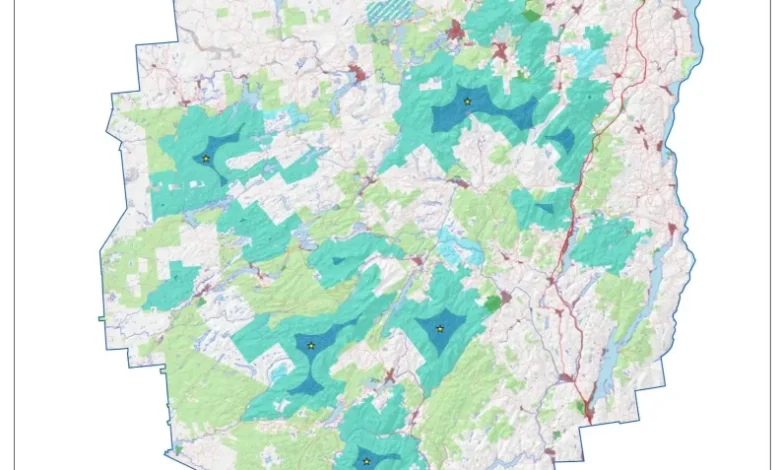
 New York State’s Adirondack Park offers much less remoteness than you might imagine. In the 2010s when all areas at least three miles from a road and at least two miles from motorized lakes were mapped, it left less than 3% of the Park.
Now a coalition of environmental organizations is asking the Adirondack Park Agency (APA) to develop new Policy and Guidance to measure and better protect those remote areas.
The Adirondack Council, Adirondack Wild, Adirondack Wilderness Advocates and the Rewilding Institute submitted a detailed proposal to the APA and the New York State Department of Environmental Conservation (DEC) for measuring remoteness.
“The rationale is simple,” Adirondack Wilderness Advocates Board Chair Pete Nelson says. “If we can measure remoteness we can protect it better. Lands that are remote from human disturbance are in scarce supply, not only in the United States but even in the Adirondack Park.”
In 2012 the private Project Remote, an effort to discover the most remote place in every U.S. state, determined that it was on the north side of the Cold River, less than a half mile from the Northville-Placid Trail. The most remote spot was only 5.3 miles from a road, near the Seward and Ouluska lean-tos.
In 1936 wilderness advocate Bob Marshall wrote about the damage the recently constructed Calkins Creek Truck Trail in the Western High Peaks, saying it ruined the remoteness he had experienced there as a young man.
“The Cold River drainage is no longer a whole world where one can live the splendid life of the primeval,” he wrote.
Remoteness As An Ecological Characteristic
Remoteness is one of the characteristics enshrined in the Adirondack Park State Land Master Plan (SLMP). It is an essential feature of “untrammeled” wilderness and the ability to experience solitude.
“Untrammeled Forest Preserve lends to feelings of being unconfined, unlimited and free to explore on foot or ski remote Adirondack country on its terms, contrasting with our otherwise mechanized and digital lives,” said Adirondack Wild’s David Gibson.
“By being measurable, this policy can strengthen the contrast value of more remote Forest Preserve with areas closer to roads, and be especially helpful to guide planning choices about where to route hiking, biking, skiing, and snowmobiling trails.”
Remoteness is not just an aesthetic quality, but also a critical feature of ecological integrity, affecting everything from wildlife to the impact of invasive species.
“Science demonstrates that remoteness plays a key role in maintaining biodiversity and ecosystem resilience,” said Adirondack Council Director of Conservation Jackie Bowen. “When roads and trails expand into previously undisturbed areas, the impacts ripple outward, altering wildlife behavior, increasing invasive species pressure, and weakening natural climate defenses. Establishing consistent, science-based measures of remoteness will give managers the tools they need to evaluate those impacts and make better long-term decisions on the Forest Preserve.”
“The proposal embraces and is consistent with the SLMP’s definition of remoteness,” an announcement of the initiative sent to the press says, adding:
“It is not intended to redefine remoteness in any way, nor to set thresholds for how much remoteness might be required in a given area.
“The sole purpose is to establish objective baseline measurements in order to provide a useful tool for comparing the impacts on remoteness of various management actions, such as routing, rerouting or closing roads or trails.
“These measurements can help the State and stakeholders apply the letter and spirit of remoteness in SLMP, helping to protect an essential, scarce resource.
The coalition is asking the APA to formally consider this proposed Policy and Guidance on measuring remoteness by engaging in a public process, including public hearings and a comment period in 2026.
Read more about the Adirondacks.
Illustration: Adirondack Park Agency (APA) map of most remote areas, ca. 2012.
Source link