
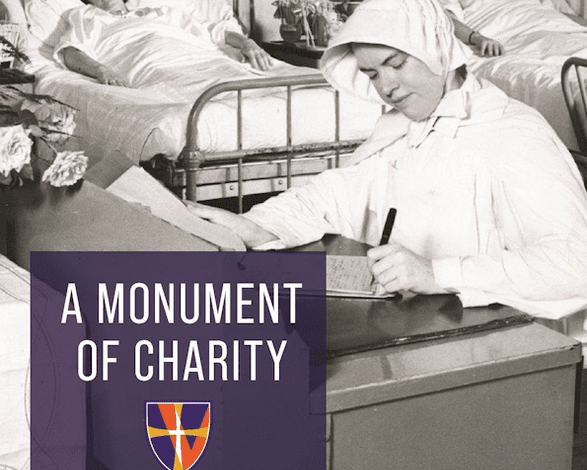
 A Monument of Charity: St. Vincent’s Hospital and Catholic Health Care in New York City (NYU Press, 2026) by Thomas F. Rzeznik provides the first comprehensive history of this remarkable institution, from its humble beginnings to its abrupt closure. What follows is a Q & A with the author:
Why and when was St. Vincent’s hospital founded? What was its mission? What were some of its distinctive achievements?
St. Vincent’s Hospital was founded in 1849 by the Sisters of Charity of New York. The city had just experienced a devastating cholera epidemic and the sisters took it upon themselves to do what they could to help those in need, especially the poor.
They began their work in a rented townhouse equipped with thirty beds and not much more. It was a humble act, but one guided by a deep sense of purpose.
St. Vincent’s was founded specifically to provide “care of the sick with no financial means of their own” – a mission that endured for more than 160 years.
St. Vincent’s was a truly remarkable institution. In addition to being New York City’s first Catholic hospital, it was the first to offer private accommodations, the first to have a motorized ambulance, and the first to develop a coronary intensive care unit. At one point it was also the largest church-affiliated hospital of any religious denomination in the country.
It earned distinction for the quality of its medical programs and its unparalleled commitment to nursing care. But most importantly, it served as a refuge for those in need, accepting all regardless of creed, color, nationality, or financial status. It stood as a model for what health care could be.
Can you describe the Sisters of Charity? Who were they and what did they accomplish?
The Sisters of Charity are a Roman Catholic religious order; vowed women dedicated to serving the poor. The community was founded in 1809 in Emmitsburg, Maryland, by Elizabeth Ann Seton, a native New Yorker who is recognized by the Catholic Church as the first American-born saint.
The first sisters to serve in New York arrived in 1817, responding to an urgent request from the bishop for them to establish and manage an orphanage. The sisters’ ministry soon expanded into education, health care, and social welfare.
By the early twentieth century, they operated a vast network of schools, hospitals, and other institutions throughout the local archdiocese. They were pioneers in organized charity, helping build up the Catholic Church’s presence in New York while serving those in need.
Their record of selfless service earned them immense respect and gratitude from generations of New Yorkers, both Catholics and non-Catholics alike. They are rightly remembered for caring for those in need often when no one else did.
Why are faith-based institutions, like St. Vincent’s, important for providing medical care, as opposed to other voluntary hospitals or public institutions?
Faith-based institutions are important because they are guided by mission rooted in religious values. When St. Vincent’s opened, it promised to care equally for all, regardless of their state or station in life.
Patients did not need to prove their financial or moral worthiness. The hospital served all, without discrimination or distinction.
That was a radical stance at the time, one that set St. Vincent’s apart from other hospitals and asylums of the day that routinely turned away the poor or subjected them to scrutiny or shameful conditions.
As the need for medical care increased, religious communities often took the lead in establishing the nation’s early hospitals and other healthcare facilities. The goal was not simply to provide care for members of their own religious communities, but to put faith in action.
For the Sisters of Charity, St. Vincent’s provided them with an institutional foundation to live out their vocation of service to the sick poor and others on the medical margins. They strove to make medicine more compassionate and humane, and in so doing they transformed healthcare in New York City.
St. Vincent’s provided emergency services for the victims of the Triangle Shirtwaist Factory fire, and a year later, received public accolades for the care it provided to those rescued from the Titanic. How did these events cement St. Vincent’s status as a community institution?
St. Vincent’s is often remembered for its response in times of crisis. The hospital stood ready to care for those in need when tragedy struck. In the early twentieth century, that included victims of the Triangle Shirtwaist Factory fire, one of the most tragic industrial accidents of the time, and those rescued from the Titanic.
When news of that shocking disaster reached the hospital, the sisters sent a fleet of ambulances to the docks and promised to care for as many passengers as they could – especially the poor who had been traveling in steerage.
Such actions revealed how St. Vincent’s had reoriented itself during the early twentieth century from a sectarian charity to a vital community institution serving all those who lived in Greenwich Village and the surrounding neighborhoods.
The hospital’s ambulance service raced through the crowded streets to respond to those in need, and the hospital’s dispensary served as the “family doctor” for tens of thousands of Village residents.
When other hospitals in the area relocated uptown, St. Vincent’s rededicated itself to serving the local community. Residents came to see St. Vincent’s as “their hospital,” and knew that they could rely on the hospital to be there for them.
The AIDS crisis was a defining moment in St. Vincent’s history, as the hospital was located in the heart of Greenwich Village at the epicenter of the crisis. How did the hospital care for victims of AIDS, who faced broad stigma and alienation?
The AIDS crisis was indeed a defining moment for St. Vincent’s. Even to this day, many in the LGBTQ community remember the hospital for its heroic response to that harrowing epidemic.
Among the city’s major medical centers, none witnessed the devastation more acutely than St. Vincent’s, which stood on the front lines of the crisis and whose very name became synonymous with AIDS care.
It housed the first and largest AIDS ward on the East Coast and remained one the nation’s largest AIDS treatment centers well into the 1990s.
But more than that, St. Vincent’s offered compassionate care to those suffering not just from the disease, but also from alienation and abandonment.
Among those who shaped the hospital’s response, none was more important than Sister Patrice Murphy, the founder of the hospital’s Supportive Care Program.
She worked to recruit staff members and volunteers to work with patients with AIDS and sought to combat the stigma associated with the disease. She reminded others in the hospital that they were not there to judge, but to serve as caregivers and healers.
They were to embrace all, unconditionally. Even though the hospital’s response was not perfect, especially in the early years of the crisis, it refused to turn its back on the afflicted. St. Vincent’s responded to them as it did to all: with love and charity.
The hospital played a prominent role in caring for victims of 9/11. Can you describe that?
Of the city’s major medical centers, St. Vincent’s was closest to the World Trade Center. So when news of the attacks went out, the hospital sprang into action. Extra emergency rooms were set up and teams of medical staff lined up outside waiting for ambulances to arrive.
In the days that followed, St. Vincent’s treated more than 1,400 people, including 450 first responders. Many in that first wave were the “walking wounded” in need of attention for eye irritation, respiratory distress, or wounds from falling debris.
Sadly, though, as the days passed, a grim reality set in: most of the victims of the attacks had not survived. Like their counterparts at other hospitals, those at St. Vincent’s stood waiting for patients who never arrived.
But the hospital responded in other ways, too. Its call center fielded more than ten thousand inquiries from friends and family members desperate for information about their loved ones.
Others came to the hospital with photos hoping for positive identification. Some began to post those images on the wall outside the emergency room, which turned the hospital’s facade into a makeshift shrine to those who had died.
The Wall of Hope and Remembrance, as it was known, marked the hospital as hallowed ground.
Why did the hospital close abruptly in 2010?
The hospital’s closure — a sad ending to a remarkable story — is a complex tale that reflects the challenges of the medical marketplace.
In the late 1990s, St. Vincent’s became part of a new Catholic healthcare system (which bore the St. Vincent name) intended to help institutions compete with other networks. But the finances proved precarious and St. Vincent’s simply could not sustain the system’s other struggling hospitals.
In the end, efforts to save St. Vincent’s fell short. In the wake of a 2005 bankruptcy, hospital officials launched a reorganization plan and looked to redevelop the St. Vincent’s campus and build a brand new hospital.
But the Great Recession (2007-2009) and the collapse of financial markets caused the plan to crater. When attempts to secure a new partner or sell the hospital failed, St. Vincent’s had no choice but to shut its doors. With that, New York City’s first Catholic hospital had become its last.
How has Catholic healthcare changed over the centuries, since the founding of St. Vincent’s in 1849? What problems do faith-based hospitals face today?
Catholic healthcare has certainly changed a great deal since 1849. In the book, I show how St. Vincent’s evolved from a humble refuge for the sick to a major medical center. It stood as a triumph of what religious communities could accomplish.
But as it grew larger — and healthcare became more complex and more costly — St. Vincent’s struggled like countless other charitable institutions to find the resources necessary to maintain its mission.
Modest donations and the uncompensated service of the sisters that once sustained the hospital were no longer enough. Still, it refused to surrender to the logic of the market and limit the amount of charity care it provided.
As real as the pressures that faith-based institutions face are, the history of St. Vincent’s reminds us that the need for their witness is as important now as it was before.
They continue to be a vital part of the nation’s healthcare sector, especially in advancing faith-based commitments to caring for the poor, respecting human dignity, and ensuring equitable access.
In the end, I hope that book serves as a tribute to the monumental work of charity that was carried out at St. Vincent’s and that continues still at countless other Catholic hospitals and healthcare facilities across the country.
Thomas F. Rzeznik is Professor of History at Seton Hall University and co-editor of the quarterly journal American Catholic Studies. He is author of Church and Estate: Religion and Wealth in Industrial Era Philadelphia and co-editor with Margaret M. McGuinness of The Cambridge Companion to American Catholicism.
Book Purchases made through Bookshop.org support both your local independent bookstore and New York Almanack’s mission to report new publications relevant to New York State. Purchases via this Amazon link also support the Almanack.
Source link