 The Reconstruction Era (1865–1877) was an exceedingly turbulent period after the Civil War. The federal government faced the challenges of reintegrating the 11 seceded Confederate states back into the United States, rebuilding the Southern economy, defining the legal, social, and political status of four million Black Americans newly freed from slavery, and more.
Reconstruction, a Massachusetts Historical Society conference and teacher workshop, will be held in Boston on June 25–27, 2026. This conference will bring together scholars to explore the broad themes associated with Reconstruction such as labor, legal issues, trans-national histories and comparisons, expansion, and memory, among others.
Historically, the era is broken down into three distinct phases:
Wartime Reconstruction (1863–1865): Initiated by President Abraham Lincoln under his lenient 10% Plan. It allowed Southern states to form new governments once 10% of their 1860 voting population swore an oath of allegiance to the Union.
Presidential Reconstruction (1865–1867): Led by President Andrew Johnson following Lincoln’s assassination. Johnson pursued lenient policies that allowed former Confederate leaders to regain power. This led Southern states to pass Black Codes to severely restrict Black freedom and force them into low-wage labor.
Radical (or Congressional) Reconstruction (1867–1877): Driven by “Radical Republicans” in Congress who overrode Johnson’s vetoes. They passed the Reconstruction Acts of 1867, dividing the South into five military districts. This phase protected Black civil rights and better enabled democracy.
During Reconstruction Congress passed three important amendments to the U.S. Constitution, which fundamentally reshaped American citizenship:
Thirteenth Amendment (1865): Officially abolished slavery across the nation.
Fourteenth Amendment (1868): Granted birthright citizenship, due process, and equal protection under the law.
Fifteenth Amendment (1870): Prohibited voter discrimination based on race, color, or previous condition of servitude.
Reconstruction faced a violent, organized backlash from white supremacist groups like the Ku Klux Klan, who used terror and assassination to suppress Black civil rights.
Northern political will gradually faded and the era is considered to have ended with the Compromise of 1877, which settled the contested 1876 presidential election by installing Republican Rutherford B. Hayes in exchange for pulling the remaining federal troops protecting Black Americans out of the South.
Following the troop withdrawal, Southern whites seized control, dismantled civil rights protections, and established the oppressive system of Jim Crow segregation.
Conference Details
The conference (panels and presentations) will take place at the Massachusetts Historical Society and Suffolk University in Boston on June 25-26, 2026. An associated teacher workshop for K-12 educators will also take place on June 27th.
The full conference program is now available here.
Registration is required for each day of the conference.
Registration: 25 June in person
Registration: 26 June in person
Graduate students attend for free, by emailing Associate Director of Research Cassie Cloutier (ccloutier@masshist.org) with a note about which days you wish to attend.
Registrants will receive access to the pre-circulated papers here.
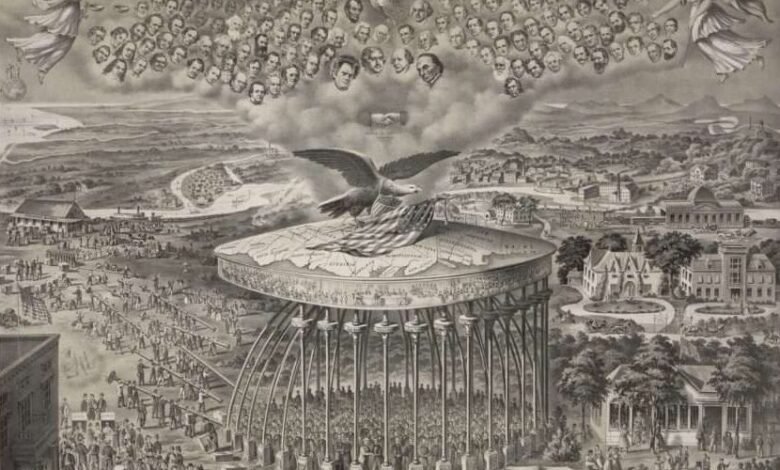
Illustration: “Reconstruction,” ca. 1867, by artist Horatio Bateman and lithographer J. L. Giles.
Source link